


Running-Related Injury Incidence: Does It Correlate with Kinematic Sub-groups of Runners? A Scoping Review
- PMID: 38280179
- PMCID: PMC11127823
- DOI: 10.1007/s40279-023-01984-0
Running-Related Injury Incidence: Does It Correlate with Kinematic Sub-groups of Runners? A Scoping Review
Abstract
Background: Historically, kinematic measures have been compared across injured and non-injured groups of runners, failing to take into account variability in kinematic patterns that exist independent of injury, and resulting in false positives. Research led by gait patterns and not pre-defined injury status is called for, to better understand running-related injury (RRI) aetiology and within- and between-group variability.
Objectives: Synthesise evidence for the existence of distinct kinematic sub-groups across a population of injured and healthy runners and assess between-group variability in kinematics, demographics and injury incidence.
Data sources: Electronic database search: PubMed, Web of Science, Cochrane Central Register of Controlled Trials (Wiley), Embase, OVID, Scopus.
Eligibility criteria: Original, peer-reviewed, research articles, published from database start to August 2022 and limited to English language were searched for quantitative and mixed-methods full-text studies that clustered injured runners according to kinematic variables.
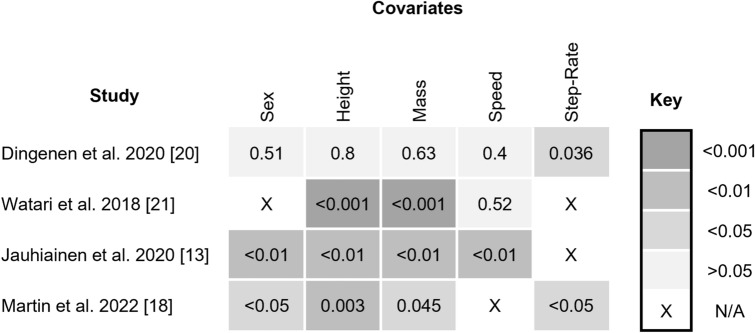
Results: Five studies (n = 690) were included in the review. All studies detected the presence of distinct kinematic sub-groups of runners through cluster analysis. Sub-groups were defined by multiple differences in hip, knee and foot kinematics. Sex, step rate and running speed also varied significantly between groups. Random injury dispersal across sub-groups suggests no strong evidence for an association between kinematic sub-groups and injury type or location.
Conclusion: Sub-groups containing homogeneous gait patterns exist across healthy and injured populations of runners. It is likely that a single injury may be represented by multiple movement patterns, and therefore kinematics may not predict injury risk. Research to better understand the underlying causes of kinematic variability, and their associations with RRI, is warranted.
© 2024. The Author(s).
Conflict of interest statement
The authors have no competing interests or conflicts with the content of this article to declare.
Figures

References
-
- Pedisic Z, Shrestha N, Kovalchik S, Stamatakis E, Liangruenrom N, Grgic J, et al. Is running associated with a lower risk of all-cause, cardiovascular and cancer mortality, and is the more the better? A systematic review and meta-analysis. Br J Sports Med. 2020;54(15):898–905. doi: 10.1136/bjsports-2018-100493. - DOI - PubMed
-
- Stamatakis E, Chaudhury M. Temporal trends in adults’ sports participation patterns in England between 1997 and 2006: the Health Survey for England. Br J Sports Med. 2008;42(11):901. http://bjsm.bmj.com/content/42/11/901.abstract. - PubMed
-
- van Gent RN, Siem D, van Middelkoop M, van Os AG, Bierma-Zeinstra MA. Incidence and determinants of lower extremity running injuries in long distance runners: a systematic review. Br J Sports Med. 2007;41:469–80. http://bjsm.bmj.com/. - PMC - PubMed
-
- Fields KB, Sykes JC, Walker KM, Jackson JC. Prevention of running injuries. Curr Sports Med Rep. 2010;9(3). https://journals.lww.com/acsm-csmr/Fulltext/2010/05000/Prevention_of_Run.... - PubMed
Publication types
MeSH terms
LinkOut - more resources
Full Text Sources
Medical
