


A Study on Knowledge, Attitude, and Practice Related to Sexually Transmitted Infections Among Students of Nonmedical Background in Manipal, India
- PMID: 38282989
- PMCID: PMC10810381
- DOI: 10.4103/idoj.idoj_687_22
A Study on Knowledge, Attitude, and Practice Related to Sexually Transmitted Infections Among Students of Nonmedical Background in Manipal, India
Abstract
Background: Sexually transmitted infections (STIs) are one of the major public health problems in India with adolescents being a vulnerable section of the affected population. According to the World Health Organization (WHO), one in twenty adolescents contracts an STI every year, excluding the human immunodeficiency virus (HIV) and other viral infections. It is important to assess the knowledge, attitude, and practices related to STIs among adolescents and young adults of non-medical backgrounds to educate them properly about protective and preventive measures and to allay misconceptions, if any.
Materials and methods: This is a cross-sectional study involving 507 engineering students who were asked to fill out the predesigned anonymous questionnaire form. Results were statistically analyzed and tabulated.
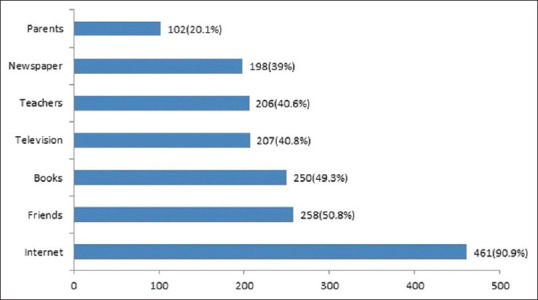
Results: Of the 507 students, 375 were males and 132 were females. The mean age of the patients was 20.5 years. HIV was the most commonly identified STI (94.2%), followed by herpes genitalis (76.5%). Around 97.4% and 85.7% identified the sexual route and blood transfusion as the modes of transmission of STIs, respectively. A total of 90.9% said that the Internet was their primary source of information regarding STIs. Infertility and cancer were identified as complications by 59.5% and 25% of them, respectively. Only 23.4% were aware of the National STI Control Program. The results with respect to attitudes and practices related to STIs were variable.
Conclusion: Our study reflects that with change in time, the attitude of young adults toward sexuality is becoming very casual, but knowledge remains low. A lot of educational activities should be undertaken to educate our youth about various aspects of STIs and thus reduce the burden of the disease in the community.
Keywords: Adolescents; knowledge; questionnaire; sexually transmitted infections; young adults.
Copyright: © 2023 Indian Dermatology Online Journal.
Conflict of interest statement
There are no conflicts of interest.
Figures
References
-
- United Nations educational, scientific and cultural organization. International technical guidance on sexuality education. An evidence-informed approach. [Online] 2018. [[Last accessed 2019 May 20]]. Available from: https://www.unaids.org/sites/default/files/media_asset/ITGSE_en.pdf .
-
- Nayak S, Toppo NA, Tomar SP, Kasar PK, Tiwari R. A study on knowledge about sexually transmitted infections (STIs) and AIDS among adolescents of rural areas of Jabalpur district. Int J Med Sci Public Health. 2016;5:1592–5.
-
- Kumar P, Pore P, Patil U. HIV/AIDS-related KAP among high-school students of municipal corporation school in Pune. An interventional study. Natl J Community Med. 2012;3:74–9.
-
- Dehne KL, Riedner G. Sexually transmitted infections among adolescents: the need for adequate health services. Reprod Health Matters. 2001;9:170–83. - PubMed
LinkOut - more resources
Full Text Sources
