


Review
doi: 10.2147/CCID.S391705.
eCollection 2024.
Rosacea: Practical Guidance and Challenges for Clinical Management
Affiliations
- PMID: 38283794
- PMCID: PMC10821660
- DOI: 10.2147/CCID.S391705
Item in Clipboard
Review
Rosacea: Practical Guidance and Challenges for Clinical Management
Clin Cosmet Investig Dermatol.
.
Abstract
Rosacea is a common chronic dermatosis. Clinically, rosacea can present with flushing, erythema, papules, pustules, telangiectasias, phymatous changes, pruritus, burning, and stinging. In 2017, the National Rosacea Society Expert Committee recommended a phenotype-based classification for therapy. In this review, we identify monotherapies and multimodal treatment approaches for the clinical management of rosacea including topical, systemic, laser and light, alternative, and combination therapies.
Keywords: combination therapy; management; monotherapy; rosacea; therapy; treatment.
© 2024 Nguyen et al.
Conflict of interest statement
The authors report no conflicts of interest in this work.
Figures
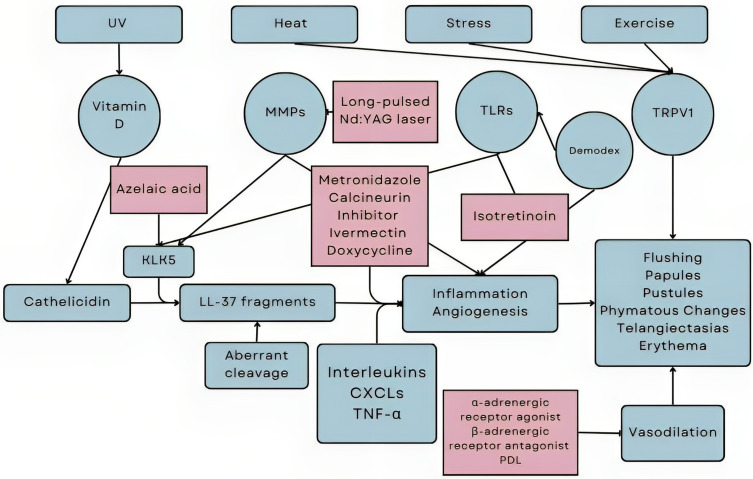
Rosacea triggers. The color blue represents components contributing to the pathophysiology of rosacea-related cutaneous changes. The color red represents treatments and their respective inhibitory effects.
References
Publication types
LinkOut - more resources
Full Text Sources
