


Effects of physical exercise during adjuvant chemotherapy for breast cancer on long-term tested and perceived cognition: results of a pragmatic follow-up study
- PMID: 38285111
- PMCID: PMC11062992
- DOI: 10.1007/s10549-023-07220-7
Effects of physical exercise during adjuvant chemotherapy for breast cancer on long-term tested and perceived cognition: results of a pragmatic follow-up study
Abstract
Purpose: Cancer-related cognitive impairment (CRCI) following chemotherapy is commonly reported in breast cancer survivors, even years after treatment. Data from preclinical studies suggest that exercise during chemotherapy may prevent or diminish cognitive problems; however, clinical data are scarce.
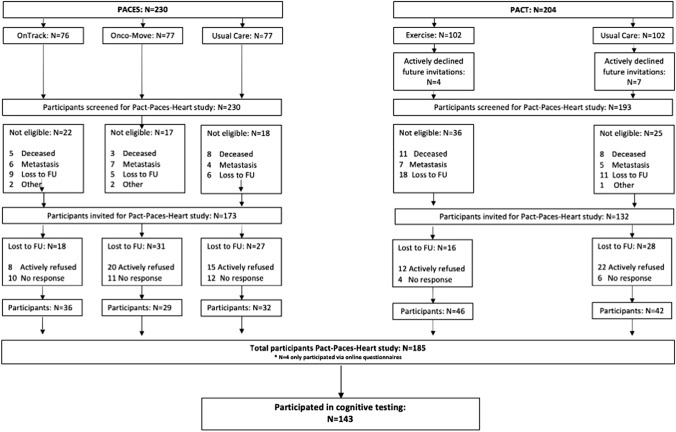
Methods: This is a pragmatic follow-up study of two original randomized trials, which compares breast cancer patients randomized to exercise during chemotherapy to non-exercise controls 8.5 years post-treatment. Cognitive outcomes include an online neuropsychological test battery and self-reported cognitive complaints. Cognitive performance was compared to normative data and expressed as age-adjusted z-scores.
Results: A total of 143 patients participated in the online cognitive testing. Overall, cognitive performance was mildly impaired on some, but not all, cognitive domains, with no significant differences between groups. Clinically relevant cognitive impairment was present in 25% to 40% of all participants, regardless of study group. We observed no statistically significant effect of exercise, or being physically active during chemotherapy, on long-term cognitive performance or self-reported cognition, except for the task reaction time, which favored the control group (β = -2.04, 95% confidence interval: -38.48; -2.38). We observed no significant association between self-reported higher physical activity levels during chemotherapy or at follow-up and better cognitive outcomes.
Conclusion: In this pragmatic follow-up study, exercising and being overall more physically active during or after adjuvant chemotherapy for breast cancer was not associated with better tested or self-reported cognitive functioning, on average, 8.5 years after treatment. Future prospective studies are needed to document the complex relationship between exercise and CRCI in cancer survivors.
Keywords: Breast cancer; Cognition; Exercise; Physical activity.
© 2024. The Author(s).
Conflict of interest statement
GS has received institutional research support from AstraZeneca, Merck, Novartis, Roche, and Seagen; and is a consultant for Biovica. Other authors report no conflict of interest.
Figures
References
-
- Kocarnik JM, et al. Cancer incidence, mortality, years of life lost, years lived with disability, and disability-adjusted life years for 29 cancer groups from 2010 to 2019: a systematic analysis for the global burden of disease study 2019. JAMA Oncol. 2022;8(3):420–444. doi: 10.1001/jamaoncol.2021.6987. - DOI - PMC - PubMed
-
- Cancer Treatment | Survivor Facts & Figures. https://www.cancer.org/research/cancer-facts-statistics/survivor-facts-f... Accessed 21 Mar 2023
Publication types
MeSH terms
Grants and funding
LinkOut - more resources
Full Text Sources
Medical
