Congenital fibrinogen disorders: a retrospective clinical and genetic analysis of the Prospective Rare Bleeding Disorders Database
- PMID: 38286442
- PMCID: PMC10950829
- DOI: 10.1182/bloodadvances.2023012186
Congenital fibrinogen disorders: a retrospective clinical and genetic analysis of the Prospective Rare Bleeding Disorders Database
Abstract
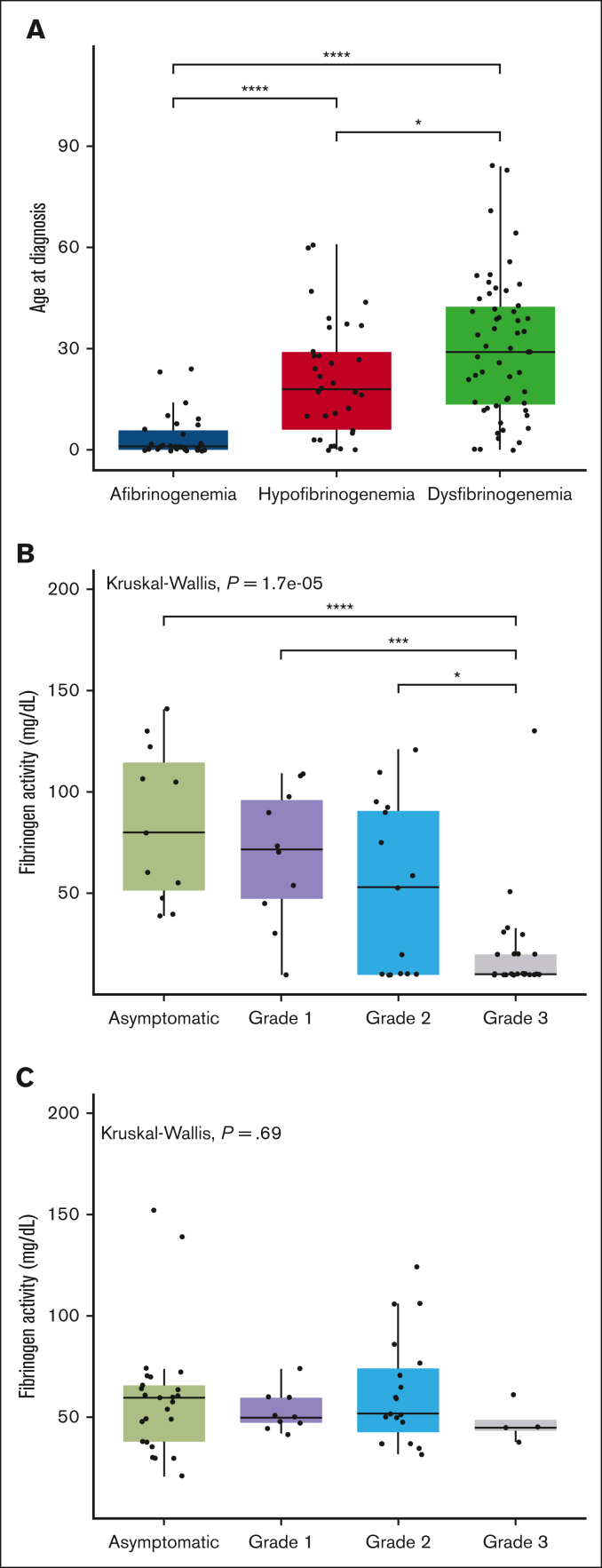
Congenital fibrinogen deficiency (CFD) is a rare bleeding disorder caused by mutations in FGA, FGB, and FGG. We sought to comprehensively characterize patients with CFD using PRO-RBDD (Prospective Rare Bleeding Disorders Database). Clinical phenotypes, laboratory, and genetic features were investigated using retrospective data from the PRO-RBDD. Patients were classified from asymptomatic to grade 3 based on their bleeding severity. In addition, FGA, FGB, and FGG were sequenced to find causative variants. A total of 166 CFD cases from 16 countries were included, of whom 123 (30 afibrinogenemia, 33 hypofibrinogenemia, 55 dysfibrinogenemia, and 5 hypodysfibrinogenemia) were well characterized. Considering the previously established factor activity and antigen level thresholds, bleeding severity was correctly identified in 58% of the cases. The rates of thrombotic events among afibrinogenemic and hypofibrinogenemic patients were relatively similar (11% and 10%, respectively) and surprisingly higher than in dysfibrinogenemic cases. The rate of spontaneous abortions among 68 pregnancies was 31%, including 86% in dysfibrinogenemic women and 14% with hypofibrinogenemia. Eighty-six patients received treatment (69 on-demand and/or 17 on prophylaxis), with fibrinogen concentrates being the most frequently used product. Genetic analysis was available for 91 cases and 41 distinct variants were identified. Hotspot variants (FGG, p.Arg301Cys/His and FGA, p.Arg35Cys/His) were present in 51% of dysfibrinogenemia. Obstetric complications were commonly observed in dysfibrinogenemia. This large multicenter study provided a comprehensive insight into the clinical, laboratory, and genetic history of patients with CFDs. We conclude that bleeding severity grades were in agreement with the established factor activity threshold in nearly half of the cases with quantitative defects.
© 2024 by The American Society of Hematology. Licensed under Creative Commons Attribution-NonCommercial-NoDerivatives 4.0 International (CC BY-NC-ND 4.0), permitting only noncommercial, nonderivative use with attribution. All other rights reserved.
Conflict of interest statement
Conflict-of-interest disclosure: F.P. reports participation at educational meetings/symposia of Takeda/Spark and the advisory board of Sanofi, Sobi, CSL Behring, Roche, and BioMarin. R.P. reports participation and speaker fees at the educational workshop organized by Novo Nordisk. S.H. has received speaker’s honorarium from Bayer Healthcare GmbH, Baxalta Innovations (Now Shire) GmbH, Biotest AG, CSL Behring GmbH and Novartis Pharma GmbH, Novo Nordisk Pharma, GmbH, Octapharma GmbH, Pfizer Pharma, Roche Pharma AG, Swedish Orphan Biovitrum GmbH; and received research grant and attended advisory board of Bayer Healthcare GmbH, Biotest AG, CSL Behring GmbH, Novo Nordisk Pharma, GmbH, Octapharma GmbH, Chugai Pharma Germany GmbH, and Swedish Orphan Biovitrum GmbH. J.B. has received speaker’s and/or consultation fees for Novo Nordisk, Roche, Sobi, Takeda, and CSL Behring. A. Casini has received grants and fees from Octapharma, Sobi, LFB, Takeda, and Novo Nordisk. The institution of R.E.G.S. has received speaker’s fees and/or research grants from Bayer, CSL Behring, Hemab, Novartis, Novo Nordisk, Octapharma, Roche, Sobi, and Takeda. The remaining authors declare no competing financial interests.
Figures



References
-
- Tennent GA, Brennan SO, Stangou AJ, O'Grady J, Hawkins PN, Pepys MB. Human plasma fibrinogen is synthesized in the liver. Blood. 2007;109(5):1971–1974. - PubMed
-
- Menegatti M, Peyvandi F. Treatment of rare factor deficiencies other than hemophilia. Blood. 2019;133(5):415–424. - PubMed
-
- Casini A, Undas A, Palla R, Thachil J, De Moerloose P, Subcommittee on Factor XIII and Fibrinogen Diagnosis and classification of congenital fibrinogen disorders: communication from the SSC of the ISTH. J Thromb Haemost. 2018;16(9):1887–1890. - PubMed
-
- Palla R, Peyvandi F, Shapiro AD. Rare bleeding disorders: diagnosis and treatment. Blood. 2015;125(13):2052–2061. - PubMed
Publication types
MeSH terms
Substances
LinkOut - more resources
Full Text Sources
Molecular Biology Databases
Miscellaneous