


Sodium-glucose cotransporter-2 inhibitors (SGLT2) in frail or older people with type 2 diabetes and heart failure: a systematic review and meta-analysis
- PMID: 38287703
- PMCID: PMC10825241
- DOI: 10.1093/ageing/afad254
Sodium-glucose cotransporter-2 inhibitors (SGLT2) in frail or older people with type 2 diabetes and heart failure: a systematic review and meta-analysis
Abstract
Objective: Sodium-glucose cotransporter-2 inhibitors (SGLT2Is) reduce cardio-metabolic and renal outcomes in patients with type 2 diabetes (T2D) but their efficacy and safety in older or frail individuals remains unclear.
Methods: We searched PubMed, Scopus, Web of Science, Cochrane CENTRA and Google Scholar and selected randomised controlled trials and observational studies comparing SGLT2Is versus placebo/other glucose-lowering agent for people with frailty or older individuals (>65 years) with T2D and heart failure (HF). Extracted data on the change in HbA1c % and safety outcomes were pooled in a random-effects meta-analysis model.
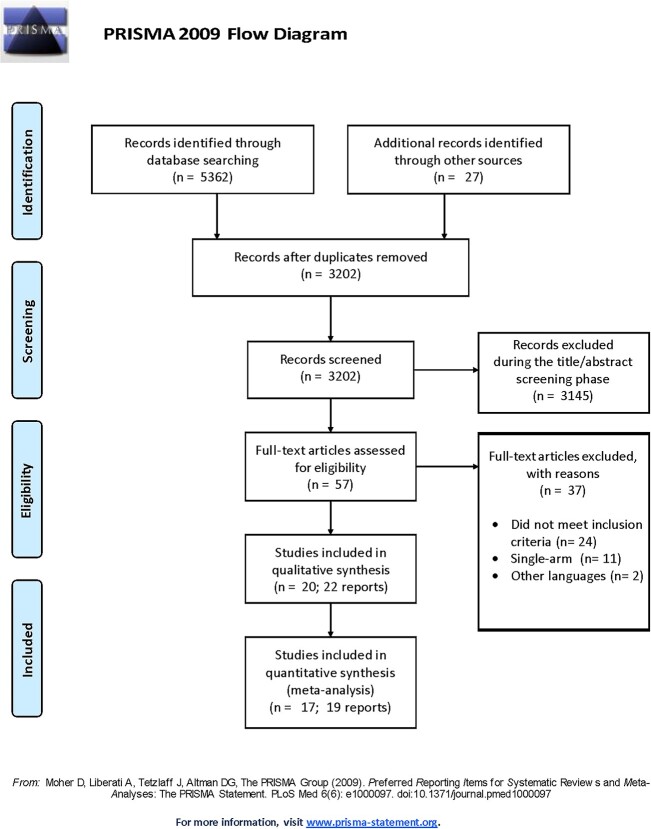
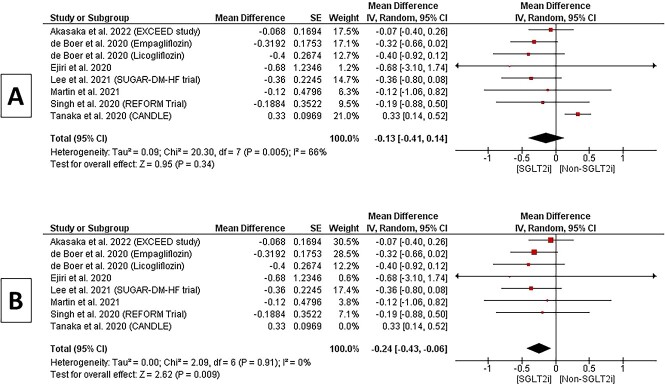
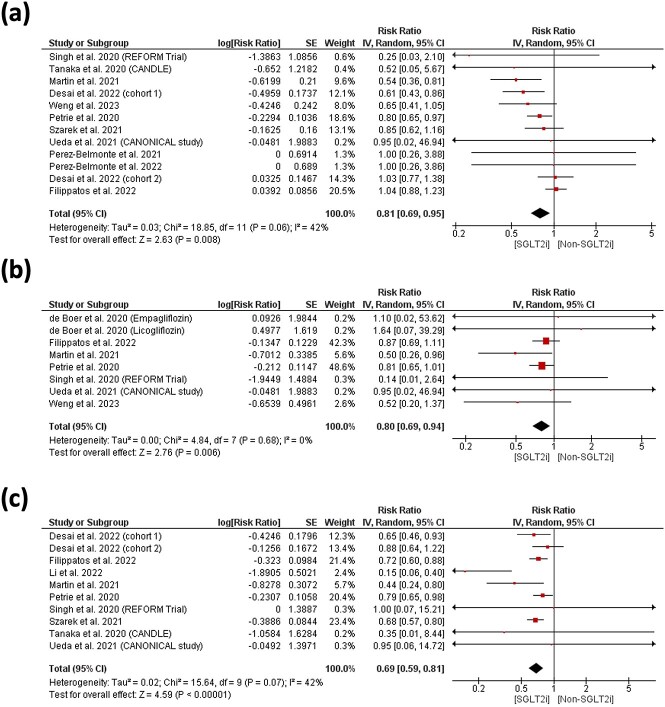
Results: We included data from 20 studies (22 reports; N = 77,083 patients). SGLT2Is did not significantly reduce HbA1c level (mean difference -0.13, 95%CI: -0.41 to 0.14). SGLT2Is were associated with a significant reduction in the risk of all-cause mortality (risk ratio (RR) 0.81, 95%CI: -0.69 to 0.95), cardiac death (RR 0.80, 95%CI: -0.94 to 0.69) and hospitalisation for heart failure (HHF) (RR 0.69, 95%CI: 0.59-0.81). However, SGLT2Is did not demonstrate significant effect in reducing in the risk of macrovascular events (acute coronary syndrome or cerebral vascular occlusion), renal progression/composite renal endpoint, acute kidney injury, worsening HF, atrial fibrillation or diabetic ketoacidosis.
Conclusions: In older or frail patients with T2D and HF, SGLT2Is are consistently linked with a decrease in total mortality and the overall burden of cardiovascular (CV) events, including HHF events and cardiac death, but not protective for macrovascular death or renal events. Adverse events were more difficult to quantify but the risk of diabetic ketoacidosis or acute kidney injury was not significantly increase.
Keywords: frail; heart failure; older; older people; sodium-glucose cotransporter 2 inhibitors; systematic review; type 2 diabetes.
© The Author(s) 2024. Published by Oxford University Press on behalf of the British Geriatrics Society.
Conflict of interest statement
None.
Figures
References
-
- Seferović PM, Petrie MC, Filippatos GSet al. . Type 2 diabetes mellitus and heart failure: a position statement from the Heart Failure Association of the European Society of Cardiology. Eur J Heart Fail 2018; 20: 853–72. - PubMed
-
- Targher G, Dauriz M, Laroche Cet al. . In-hospital and 1-year mortality associated with diabetes in patients with acute heart failure: results from the ESC-HFA Heart Failure Long-Term Registry. Eur J Heart Fail 2017; 19: 54–65. - PubMed
-
- Dauriz M, Targher G, Laroche Cet al. . Association between Diabetes and 1-year adverse clinical outcomes in a multinational cohort of ambulatory patients with chronic heart failure: results from the ESC-HFA Heart Failure Long-Term Registry. Diabetes Care 2017; 40: 671–8. - PubMed
-
- Savarese G, Jonsson Å, Hallberg AC, Dahlström U, Edner M, Lund LH. Prevalence of, associations with, and prognostic role of anemia in heart failure across the ejection fraction spectrum. Int J Cardiol 2020; 298: 59–65. - PubMed
-
- Sinclair A, Saeedi P, Kaundal A, Karuranga S, Malanda B, Williams R. Diabetes and global ageing among 65-99-year-old adults: findings from the International Diabetes Federation Diabetes Atlas, 9(th) edition. Diabetes Res Clin Pract 2020; 162: 108078. - PubMed
Publication types
MeSH terms
Substances
LinkOut - more resources
Full Text Sources
Medical
Research Materials
Miscellaneous
