


Anorexia Nervosa: Evaluating Disparities in Places of Death in the United States Over 22 Years Using the CDC WONDER Database
- PMID: 38288199
- PMCID: PMC10823200
- DOI: 10.7759/cureus.51245
Anorexia Nervosa: Evaluating Disparities in Places of Death in the United States Over 22 Years Using the CDC WONDER Database
Abstract
Introduction: Anorexia nervosa is a severe and occasionally fatal eating disorder characterized by extreme weight loss and a distorted body image in which the affected individuals typically exhibit a strong fear of gaining weight, leading to rigid dietary restrictions and excessive activity. This condition can cause severe health problems, such as hunger, cardiovascular issues, and organ destruction. Anorexia nervosa is a key subject for research in the context of end-of-life care disparities due to its psychological and physical challenges. Aims: This study examines differences in the places of death for people with anorexia nervosa during a 22-year period in the USA, taking into account four important factors: age group, gender, race, and U.S. census region.
Methodology: Data were collected from the CDC WONDER website on August 31, 2023, and spans years 1999 to 2020, using the particular ICD-11 code F50.0 for anorexia nervosa. The study aims to uncover the important determinants impacting the location of death within this specific population using sophisticated statistical methods, including univariate logistic regression.
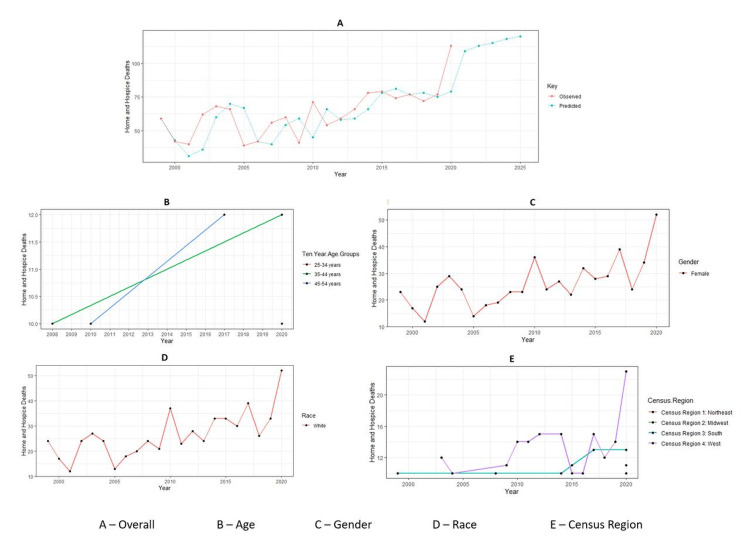
Results: The analysis of aggregate data yielded notable findings. The patient's principal site of death was at home or in hospice care. Other sites were less prevalent, with medical facilities or nursing homes ranking second. The place of death was highly influenced by age groups with diverse patterns. Gender had no significant impact; however, geographical inequalities were noticeable. Individuals in the Northeast, Midwest, and South were less likely than those in the West to die at home or in hospice care. The location of death was unaffected by race.
Conclusions: In conclusion, this study found that death in home and hospice was more common than in medical or hospital nursing facilities in all four analyzed groups. These findings highlight the critical need for significant advancements in end-of-life care, particularly in home and hospice settings.
Keywords: anorexia nervosa; cdc-wonder database; end-of-life care; home care; hospice care; mortality trends; palliative care.
Copyright © 2023, Patel et al.
Conflict of interest statement
The authors have declared that no competing interests exist.
Figures
References
-
- End-of-life care: improving quality of life at the end of life. Eues SK. Prof Case Manag. 2007;12:339–344. - PubMed
-
- End-of-life and hospice care for neurologic illness. Daly FN, Ramanathan U. Handb Clin Neurol. 2022;190:195–215. - PubMed
-
- Huffman JL, Harmer B. StatPearls. Treasure Island, FL: StatPearls Publishing; 2023. End-of-life care. - PubMed
-
- Evaluating for disparities in place of death for head and neck cancer patients in the United States utilizing the CDC WONDER database. Stephens SJ, Chino F, Williamson H, Niedzwiecki D, Chino J, Mowery YM. Oral Oncol. 2020;102:104555. - PubMed
-
- The determinants of place of death: an evidence-based analysis. Costa V. https://www.ncbi.nlm.nih.gov/pmc/articles/PMC4561767/ Ont Health Technol Assess Ser. 2014;14:1–78. - PMC - PubMed
LinkOut - more resources
Full Text Sources