


Obsessive-compulsive symptoms and brain lesions compatible with multiple sclerosis
- PMID: 38289491
- PMCID: PMC10874305
- DOI: 10.1007/s00702-023-02737-z
Obsessive-compulsive symptoms and brain lesions compatible with multiple sclerosis
Abstract
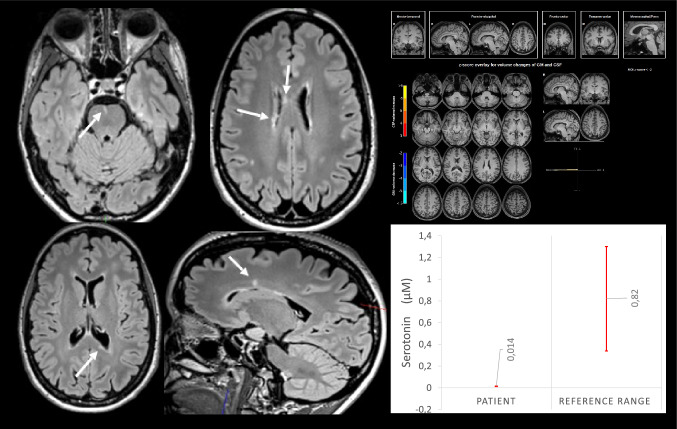
Autoimmune-mediated obsessive-compulsive disorder (OCD) can occur in multiple sclerosis (MS). Here, a well-studied case study of a patient with OCD and MS-compatible diagnostic findings is presented. The 42-year-old female patient had displayed OCD symptoms for 6 years. Magnetic resonance imaging (MRI) identified several periventricular and one brainstem lesion suggestive of demyelination. Cerebrospinal fluid (CSF) analyses detected an increased white blood cell count, intrathecal immunoglobulin (Ig) G and IgM synthesis, CSF-specific oligoclonal bands, and a positive MRZ reaction. Neopterin was increased, but sarcoidosis was excluded. In the absence of neurological attacks and clues for MRI-based dissemination in time, a radiologically isolated syndrome, the pre-disease stage of MS, was diagnosed. Neurotransmitter measurements of CSF detected reduced serotonin levels. In the absence of visible strategic demyelinating lesions within the cortico-striato-thalamo-cortical circuits, OCD symptoms may relate to reduced intrathecal serotonin levels and mild neuroinflammatory processes. Serotonin abnormalities in MS should be studied further, as they could potentially explain the association between neuroinflammation and mental illnesses.
Keywords: Autoimmune; CSF; Inflammation; Multiple sclerosis; OCD; RIS.
© 2024. The Author(s).
Conflict of interest statement
KD: Formerly, Steering Committee Neurosciences and speaker honoraria, Janssen-Cilag, within the last three years. LTvE: Advisory boards, lectures, or travel grants within the last three years: Roche, Eli Lilly, Janssen-Cilag, Novartis, Shire, UCB, GSK, Servier, Janssen and Cyberonics. All other authors declare that they do not have any conflicts of interest.
Figures
References
-
- Endres D, von Zedtwitz K, Matteit I, Bünger I, Foverskov-Rasmussen H, Runge K, Feige B, Schlump A, Maier S, Nickel K, Berger B, Schiele MA, Cunningham JL, Domschke K, Prüss H, Tebartz van Elst L (2022) Spectrum of novel anti-central nervous system autoantibodies in the cerebrospinal fluid of 119 patients with schizophreniform and affective disorders. Biol Psychiatry 92:261–274 - PubMed
Publication types
MeSH terms
Substances
LinkOut - more resources
Full Text Sources
Medical
