Clinical Trial
. 2024 Jan 30;12(1):e007823.
doi: 10.1136/jitc-2023-007823.

Association of a gene-expression subtype to outcome and treatment response in patients with recurrent/metastatic head and neck squamous cell carcinoma treated with nivolumab

Affiliations
Clinical Trial

Association of a gene-expression subtype to outcome and treatment response in patients with recurrent/metastatic head and neck squamous cell carcinoma treated with nivolumab

Mara Serena Serafini et al. J Immunother Cancer. .

Abstract

Background: Immune checkpoint inhibitors have been approved and currently used in the clinical management of recurrent and metastatic head and neck squamous cell carcinoma (R/M HNSCC) patients. The reported benefit in clinical trials is variable and heterogeneous. Our study aims at exploring and comparing the predictive role of gene-expression signatures with classical biomarkers for immunotherapy-treated R/M HNSCC patients in a multicentric phase IIIb trial.

Methods: Clinical data were prospectively collected in Nivactor tiral (single-arm, open-label, multicenter, phase IIIb clinical trial in platinum-refractory HNSCC treated with nivolumab). Findings were validated in an external independent cohort of immune-treated HNSCC patients, divided in long-term and short-term survivors (overall survival >18 and <6 months since the start of immunotherapy, respectively). Pretreatment tumor tissue specimen from immunotherapy-treated R/M HNSCC patients was used for PD-L1 (Tumor Proportion Score; Combined Positive Score (CPS)) and Tumor Mutational Burden (Oncopanel TSO500) evaluation and gene expression profiling; classical biomarkers and immune signatures (retrieved from literature) were challenged in the NIVACTOR dataset.

Results: Cluster-6 (Cl6) stratification of NIVACTOR cases in high score (n=16, 20%) and low score (n=64, 80%) demonstrated a statistically significant and clinically meaningful improvement in overall survival in the high-score cases (p=0.00028; HR=4.34, 95% CI 1.84 to 10.22) and discriminative ability reached area under the curve (AUC)=0.785 (95% CI 0.603 to 0.967). The association of high-score Cl6 with better outcome was also confirmed in: (1) NIVACTOR progression-free survival (p=4.93E-05; HR=3.71, 95% CI 1.92 to 7.18) and objective-response-rate (AUC=0.785; 95% CI 0.603 to 0.967); (2) long survivors versus short survivors (p=0.00544). In multivariate Cox regression analysis, Cl6 was independent from Eastern Cooperative Oncology Group performance status, PDL1-CPS, and primary tumor site.

Conclusions: These data highlight the presence of underlying biological differences able to predict survival and response following treatment with immunotherapy in platinum-refractory R/M HNSCC that could have translational implications improving treatment selection.

Trial registration number: EudraCT Number: 2017-000562-30.

Keywords: biomarkers, tumor; head and neck neoplasms; immunotherapy.


Conflict of interest statement

Competing interests: No, there are no competing interests.

Figures
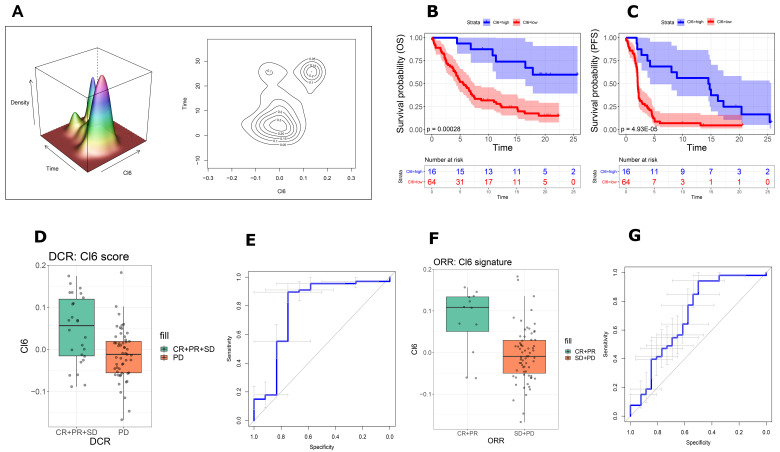
Figure 1
Figure 1
Cl6 signature in the training set. (A) Joint density estimation for the Cl6 signature and survival time variable in the training set visualized at 3D level (left panel) (x-axis=Cl6; y-axis=log(survival time); z-axis=density kernel estimate). Contour plot obtained for the previously considered data (right panel) (x-axis=Cl6; y-axis=log(survival time); the lines indicates iso-values corresponding to 0.05 increase in density kernel estimates). (B) Kaplan-Meier survival curves for patients stratified with high (blue, n=16) or low (red, n=64) Cl6 scores. High-score patients had a longer OS (overall survival) than those with low scores (p=0.00028; HR=4.34, 95% CI 1.84 to 10.22). High-score and low-score curves were compared with the long-rank test. Shadows indicate upper and lower 95% CIs. (C) Kaplan-Meier survival curves for patients stratified with Cl6 high scores (blue, n=16) or low scores (red, n=64). High-score patients had a longer PFS (progression-free survival) than those with low-scores (p=4.93E-05; HR=3.71, 95% CI 1.92 to 7.18). High-score and low-score curves were compared with the long-rank test. HR=HR ratio. Shadows indicate upper and lower 95% CIs. (D) Cl6 and ORR Boxplot of the Cl6 signature for ORR (PR, n=12) and non-responder (SD, n=14; PD, n=53). (E) Cl6 and ORR receiver operating characteristics (ROC) curve and area under the curve (AUC) of the Cl6 signature based on ORR. AUC=0.785 (95% CI 0.603 to 0.967). Gray bars represent 95% CI. (F) Cl6 and DCR. Boxplot of the Cl6 signature for DCR (clinical benefit: PR, n=12 and SD, n=14 vs PD, n=53). (G) Cl6 and DCR. ROC curve and AUC of the Cl6 signature based on DCR. AUC=0.702 (95% CI 0.566 to 0.838). Gray bars represent 95% CI. ORR, objective response rate; PD, progressive disease; PR, partial responder; SD, stable disease.
Figure 2
Figure 2
Performance of Cl6 signature. (A) Area under the ROC curves (AUC) based on Cl6 signature fitting the OS, obtained from a time-dependent ROC analysis. (B) Prediction error curves by Brier scores. The Cl6 signature, ECOG_PS, and an integrated model with Cl6 and ECOG_PS were compared with estimates for all patients without any stratification applied (reference scenario curve). For a single patient, the Brier score at the time t is defined as the squared difference between the observed survival status and the predicted outcome probability. ECOG, Eastern Cooperative Oncology Group; OS, overall survival; PS, performance status; ROC, receiver operating characteristic.
Figure 3
Figure 3
Stratification ability of Cl6 signature in the test set. (A) Boxplot of the Cl6 signature in LTS and STS cases. Median value is significantly higher in LTS with broader IQRs compared with STS (p=0.00544). (B) Receiver operating characteristics analysis and area under the curve (AUC) of the Cl6 signature. AUC=0.864; (95% CI 0.687 to 1). Gray bars represent 95% CI. LTS, long-term survivor; STS, short-term survivor.
Figure 4
Figure 4
Immune-related signatures on Nivactor. (A) Correlation plot. The plot depicts the Pearson correlations of signature pairs in a colorimetric scale. The size of each point corresponds to the magnitude of the correlation. To ascertain if unseen dependencies are present in our data, Spearman correlation was also evaluated (online supplemental efigure 12). (B) Forest plot for OS of the 13 signatures compared with C6. Patients were stratified based on high-score and low-score signature and associated to OS as clinical endpoint. (C) Forest plot for PFS of the 13 signatures compared with Cl6. Patients were stratified based on high-score and low-score signature and associated to PFS as clinical endpoint. OS, overall survival; PFS, progression-free survival.

References

    1. Harrington KJ, Burtness B, Greil R, et al. . Pembrolizumab with or without chemotherapy in recurrent or metastatic head and neck squamous cell carcinoma: updated results of the phase III KEYNOTE-048 study. JCO 2023;41:790–802. 10.1200/JCO.21.02508 - DOI - PMC - PubMed
    1. Cohen EEW, Soulières D, Le Tourneau C, et al. . Pembrolizumab versus methotrexate, Docetaxel, or Cetuximab for recurrent or metastatic head-and-neck squamous cell carcinoma (KEYNOTE-040): a randomised, open-label, phase 3 study. Lancet 2019;393:156–67. 10.1016/S0140-6736(18)31999-8 - DOI - PubMed
    1. Ferris RL, Blumenschein G, Fayette J, et al. . Nivolumab vs investigator’s choice in recurrent or metastatic squamous cell carcinoma of the head and neck: 2-year long-term survival update of Checkmate 141 with analyses by tumor PD-L1 expression. Oral Oncol 2018;81:45–51. 10.1016/j.oraloncology.2018.04.008 - DOI - PMC - PubMed
    1. Chen Y-P, Wang Y-Q, Lv J-W, et al. . Identification and validation of novel Microenvironment-based immune molecular subgroups of head and neck squamous cell carcinoma: implications for Immunotherapy. Ann Oncol 2019;30:68–75. 10.1093/annonc/mdy470 - DOI - PubMed
    1. Chen H, Lin R, Lin W, et al. . An immune gene signature to predict prognosis and Immunotherapeutic response in lung adenocarcinoma. Sci Rep 2022;12:8230. 10.1038/s41598-022-12301-6 Available: 10.1038/s41598-022-12301-6 - DOI - DOI - PMC - PubMed

Publication types

MeSH terms