


Canadians' knowledge of cancer risk factors and belief in cancer myths
- PMID: 38291409
- PMCID: PMC10829248
- DOI: 10.1186/s12889-024-17832-3
Canadians' knowledge of cancer risk factors and belief in cancer myths
Erratum in
-
Correction: Canadians' knowledge of cancer risk factors and belief in cancer myths.BMC Public Health. 2025 Mar 10;25(1):942. doi: 10.1186/s12889-025-22185-6. BMC Public Health. 2025. PMID: 40065315 Free PMC article. No abstract available.
Abstract
Background: Many untrue statements about cancer prevention and risks are circulating. The objective of this study was to assess Canadians' awareness of known cancer risk factors and cancer myths (untruths or statements that are not completely true), and to explore how awareness may vary by sociodemographic and cognitive factors.
Methods: Cancer myths were identified by conducting scans of published, grey literature, and social media. Intuitive-analytic thinking disposition scores included were actively open- and close-minded thinking, as well as preference for intuitive and effortful thinking. A survey was administered online to participants aged 18 years and older through Prolific. Results were summarized descriptively and analyzed using chi-square tests, as well as Spearman rank and Pearson correlations.
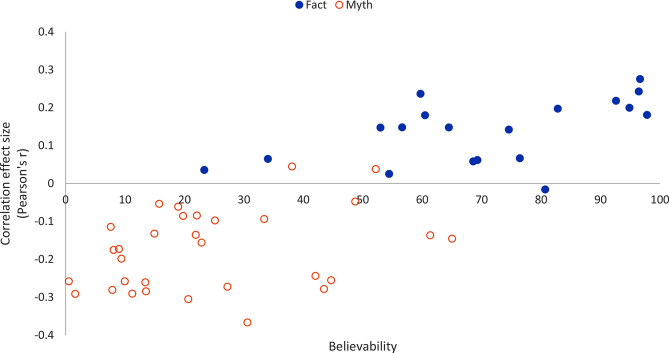
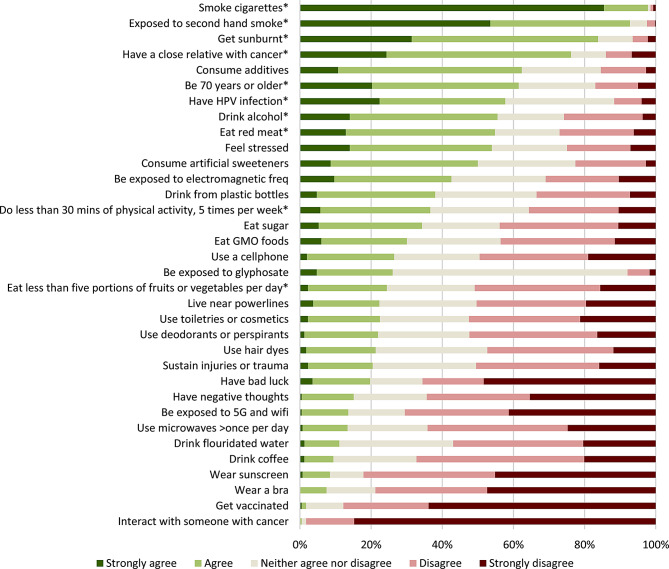
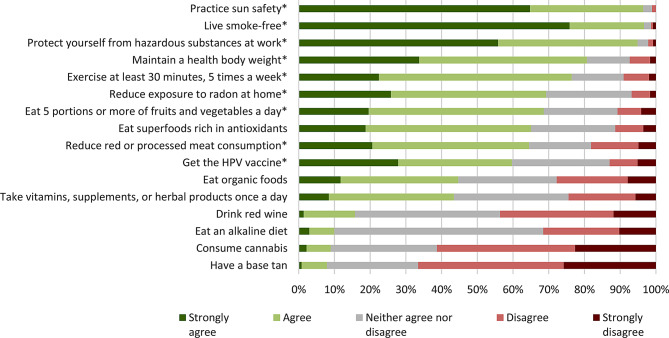
Results: Responses from 734 Canadians were received. Participants were better at identifying known cancer risk factors (70% of known risks) compared to cancer myths (49%). Bivariate analyses showed differential awareness of known cancer risk factors (p < 0.05) by population density and income, cancer myths by province, and for both by ethnicity, age, and all thinking disposition scores. Active open-minded thinking and preference for effortful thinking were associated with greater discernment. Tobacco-related risk factors were well-identified (> 90% correctly identified), but recognition of other known risk factors was poor (as low as 23% for low vegetable and fruit intake). Mythical cancer risk factors with high support were consuming additives (61%), feeling stressed (52%), and consuming artificial sweeteners (49%). High uncertainty of causation was observed for glyphosate (66% neither agreed or disagreed). For factors that reduce cancer risk, reasonable awareness was observed for HPV vaccination (60%), but there was a high prevalence in cancer myths, particularly that consuming antioxidants (65%) and organic foods (45%) are protective, and some uncertainty whether drinking red wine (41%), consuming vitamins (32%), and smoking cannabis (30%) reduces cancer risk.
Conclusions: While Canadians were able to identify tobacco-related cancer risk factors, many myths were believed and numerous risk factors were not recognized. Cancer myths can be harmful in themselves and can detract the public's attention from and action on established risk factors.
Keywords: Awareness; Cancer; Cancer beliefs; Cancer misinformation; Cancer myths; Thinking disposition.
© 2024. The Author(s).
Conflict of interest statement
The authors declare no competing interests.
Figures
References
-
- Statistics Canada. Tables 13-10-0394-01. Leading causes of death, total population, by age group. 2022.
-
- Canadian Cancer Statistics Advisory Committee in collaboration with the Canadian Cancer Society Statistics Canada. and the Public Health Agency of Canada. Canadian Cancer Statistics 2021. Can Cancer Stat 2021. 2021;1–95.
-
- International Agency for Research on Cancer. IARC monographs on the evaluation of carcinogenic risks to humans: Tobacco smoking, Volume 100E. Lyon, France; 2012.
Publication types
MeSH terms
Supplementary concepts
LinkOut - more resources
Full Text Sources
Medical
