


Children's active school transportation: an international scoping review of psychosocial factors
- PMID: 38291491
- PMCID: PMC10826279
- DOI: 10.1186/s13643-023-02414-y
Children's active school transportation: an international scoping review of psychosocial factors
Abstract
Background: Over the last decades, the prevalence of AST has decreased significantly. Barriers to active school transport (AST) have been extensively examined in the literature, while psychosocial factors that facilitate AST have received less attention. To our best knowledge, there are currently no reviews on this subject. Therefore, the objective of this review was to scope the literature and identify published research about psychosocial factors related to AST.
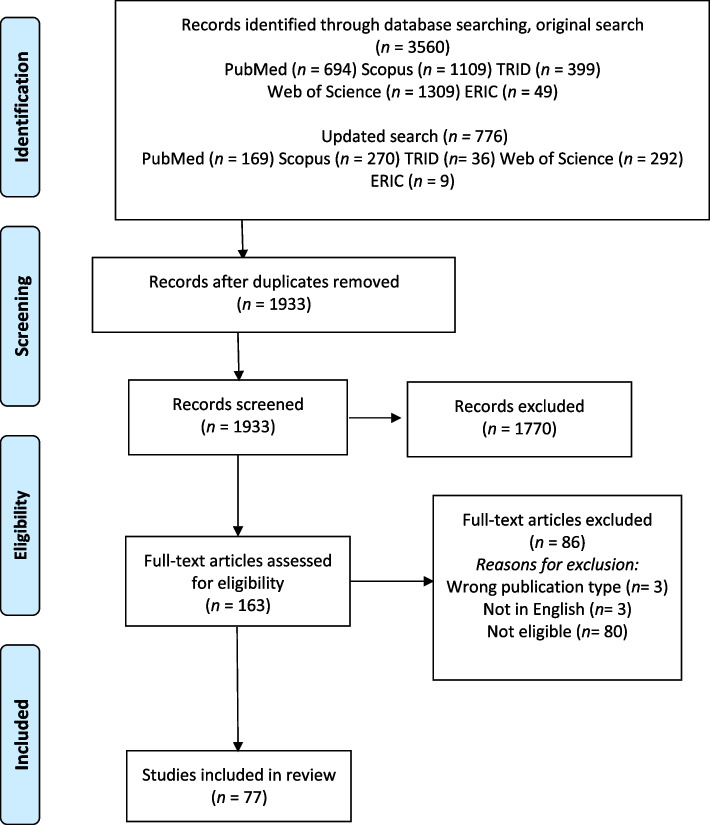
Methods: Systematic searches conducted in PubMed, Web of Science, TRID, Scopus, and ERIC resulted in a total of 1933 publications, and 77 of them were considered eligible for this review.
Results: The results of the included articles were categorised into four psychosocial factors: confidence in ability, attitudes, social support, and social norms, which were all generally positively related to AST, with a few exceptions.
Conclusion: The findings of this review indicate that these psychosocial factors may be important to consider when developing interventions and highlight that both children and parents should be involved in the process. This knowledge can serve as a valuable guide for developing interventions to promote AST. However, the evidence base supporting these psychosocial factors requires further investigation to fully understand how and when to incorporate them to maximise AST efficacy.
Keywords: Active school commuting; Attitudes; Confidence in ability; Social norms; Social support.
© 2024. The Author(s).
Conflict of interest statement
The authors declare that they have no competing interests.
Figures
References
-
- Aibar Solana A, Mandic S, Generelo Lanaspa E, Gallardo LO, Zaragoza Casterad J. Parental barriers to active commuting to school in children: does parental gender matter? J Transp Health. 2018;9:141–149. doi: 10.1016/j.jth.2018.03.005. - DOI
-
- Ajzen I. The theory of planned behavior: Frequently asked questions. Human Behav Emerg Technol. 2020;2(4):314–324. doi: 10.1002/hbe2.195. - DOI
-
- Arksey H, O'Malley L. Scoping studies: towards a methodological framework. Int J Soc Res Methodol. 2005;8(1):19–32. doi: 10.1080/1364557032000119616. - DOI
Publication types
MeSH terms
Grants and funding
LinkOut - more resources
Full Text Sources
