


Wolf creek XVII part 4: Amplifying lay-rescuer response
- PMID: 38292468
- PMCID: PMC10827540
- DOI: 10.1016/j.resplu.2023.100547
Wolf creek XVII part 4: Amplifying lay-rescuer response
Abstract
Introduction: Amplifying lay-rescuer response is a key priority to increase survival from out-of-hospital cardiac arrest (OHCA). We describe the current state of lay-rescuer response, how we envision the future, and the gaps, barriers, and research priorities that will amplify response to OHCA.
Methods: 'Amplifying Lay-Rescuer Response' was one of six focus topics for the Wolf Creek XVII Conference held on June 14-17, 2023, in Ann Arbor, Michigan, USA. Conference invitees included international thought leaders and scientists in the field of cardiac arrest resuscitation from academia and industry. Participants submitted via online survey knowledge gaps, barriers to translation and research priorities for each focus topic. Expert panels used the survey results and their own perspectives and insights to create and present a preliminary unranked list for each category that was debated, revised and ranked by all attendees to identify the top 5 for each category.
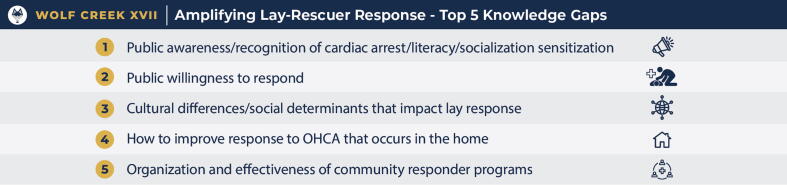
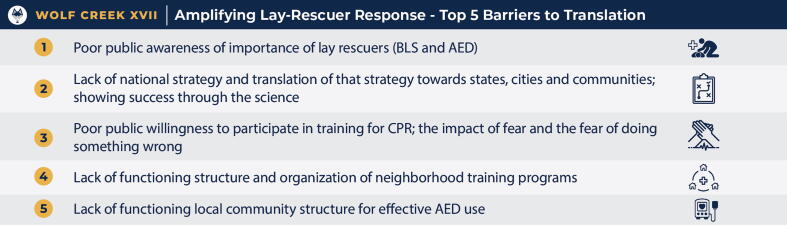
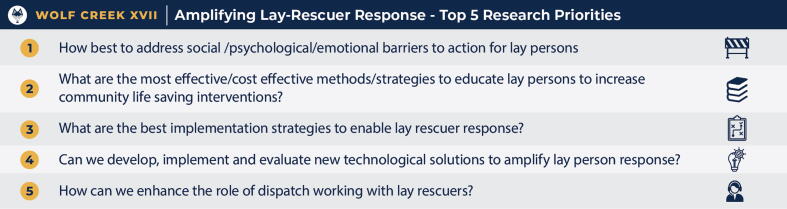
Results: The top five knowledge gaps as ranked by the panel, reflected a recognition of the need to better understand the psycho-social aspects of lay response. The top five barriers to translation reflected issues at the individual, community, societal, structural, and governmental levels. The top five research priorities were focused on understanding the social/psychological and emotional barriers to action, finding the most effective/cost-effective strategies to educate lay persons and implement community life-saving interventions, evaluation of new technological solutions and how to enhance the role of dispatch working with lay-rescuers.
Conclusion: Future research in lay rescuer response should incorporate technology innovations, understand the "humanity" of the situation, leverage implementation science and systems thinking to save lives. This will require the field of resuscitation to engage with scholars outside our traditional ranks and to be open to new ways of thinking about old problems.
Keywords: lay rescuer; lay response; sudden cardiac arrest.
© 2023 The Authors.
Conflict of interest statement
The authors declare that they have no known competing financial interests or personal relationships that could have appeared to influence the work reported in this paper.
Figures
References
-
- Panchal A.R., et al. Part 3: Adult basic and advanced life support: 2020 American heart association guidelines for cardiopulmonary resuscitation and emergency cardiovascular care. Circulation. 2020;142:S366–S468. - PubMed
-
- Deakin C.D. The chain of survival: Not all links are equal. Resuscitation. 2018;126:80–82. - PubMed
-
- Tanaka H., et al. Modifiable Factors Associated With Survival After Out-of-Hospital Cardiac Arrest in the Pan-Asian Resuscitation Outcomes Study. Ann. Emerg. Med. 2018;71:608–617.e15. - PubMed
-
- Pek P.P., et al. Improved Out-of-Hospital Cardiac Arrest Survival with a Comprehensive Dispatcher-Assisted CPR Program in a Developing Emergency Care System. Prehosp. Emerg. Care. 2021;25:802–811. - PubMed
Publication types
LinkOut - more resources
Full Text Sources
