. 2024 May;27(2):211-227.
doi: 10.1007/s10456-023-09902-8. Epub 2024 Jan 31.

Impact of heterozygous ALK1 mutations on the transcriptomic response to BMP9 and BMP10 in endothelial cells from hereditary hemorrhagic telangiectasia and pulmonary arterial hypertension donors

Affiliations

Impact of heterozygous ALK1 mutations on the transcriptomic response to BMP9 and BMP10 in endothelial cells from hereditary hemorrhagic telangiectasia and pulmonary arterial hypertension donors

T Al Tabosh et al. Angiogenesis. 2024 May.

Abstract

Heterozygous activin receptor-like kinase 1 (ALK1) mutations are associated with two vascular diseases: hereditary hemorrhagic telangiectasia (HHT) and more rarely pulmonary arterial hypertension (PAH). Here, we aimed to understand the impact of ALK1 mutations on BMP9 and BMP10 transcriptomic responses in endothelial cells. Endothelial colony-forming cells (ECFCs) and microvascular endothelial cells (HMVECs) carrying loss of function ALK1 mutations were isolated from newborn HHT and adult PAH donors, respectively. RNA-sequencing was performed on each type of cells compared to controls following an 18 h stimulation with BMP9 or BMP10. In control ECFCs, BMP9 and BMP10 stimulations induced similar transcriptomic responses with around 800 differentially expressed genes (DEGs). ALK1-mutated ECFCs unexpectedly revealed highly similar transcriptomic profiles to controls, both at the baseline and upon stimulation, and normal activation of Smad1/5 that could not be explained by a compensation in cell-surface ALK1 level. Conversely, PAH HMVECs revealed strong transcriptional dysregulations compared to controls with > 1200 DEGs at the baseline. Consequently, because our study involved two variables, ALK1 genotype and BMP stimulation, we performed two-factor differential expression analysis and identified 44 BMP9-dysregulated genes in mutated HMVECs, but none in ECFCs. Yet, the impaired regulation of at least one hit, namely lunatic fringe (LFNG), was validated by RT-qPCR in three different ALK1-mutated endothelial models. In conclusion, ALK1 heterozygosity only modified the BMP9/BMP10 regulation of few genes, including LFNG involved in NOTCH signaling. Future studies will uncover whether dysregulations in such hits are enough to promote HHT/PAH pathogenesis, making them potential therapeutic targets, or if second hits are necessary.

Keywords: ALK1; BMP; HHT; LFNG; PAH; RNA-seq.


Conflict of interest statement

The authors have no conflicts of interest to disclose.

Figures
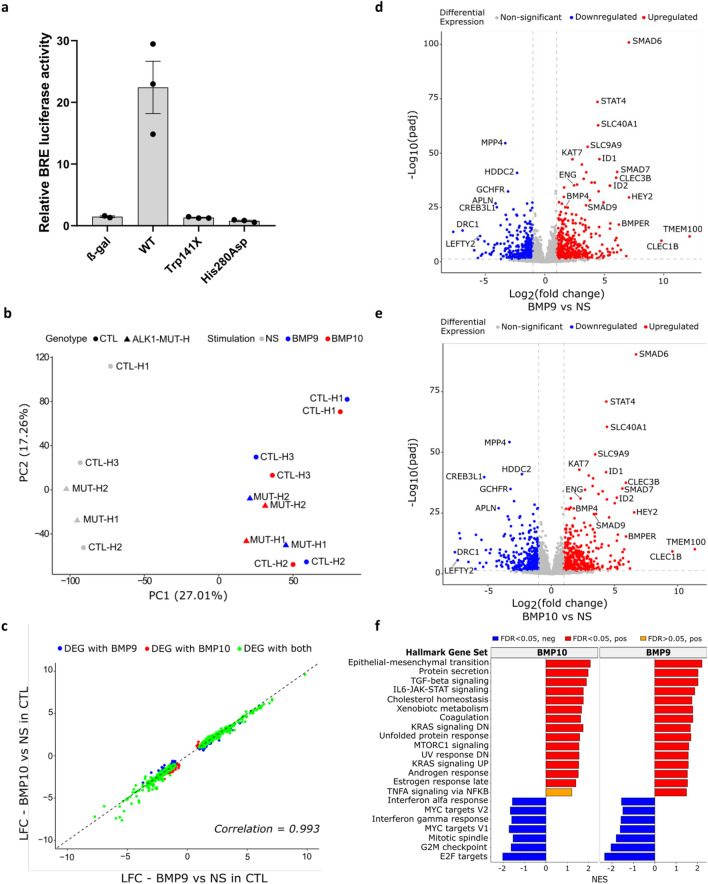
Fig. 1
Fig. 1
BMP9 and BMP10 induce a similar transcriptomic response in control ECFCs. a Relative BMP Response Element (BRE) luciferase activity measured in NIH-3T3 cells overexpressing either WT or mutant ALK1 plasmids identified in ALK1-mutated ECFCs (p.Trp141X, MUT-H1) and (p.His280Asp, MUT-H2) used in the ECFC RNA-seq analysis. BRE firefly luciferase activities were normalized to renilla luciferase activity. Data shown are mean ± SEM from three independent experiments. bf 3 CTL (CTL-H1, CTL-H2 and CTL-H3) and 2 ALK1-mutated ECFCs (MUT-H1 and MUT-H2) were stimulated or not with BMP9 or BMP10 (10 ng/mL) for 18 h. The experiment was repeated three times after which bulk RNA-seq analysis was performed. b Principal component analysis (PCA) showing clustering of RNA-seq samples by treatment (BMP9 or BMP10 stimulation vs NS) in CTL and MUT ECFCs. Each dot represents the mean of three experiments for one sample. c Scatter plot comparing log2 fold change (LFC) values of protein coding DEGs regulated in CTL ECFCs by BMP9 vs those regulated by BMP10 both compared to NS. Pearson correlation is reported. d, e Volcano plot representations showing global changes in gene expression in CTL ECFCs after BMP9 (d) or BMP10 (e) stimulation. DEGs with high LFC and high statistical significance are annotated. f Gene-set enrichment analysis (GSEA) performed using hallmark gene sets. The bar plot represents the top significant gene set categories enriched in CTL ECFCs upon BMP10 or BMP9-stimulation ordered using normalized enrichment scores (NES)
Fig. 2
Fig. 2
ALK1 heterozygosity in ECFCs does not impair the global transcriptomic response to BMP9 or BMP10. ad 3 CTL (CTL-H1, CTL-H2 and CTL-H3) and 2 ALK1-mutated ECFCs (MUT-H1 and MUT-H2) were stimulated or not with BMP9 or BMP10 (10 ng/mL) for 18 h. The experiment was repeated three times after which bulk RNA-seq analysis was performed. a, b Scatter plots comparing log2 fold change (LFCs) values of protein coding DEGs regulated by BMP9 (a) or BMP10 (b) in CTL ECFCs vs MUT ECFCs. Pearson correlation is reported. c, d Volcano plots representations showing global changes in gene expression in ALK1-mutated ECFCs after BMP9 (c) or BMP10 (d) stimulation vs NS. DEGs with high LFC and high statistical significance are annotated
Fig. 3
Fig. 3
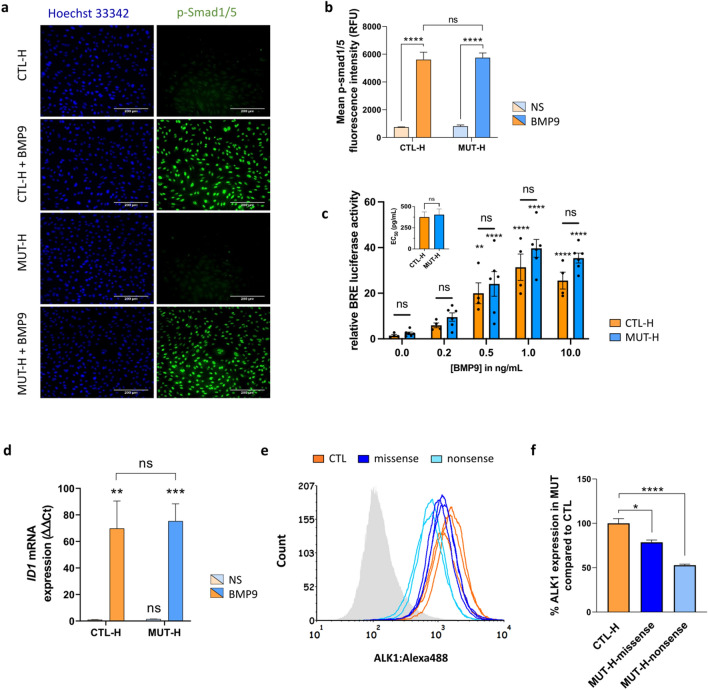
ALK1 heterozygosity in ECFCs does not impair the p-Smad1/5 response to BMP9. a, b 3 CTL and 6 MUT ECFCs (MUT-H1–H6) were stimulated with BMP9 (10 ng/mL) for 1 h then fixed and immunostained for phospho-Smad1/5 (p-Smad1/5). Cells were stimulated in duplicates and at least 16 different fields were imaged in each well. a Representative p-Smad1/5 immunostainings in 1 CTL and 1 MUT ECFC in the absence or presence of BMP9 for 1 h. The nuclei were counterstained using Hoechst 33342. b p-Smad1/5 fluorescence was quantified in the nuclei using IN Carta Image Analysis Software. Data presented are mean relative fluorescent intensity (RFU) ± SEM of three independent experiments. c 4 CTL and 6 MUT (MUT-H1–6) ECFCs were transiently transfected with pGL3(BRE)2-luc and pRL-TK-luc. Cells were then either non-treated or stimulated with increasing concentrations of BMP9 (0.2, 0.5, 1, 10 ng/mL) for 6 h. Firefly luciferase activities were normalized to renilla luciferase activities. Data shown are mean ± SD from 1 representative experiment of 4, and each point corresponds to one donor. The inset represents the calculated BMP9 EC50 for CTL and MUT ECFCs. d RT-qPCR quantification of ID1 mRNA expression normalized to HPRT level in 4 CTL and 4 MUT (MUT-H1–H4) ECFCs following an 18 h stimulation with 10 ng/mL BMP9. Data are mean ± SEM of three independent stimulations presented as ΔΔCT compared to CTL NS. e Flow cytometric analysis comparing cell-surface ALK1 levels in 3 CTL vs 5 MUT ECFCs either carrying an ALK1 missense mutations (MUT-H2, MUT-H4 and MUT-H6) or a nonsense mutations (MUT-H1 and MUT-H3). Isotypic control is illustrated in grey. One representative flow cytometry histogram of 3 is shown. f Quantification of the ALK1 cell-surface expression by flow cytometry (in percentage of in MUT ECFCs with missense or nonsense mutations compared to CTL ECFCs). Data are means ± SEM of three independent experiments. Two-way Anova followed by Sidak’s multiple comparisons tests were used for statistical analysis of bd, except for the inset of c where Mann–Whitney test was used. Kruskal–Wallis test followed by Dunn’s multiple comparison’s test was used for f. For all panels, ns non-significant, *P < 0.05, **P < 0.01, ***P < 0.001 and ****P < 0.0001
Fig. 4
Fig. 4
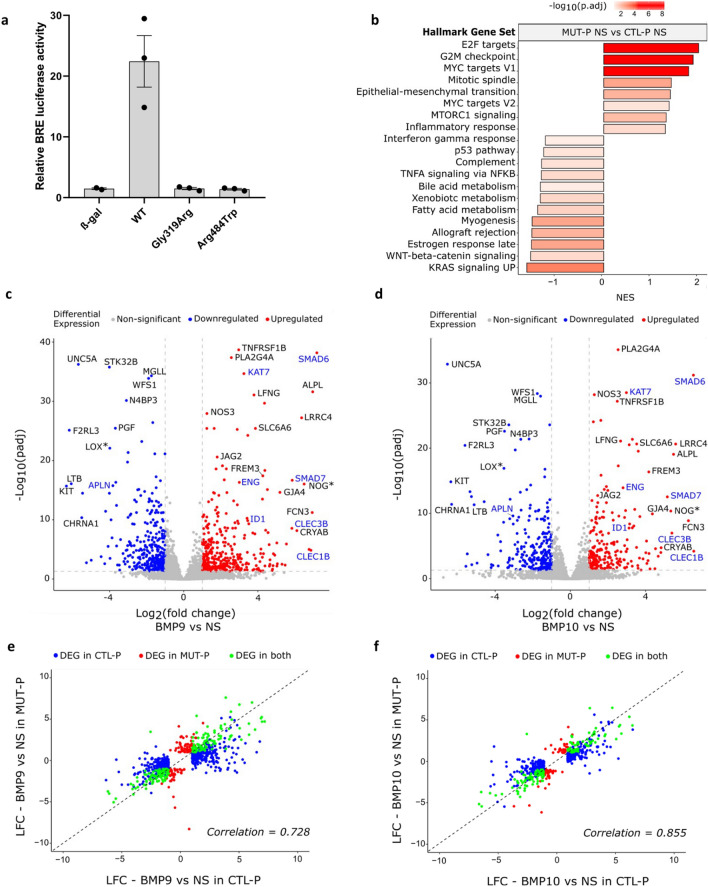
ALK1-mutated HMVECs display substantially different transcriptomic profiles compared to controls. a Relative BMP Response Element (BRE) luciferase activity measured in NIH-3T3 cells overexpressing either WT or mutant ALK1 plasmids identified in ALK1-mutated HMVECs (p.Gly319Arg, MUT-P1) and (p.Arg484Trp, MUT-P2) that are included in the HMVEC RNA-seq analysis. BRE luciferase activities were normalized to renilla luciferase activities. Data shown are mean ± SEM from of three independent experiments. bf 3 CTL and 2 ALK1-mutated (MUT-P1 and MUT-P2) HMVECs were stimulated or not with BMP9 or BMP10 (10 ng/mL) for 18 h. The experiment was repeated three times after which bulk RNA-seq analysis was performed. b GSEA performed using hallmark gene sets. The bar plot represents the top significant gene set categories enriched in non-stimulated MUT HMVECs compared to nonstimulated (NS) CTL HMVECs. Each bar represents a hallmark gene set and bars are ordered from top to bottom by decreasing order of enrichment score (NES). c, d Volcano plot representations showing global changes in gene expression in CTL HMVECs after BMP9 (c) or BMP10 (d) stimulation. DEGs with high LFC and high statistical significance are annotated. DEGs annotated in blue correspond to DEGs identified in CTL ECFCs (Fig. 1d, e). e, f Scatter plots comparing log2 fold change (LFCs) of DEGs regulated by BMP9 (e) or BMP10 (f) in CTL HMVECs vs MUT HMVECs. Pearson correlation is reported
Fig. 5
Fig. 5
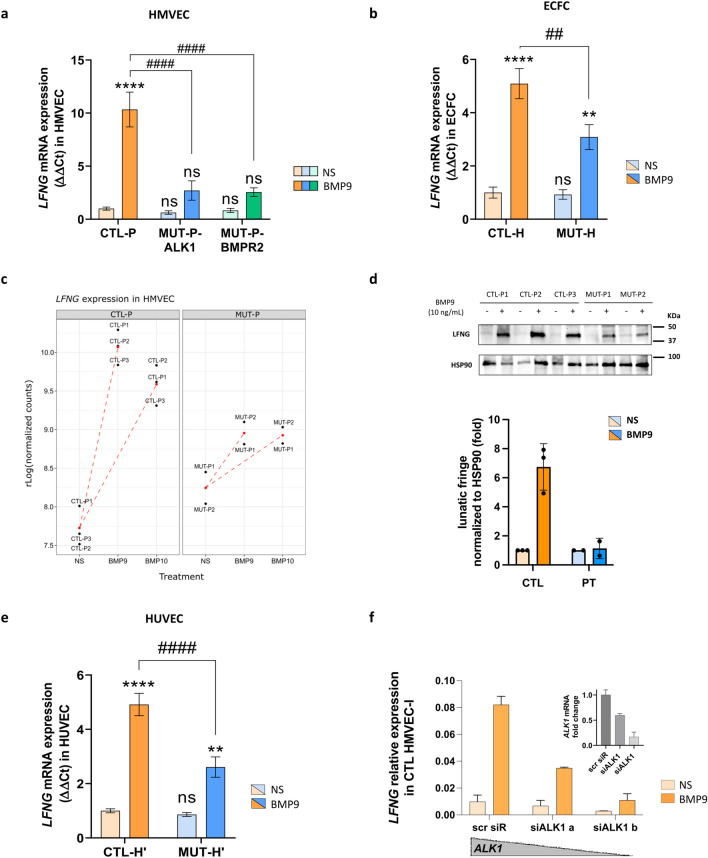
Regulation of LFNG mRNA expression by BMP9 in CTL and ALK1-mutated HMVECs, ECFCs and HUVECs. a, b RT-qPCR quantification of the mRNA expression level of LFNG in 3 CTL, 2 ALK1-mutated (MUT-P1 and -P2) and 3 BMPR2-mutated HMVECs (MUT-P3–P5) (a), 3 CTL and 4 ALK1-mutated ECFCs (MUT-H1–H4) (b). LFNG mRNA expression level was normalized to HPRT mRNA expression and presented as ΔΔCt compared to mean CTL NS. Data shown are mean ± SEM of at least three independent stimulations. c Count plot representation showing the regularized log transformed counts of LFNG mRNA in CTL-P and ALK1-MUT-P HMVECs in nonstimulated (NS) and BMP9 or BMP10 stimulated cells. d Western blot analysis of 3 CTL (1–3) and 2 ALK1-mutated HMVECs (MUT-P1–2) that were either NS or stimulated for 24h with 10 ng/mL BMP9. Cell lysates were resolved by 4–20% SDS–PAGE and immunoblotted with antibodies against lunatic fringe or against HSP90 (loading control). The resulting blots are shown along with quantification of the mean lunatic fringe signal normalized to HSP90. e RT-qPCR quantification of the mRNA expression level of LFNG in 3 CTL (CTL-H′1–3) and 3 ALK1-mutated (MUT-H′3–5) HUVECs. LFNG mRNA expression level is normalized to HPRT mRNA expression and presented as ΔΔCT compared to mean CTL NS. Data shown are mean ± SEM of at least three independent stimulations. a, b, e, Two-way Anova followed by Sidak’s multiple comparisons test were used for statistical analysis of panels. ns non-significant, **P < 0.01 and ****P < 0.0001 vs NS and ##P < 0.01 and ####P < 0.0001 vs CTL. f 2 CTL HMVECs were treated either with scrambled siRNA (siScr) or two different concentrations of siRNA against ALK1 (siALK1 a and b) to generate a gradient of ALK1 expression and then stimulated with 10 ng/mL BMP9 for 18 h. LFNG mRNA expression normalized to HPRT mRNA level is presented as 2−ΔCt. Data shown are mean ± SD of 2 CTL HMVECs. Inset represents ALK1 mRNA expression presented as ΔΔCt compared to scrambled siRNA-transfected cells

References

    1. Shovlin CL. Hereditary haemorrhagic telangiectasia: pathophysiology, diagnosis and treatment. Blood Rev. 2010;24:203–219. doi: 10.1016/j.blre.2010.07.001. - DOI - PubMed
    1. Gallione CJ, Repetto GM, Legius E, et al. A combined syndrome of juvenile polyposis and hereditary haemorrhagic telangiectasia associated with mutations in MADH4 (SMAD4) The Lancet. 2004;363:852–859. doi: 10.1016/S0140-6736(04)15732-2. - DOI - PubMed
    1. Lesca G, Burnichon N, Raux G, et al. Distribution of ENG and ACVRL1 (ALK1) mutations in French HHT patients. Hum Mutat. 2006;27:598–598. doi: 10.1002/humu.9421. - DOI - PubMed
    1. Wooderchak-Donahue WL, McDonald J, O’Fallon B, et al. BMP9 mutations cause a vascular-anomaly syndrome with phenotypic overlap with hereditary hemorrhagic telangiectasia. Am J Hum Genet. 2013;93:530–537. doi: 10.1016/j.ajhg.2013.07.004. - DOI - PMC - PubMed
    1. David L, Mallet C, Mazerbourg S, et al. Identification of BMP9 and BMP10 as functional activators of the orphan activin receptor-like kinase 1 (ALK1) in endothelial cells. Blood. 2007;109:1953–1961. doi: 10.1182/blood-2006-07-034124. - DOI - PubMed

MeSH terms

Substances

LinkOut - more resources