Review
. 2024 Jun;19(4):901-917.
doi: 10.1007/s11739-023-03515-1. Epub 2024 Jan 31.

Sepsis in elderly patients: the role of neutrophils in pathophysiology and therapy

Affiliations
Review

Sepsis in elderly patients: the role of neutrophils in pathophysiology and therapy

Davide Ramoni et al. Intern Emerg Med. 2024 Jun.

Abstract

Sepsis is among the most important causes of mortality, particularly within the elderly population. Sepsis prevalence is on the rise due to different factors, including increasing average population age and the concomitant rise in the prevalence of frailty and chronic morbidities. Recent investigations have unveiled a "trimodal" trajectory for sepsis-related mortality, with the ultimate zenith occurring from 60 to 90 days until several years after the original insult. This prolonged temporal course ostensibly emanates from the sustained perturbation of immune responses, persevering beyond the phase of clinical convalescence. This phenomenon is particularly associated with the aging immune system, characterized by a broad dysregulation commonly known as "inflammaging." Inflammaging associates with a chronic low-grade activation of the innate immune system preventing an appropriate response to infective agents. Notably, during the initial phases of sepsis, neutrophils-essential in combating pathogens-may exhibit compromised activity. Paradoxically, an overly zealous neutrophilic reaction has been observed to underlie multi-organ dysfunction during the later stages of sepsis. Given this scenario, discovering treatments that can enhance neutrophil activity during the early phases of sepsis while curbing their overactivity in the later phases could prove beneficial in fighting pathogens and reducing the detrimental effects caused by an overactive immune system. This narrative review delves into the potential key role of neutrophils in the pathological process of sepsis, focusing on how the aging process impacts their functions, and highlighting possible targets for developing immune-modulatory therapies. Additionally, the review includes tables that outline the principal potential targets for immunomodulating agents.

Keywords: Elderly; Enflammaging; Neutrophil; Sepsis.


Conflict of interest statement

LL is co-inventor on the International Patent WO/2020/226993 filed in April 2020. The patent relates to the use of antibodies which specifically bind IL-1α to reduce various sequelae of ischemia–reperfusion injury to the central nervous system. LL reports speaker fees outside of this work from Daiichi-Sankyo. FM received a round table fee from Astra Zeneca. The other authors have no direct financial or personal interests to declare.

Figures
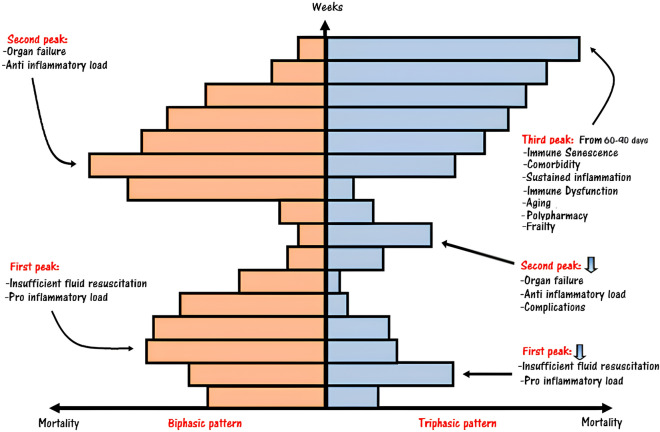
Fig. 1
Fig. 1
Sepsis mortality rates. Sepsis-related mortality was reported to have a biphasic pattern, characterized by an early first peak due to inadequate antibiotic therapy and fluid challenge and a second peak (from day 1 to first weeks) due to multi-organ failure. In the last years, thanks to the improvement of standard of care, especially in the intensive care unit department, the mortality rate showed a triphasic pattern. The third peak, starting from 60 to 90 days to several years, is more typical in a population of elderly subjects with the burden of multiple comorbidity
Fig. 2
Fig. 2
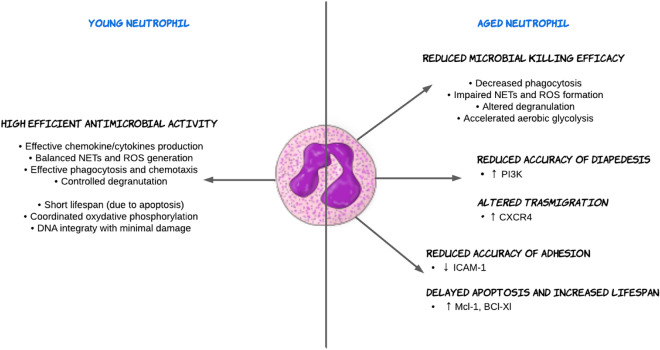
Comparison between the young and aged neutrophil. Neutrophils play a crucial role in the immune system's response to infections. In young neutrophil, there is an efficient antimicrobial activity against pathogens. In contrast, in the aged neutrophil, the immunological response might be impaired favoring several detrimental effects. The impact of aging on neutrophils can be significant and could be influenced by various factors, including overall health, genetics, and lifestyle. Understanding the changes in neutrophil function with aging is crucial for developing strategies to support immune function and mitigate age-related immuno-senescence. BCL-xl, B cell lymphoma extra large; CXCR-4, C-X-C chemokine receptor type 4; DNA, Deoxyribonucleic acid, Mcl-1, myeloid cell leukemia 1; ICAM-1, intercellular adhesion molecule 1; NET, neutrophil extracellular trap; PI3K, phosphoinositide 3-kinase ROS, reactive oxygen species
Fig. 3
Fig. 3
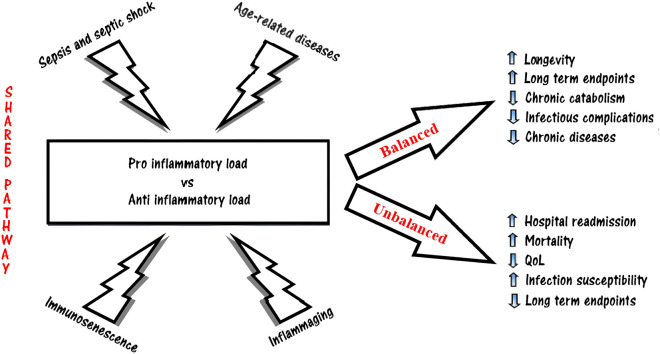
Take-home message: A shared common pathway between sepsis, aging, and inflammation. In the elderly, the chronic low-level systemic inflammation referred to as "inflammaging" is potentially linked to the development of pathological conditions such as sepsis or age-related diseases. These stimulations can disrupt the delicate equilibrium of inflammatory burden, giving rise to an elevated susceptibility to persistent, recurring, secondary, and nosocomial infections. Consequently, this heightened vulnerability contributes to amplified rates of hospital re-admissions and mortality, while concurrently diminishing the overall quality of life

References

    1. Singer M, Deutschman CS, Seymour CW, Shankar-Hari M, Annane D, Bauer M, et al. The third international consensus definitions for sepsis and septic shock (Sepsis-3) JAMA. 2016;315(8):801–810. doi: 10.1001/jama.2016.0287. - DOI - PMC - PubMed
    1. Delano MJ, Ward PA. The immune system's role in sepsis progression, resolution, and long-term outcome. Immunol Rev. 2016;274(1):330–353. doi: 10.1111/imr.12499. - DOI - PMC - PubMed
    1. Camici GG, Liberale L. Aging: the next cardiovascular disease? Eur Heart J. 2017;38(21):1621–1623. doi: 10.1093/eurheartj/ehx239. - DOI - PubMed
    1. Franceschi C, Capri M, Monti D, Giunta S, Olivieri F, Sevini F, et al. Inflammaging and anti-inflammaging: a systemic perspective on aging and longevity emerged from studies in humans. Mech Ageing Dev. 2007;128(1):92–105. doi: 10.1016/j.mad.2006.11.016. - DOI - PubMed
    1. Liberale L, Montecucco F, Tardif JC, Libby P, Camici GG. Inflamm-ageing: the role of inflammation in age-dependent cardiovascular disease. Eur Heart J. 2020;41(31):2974–2982. doi: 10.1093/eurheartj/ehz961. - DOI - PMC - PubMed