


Difficult airway simulation-based training for anaesthesiologists: efficacy and skills retention within six months
- PMID: 38297196
- PMCID: PMC10829367
- DOI: 10.1186/s12871-024-02423-x
Difficult airway simulation-based training for anaesthesiologists: efficacy and skills retention within six months
Abstract
Background: The aim of this study was to evaluate how anaesthesiologists manage a "cannot intubate, can ventilate" (CI) and "cannot intubate, cannot ventilate" (CICV) scenarios, and how following simulation training will affect their guideline adherence, skills and decision-making immediately after training and 6 months later.
Methods: A prospective controlled study was conducted from July to December 2022. Anaesthesiologists who applied for the continuous medical education course "Difficult Airway Management" were involved in the study. Each volunteer participated in two simulation scenarios (CI, CICV) with structural debriefing after each scenario. After the first simulation round, volunteers were trained in difficult airway management according to DAS guidelines, using the same equipment as during the simulation. The participants repeated the simulation scenarios the day after the training and six months later. The primary and secondary endpoints were compared between three rounds: initial simulation (Group 1), immediately after training (Group 2), and six months after training (Group 3).
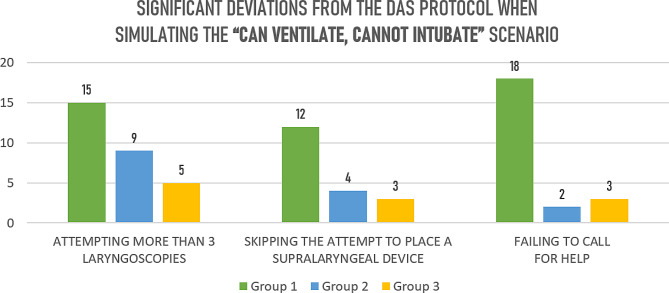
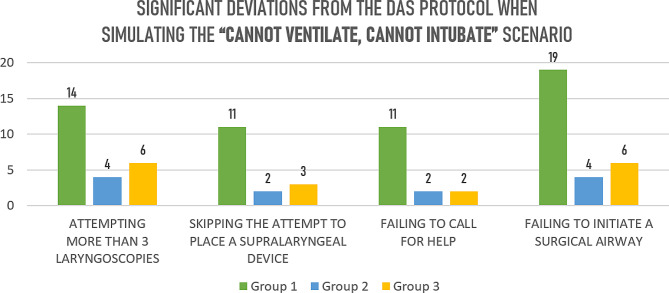
Results: A total of 24 anaesthesiologists consented to participate in the study and completed the initial survey form. During the first session, 83.3% of participants had at least one major deviation from the DAS protocol. During the first CICV scenario, 79% of participants made at least one deviation from the DAS protocol. The second time after simulation training, significantly better results were achieved: the number of anaesthesiologists, who attempted more than 3 laryngoscopies decreased (OR = 7 [1.8-26.8], p = 0.006 right after training and OR = 3.9 [1.06-14.4], p = 0.035 6 month later); the number, who skipped the supralaryngeal device attempt, call for help and failure to initiate surgical airway also decreased. Simulation training also significantly decreases the time to call for help, cricothyroidotomy initiation time, and mean desaturation time and increases the odds ratio of successful cricothyroidotomy (OR 0.02 [0.003-0.14], p < 0.0001 right after training and OR = OR 0.02 [0.003-0.16] 6 months after training).
Conclusions: Anaesthesiologists usually display major deviations from DAS guidelines while managing CI and CICV scenarios. Simulation training improves their guideline adherence, skills, and decision-making when repeating the simulation immediately after training and 6 months later.
Study registration: NCT05913492, clinicaltrials.gov, 22/06/2023.
Keywords: Difficult airways; Intubation; Simulation.
© 2024. The Author(s).
Conflict of interest statement
The authors declare no competing interests.
Figures
Comment in
-
Airway management education and retraining: an unresolved paradigm.BMC Anesthesiol. 2024 Sep 20;24(1):336. doi: 10.1186/s12871-024-02637-z. BMC Anesthesiol. 2024. PMID: 39304795 Free PMC article.
References
-
- Bielka K, Kuchyn IY, Frank M, et al. Causes and consequences of anesthetic emergencies in Ukraine. Pain Anaesth & int care. 2022;2(99):26–32. doi: 10.25284/2519-2078.2(99).2022.265836. - DOI
Publication types
MeSH terms
Associated data
LinkOut - more resources
Full Text Sources
Medical
Miscellaneous
