


Lung Disease and Social Justice: Chronic Obstructive Pulmonary Disease as a Manifestation of Structural Violence
- PMID: 38300144
- PMCID: PMC11531224
- DOI: 10.1164/rccm.202309-1650CI
Lung Disease and Social Justice: Chronic Obstructive Pulmonary Disease as a Manifestation of Structural Violence
Abstract
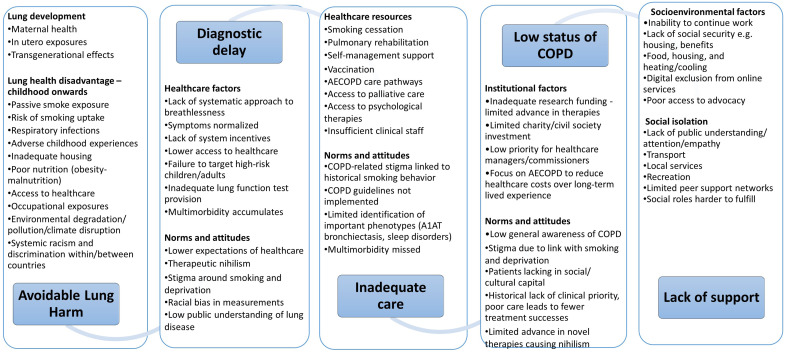
Lung health, the development of lung disease, and how well a person with lung disease is able to live all depend on a wide range of societal factors. These systemic factors that adversely affect people and cause injustice can be thought of as "structural violence." To make the causal processes relating to chronic obstructive pulmonary disease (COPD) more apparent, and the responsibility to interrupt or alleviate them clearer, we have developed a taxonomy to describe this. It contains five domains: 1) avoidable lung harms (processes impacting lung development, processes that disadvantage lung health in particular groups across the life course), 2) diagnostic delay (healthcare factors; norms and attitudes that mean COPD is not diagnosed in a timely way, denying people with COPD effective treatment), 3) inadequate COPD care (ways in which the provision of care for people with COPD falls short of what is needed to ensure they are able to enjoy the best possible health, considered as healthcare resource allocation and norms and attitudes influencing clinical practice), 4) low status of COPD (ways COPD as a condition and people with COPD are held in less regard and considered less of a priority than other comparable health problems), and 5) lack of support (factors that make living with COPD more difficult than it should be, i.e., socioenvironmental factors and factors that promote social isolation). This model has relevance for policymakers, healthcare professionals, and the public as an educational resource to change clinical practices and priorities and stimulate advocacy and activism with the goal of the elimination of COPD.
Keywords: advocacy; epidemiology; healthcare provision; inequality; stigma.
Figures
References
-
- Safiri S, Carson-Chahhoud K, Noori M, Nejadghaderi SA, Sullman MJM, Ahmadian Heris J, et al. Burden of chronic obstructive pulmonary disease and its attributable risk factors in 204 countries and territories, 1990–2019: results from the Global Burden of Disease Study 2019. BMJ . 2022;378:e069679. - PMC - PubMed
-
- Galtung J. Violence, peace, and peace research. J Peace Res . 1969;6:167–191.
-
- Carmichael S.Cooper D. Carmichael S. Laing RD. Marcuse H. Goodman P. The dialectics of liberation (radical thinkers) London: Verso Books; 1968. Black power; p. 151.
MeSH terms
LinkOut - more resources
Full Text Sources
Medical
