


Basic triage in dogs and cats: Part I
- PMID: 38304479
- PMCID: PMC10783570
Basic triage in dogs and cats: Part I
Abstract
Background: Emergency cases can present at any time of the day or night. All small animal practitioners need to have the skills to triage and stabilize common emergency cases even if they ultimately aim to refer the patient to another facility.
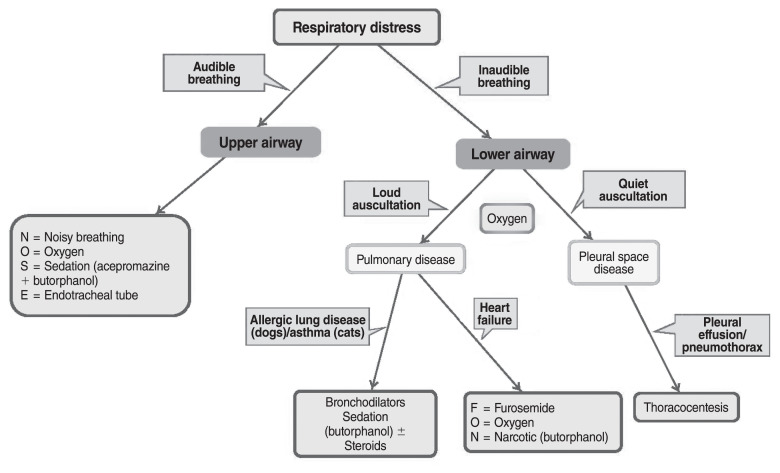
Objectives and procedures: The first part of this 3-part review article series covers respiratory distress and seizures. A stepwise approach to categorize and stabilize these cases is outlined, along with helpful tips to optimize the referral experience, if indicated.
Results: Having a strong methodical approach to animals in respiratory distress optimizes treatment. Similarly, achieving cessation of seizures, along with having a good understanding of the causes of seizures, allows for patient stabilization.
Conclusion and clinical relevance: Do NOT refer emergent cases before completing basic stabilization. Many emergency cases do not require emergent referral and can be worked up by the primary veterinarian or sent to a referral clinic on an appointment basis after appropriate stabilization steps are completed.
Triage de base chez les chiens et les chats : Partie I.
Contexte: Les cas urgents peuvent se présenter à tout moment du jour ou de la nuit. Tous les médecins vétérinaires en pratique des petits animaux doivent avoir les compétences pour effectuer un triage et stabiliser les cas urgents fréquents même s’ils prévoient ultimement référer le patient à un autre établissement.
Objectifs et procédures: La première partie de cet article de revue en 3 parties traite de la détresse respiratoire et des convulsions. Une approche progressive pour catégoriser et stabiliser ces cas est présentée, avec des conseils utiles pour optimiser l’expérience de référencement, si nécessaire.
Résultats: Avoir une approche méthodique solide lors de cas de détresse respiratoire chez les animaux permet d’optimiser le traitement. De manière similaire, être capable de maîtriser les convulsions tout en ayant une bonne compréhension de leurs causes, permettent une meilleure stabilisation du patient.
Conclusion et pertinence clinique: Ne PAS procéder au référencement de cas urgents avant d’avoir terminé une stabilisation de base. Plusieurs cas urgents ne nécessitent pas d’être référé en urgence et peuvent être pris en charge par le médecin vétérinaire primaire ou transféré à une clinique de référence après la prise d’un rendez-vous une fois qu’une stabilisation adéquate ait été complétée.(Traduit par Dr Serge Messier).
Copyright and/or publishing rights held by the Canadian Veterinary Medical Association.
Figures
References
-
- Slawson R. The development of triage. Surg Call. 2016;20:2–5.
-
- Ruys LJ, Gunning M, Teske E, Robben JH, Sigrist NE. Evaluation of a veterinary triage list modified from a human five-point triage system in 485 dogs and cats. J Vet Emerg Crit Care. 2012;22:303–312. - PubMed
-
- Sigrist NE, Adamik KN, Dherr MG, Spreng DE. Evaluation of respiratory parameters at presentation as clinical indicators of the respiratory localization in dogs and cats with respiratory disease. J Vet Emerg Crit Care. 2011;21:13–23. - PubMed
-
- Dominguez-Ruiz M, Reniero CR, Vientos-Plotts A, et al. Association between respiratory clinical signs and respiratory localization in dogs and cats with abnormal breathing patterns. Vet J. 2021;277:105761. - PubMed
Publication types
MeSH terms
LinkOut - more resources
Full Text Sources
Miscellaneous