Review
. 2023 Dec 13:10:140-145.
doi: 10.1016/j.ijregi.2023.12.003. eCollection 2024 Mar.

Incorporating direct molecular diagnostics in management algorithms for nontuberculous mycobacteria: Is it high time?

Affiliations
Review

Incorporating direct molecular diagnostics in management algorithms for nontuberculous mycobacteria: Is it high time?

Christoffel Johannes Opperman et al. IJID Reg. .

Abstract

Nontuberculous mycobacteria (NTM) are a group of acid-fast mycobacteria other than Mycobacterium tuberculosis complex (MTBC) that cause pulmonary disease that is similar to the disease caused by MTBC. International guidelines for the diagnosis of pulmonary NTM disease are rigid and have remained unchanged for nearly 2 decades. In this opinion piece, we provide a new perspective on the traditional criteria by suggesting a diagnostic algorithm that incorporates direct molecular identification of NTM performed on raw sputum specimens (using Sanger or targeted deep sequencing approaches, among others) paired with traditional culture methods. Our approach ensures a more rapid diagnosis of pulmonary NTM disease, thus, facilitating timeous clinical diagnosis, and prompt treatment initiation, where indicated, and leverages recent advances in novel molecular techniques into routine NTM identification practice.

Keywords: Culture; Guideline; Molecular technique; Mycobacteria-other-than-tuberculosis; Nontuberculous mycobacterium; Pulmonary.


Conflict of interest statement

The authors have no competing interest to declare.

Figures
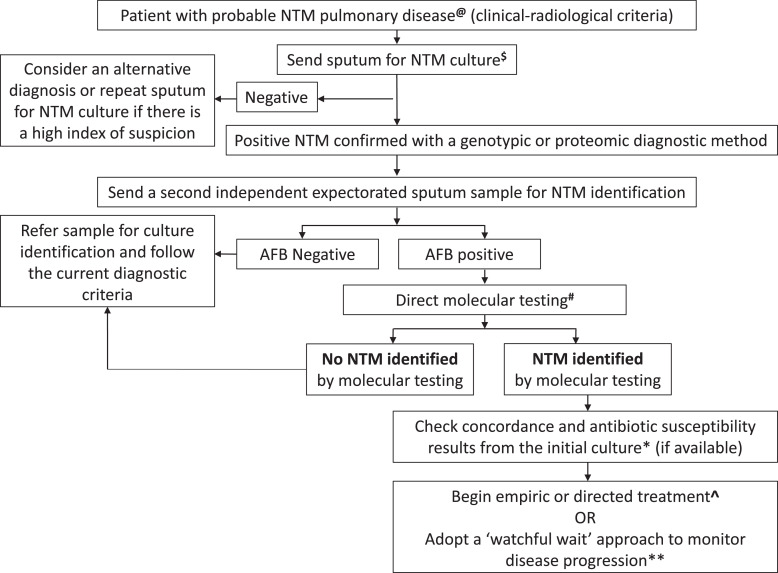
Figure 1
Figure 1
The proposed algorithm for diagnosing and managing nontuberculous mycobacteria pulmonary disease. A second independent sputum sample (ideally taken ≥1 week after the initial sputum sample) is requested if the first sputum is culture-positive for NTM in a patient with a clinical and radiological picture consistent with pulmonary NTM disease. In cases of inconclusive or negative results from molecular testing and when smear microscopy is negative for AFB, sputum culture should be performed on that specimen. In addition, if the NTM identified with a direct molecular method from the sputum correlates with the NTM isolated on the initial sputum culture, susceptibilities can be performed from the culture. The clinician can consider treatment or the watchful wait management approach without needing a second culture. AFB, acid-fast bacilli; NTM, nontuberculous mycobacteria. Footnote: @ Active pulmonary tuberculosis must be excluded using a standard diagnostic algorithm that includes a GeneXpert MTB/RIF Ultra negative in most settings. $ In cases with an isolated culture that signals NTM growth, the clinician must ensure that the results correlate with the clinical and radiological profile consistent with NTM pulmonary infection. # Direct molecular testing will only be performed depending on the availability of the appropriate assay suitable to detect the NTM that was cultured using the initial sputum sample. * A second culture must be sent for discordance between direct molecular testing and initial culture results. ^ Microbiological treatment response can be evaluated using serial cultures/smears. These must be evaluated in conjunction with the clinical and radiological response to treatment. ** Many NTM species may not cause significant pulmonary disease (low pathogenic potential), e.g., M. gordonae, M. mucogenicum, M. nonchromogenicum, M. haemophilum, M. flavescens, M. gastri, M. terrae, or M. triviale. Thus the ‘watchful waiting’ strategy may be applied with adequate patient follow-up, incorporating clinical and radiological parameters.

References

    1. Daley CL, Iaccarino JM, Lange C, Cambau E, Wallace RJ, Jr, Andrejak C, et al. Treatment of nontuberculous mycobacterial pulmonary disease: an official ATS/ERS/ESCMID/IDSA clinical practice guideline. Eur Respir J. 2020;56 doi: 10.1183/13993003.00535-2020. - DOI - PMC - PubMed
    1. Santos A, Carneiro S, Silva A, Gomes JP, Macedo R. Nontuberculous mycobacteria in Portugal: trends from the last decade. Pulmonology. 2022 doi: 10.1016/j.pulmoe.2022.01.011. - DOI - PubMed
    1. Wang HY, Bang H, Kim S, Koh WJ, Lee H. Identification of Mycobacterium species in direct respiratory specimens using reverse blot hybridisation assay. Int J Tuberc Lung Dis. 2014;18:1114–1120. doi: 10.5588/ijtld.14.0140. - DOI - PubMed
    1. Zhang Q, Xiao H, Yan L. PCR-reverse blot hybridization assay in respiratory specimens for rapid detection and differentiation of mycobacteria in HIV-negative population. BMC Infect Dis. 2021;21:264. doi: 10.1186/s12879-021-05934-x. - DOI - PMC - PubMed
    1. Kim JA, Yu HJ, Hwang YY, Kang OK, Shim HJ, Jhun BW, et al. Performance evaluation of MolecuTech REBA Myco-ID using HybREAD480 for identification of nontuberculous mycobacteria. Clin Lab. 2023;69 doi: 10.7754/Clin.Lab.2022.221115. - DOI - PubMed

LinkOut - more resources
