Review
. 2024 Feb:100:104988.
doi: 10.1016/j.ebiom.2024.104988. Epub 2024 Feb 1.

PubMed and beyond: biomedical literature search in the age of artificial intelligence

Affiliations
Review

PubMed and beyond: biomedical literature search in the age of artificial intelligence

Qiao Jin et al. EBioMedicine. 2024 Feb.

Abstract

Biomedical research yields vast information, much of which is only accessible through the literature. Consequently, literature search is crucial for healthcare and biomedicine. Recent improvements in artificial intelligence (AI) have expanded functionality beyond keywords, but they might be unfamiliar to clinicians and researchers. In response, we present an overview of over 30 literature search tools tailored to common biomedical use cases, aiming at helping readers efficiently fulfill their information needs. We first discuss recent improvements and continued challenges of the widely used PubMed. Then, we describe AI-based literature search tools catering to five specific information needs: 1. Evidence-based medicine. 2. Precision medicine and genomics. 3. Searching by meaning, including questions. 4. Finding related articles with literature recommendation. 5. Discovering hidden associations through literature mining. Finally, we discuss the impacts of recent developments of large language models such as ChatGPT on biomedical information seeking.

Keywords: Artificial intelligence; Biomedical literature search.


Conflict of interest statement

Declaration of interests None declared.

Figures
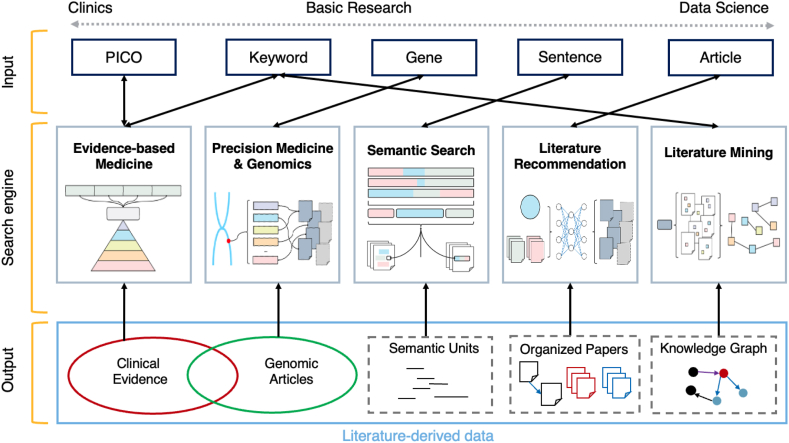
Fig. 1
Fig. 1
Overview of five specialised search scenarios in biomedicine: evidence-based medicine, precision medicine & genomics, semantic search, literature recommendation, and literature mining. Each search scenario is characterized by its unique input interface, search or ranking algorithm, and output display.
Fig. 2
Fig. 2
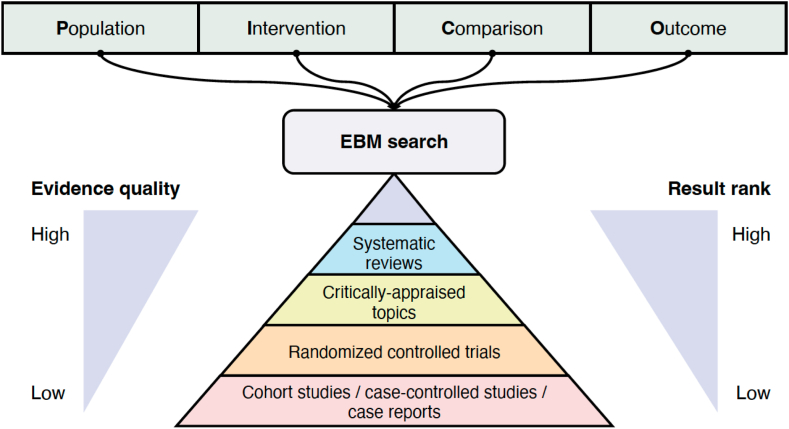
The architecture of a search engine for evidence-based medicine (EBM). EBM search engines should incorporate PICO elements (Population, Intervention, Comparison, and Outcome) within the input query and rank the articles returned based on the quality of the evidence.
Fig. 3
Fig. 3
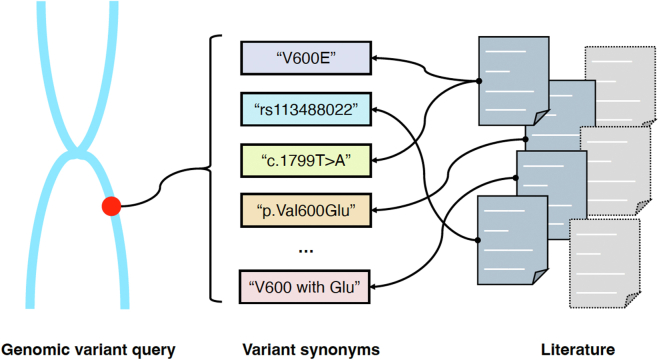
Illustration of the functionality of a search engine for precision medicine and genomics. Search engines for precision medicine and genomics should handle queries containing genomic variants and identify all synonymous references to these variants in the literature.
Fig. 4
Fig. 4
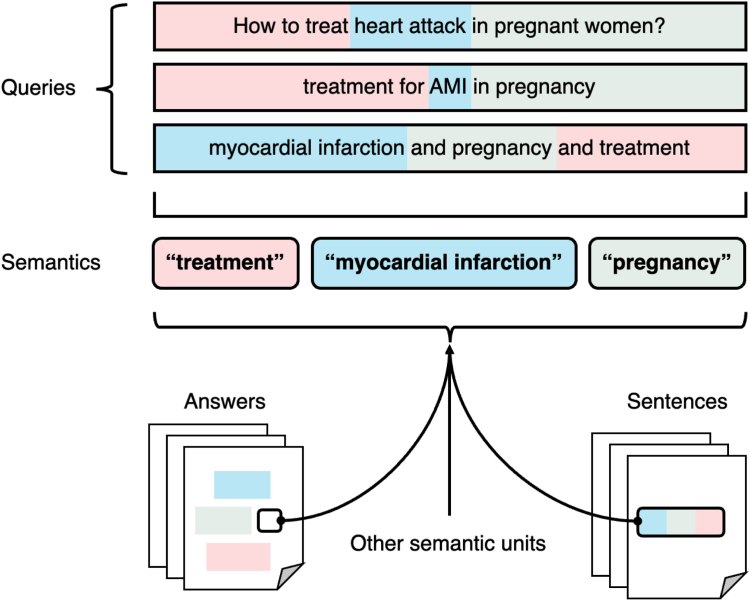
Depiction of semantic search. Unlike traditional keyword-based search engines, semantic search engines process words and phrases according to their meaning rather than the literal text. For instance, “heart attack”, “AMI”, and “myocardial infarction” share similar meanings.
Fig. 5
Fig. 5
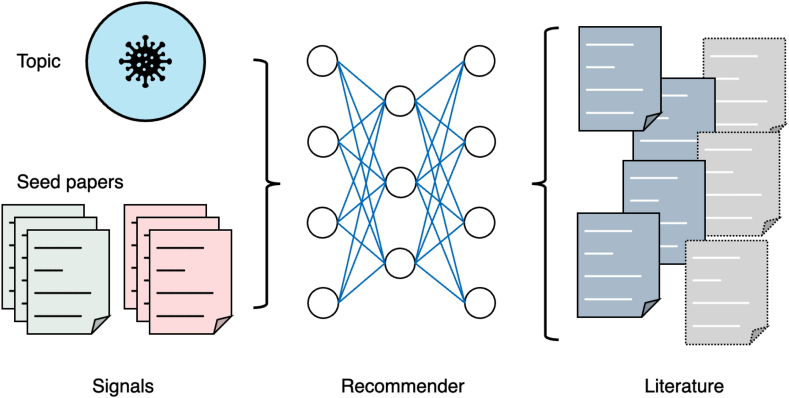
Illustration of topic-based and article-based literature recommendation systems. Topic-based systems provide articles relevant to a specific topic (e.g., COVID-19), while article-based systems return articles similar to a group of initial (seed) articles and dissimilar to a group of irrelevant articles.
Fig. 6
Fig. 6
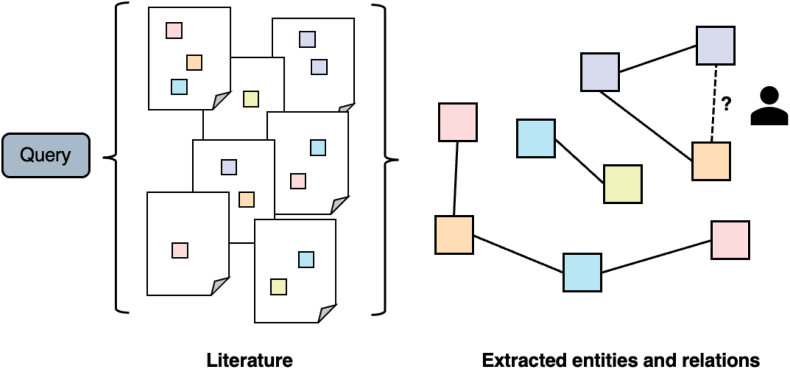
The architecture of a system for mining entity associations from the biomedical literature. The system retrieves articles relevant to a given user query, extracts biomedical entities and their relationships (e.g., variant-causing-disease), and presents the search results as a knowledge graph that visualises the extracted entities and their relationships. The users can use the knowledge graph to find hidden associations between entities.

Update of

References

    1. Baumgartner W.A., Jr., Cohen K.B., Fox L.M., Acquaah-Mensah G., Hunter L. Manual curation is not sufficient for annotation of genomic databases. Bioinformatics. 2007;23:i41–i48. - PMC - PubMed
    1. Islamaj Dogan R., Murray G.C., Neveol A., Lu Z. Understanding PubMed user search behavior through log analysis. Database (Oxford) 2009;2009:bap018. - PMC - PubMed
    1. Fiorini N., Leaman R., Lipman D.J., Lu Z. How user intelligence is improving PubMed. Nat Biotechnol. 2018 - PubMed
    1. Fiorini N., Canese K., Starchenko G., et al. Best match: new relevance search for PubMed. PLoS Biol. 2018;16 - PMC - PubMed
    1. Callaway E., Cyranoski D., Mallapaty S., Stoye E., Tollefson J. The coronavirus pandemic in five powerful charts. Nature. 2020;579:482–483. - PubMed