


Quality assessment of the MRI-radiomics studies for MGMT promoter methylation prediction in glioma: a systematic review and meta-analysis
- PMID: 38308012
- PMCID: PMC11364578
- DOI: 10.1007/s00330-024-10594-x
Quality assessment of the MRI-radiomics studies for MGMT promoter methylation prediction in glioma: a systematic review and meta-analysis
Abstract
Objectives: To evaluate the methodological quality and diagnostic accuracy of MRI-based radiomic studies predicting O6-methylguanine-DNA methyltransferase (MGMT) promoter methylation status in gliomas.
Methods: PubMed Medline, EMBASE, and Web of Science were searched to identify MRI-based radiomic studies on MGMT methylation in gliomas published until December 31, 2022. Three raters evaluated the study methodological quality with Radiomics Quality Score (RQS, 16 components) and Transparent Reporting of a Multivariable Prediction Model for Individual Prognosis Or Diagnosis (TRIPOD, 22 items) scales. Risk of bias and applicability concerns were assessed with QUADAS-2 tool. A meta-analysis was performed to estimate the pooled area under the curve (AUC) and to assess inter-study heterogeneity.
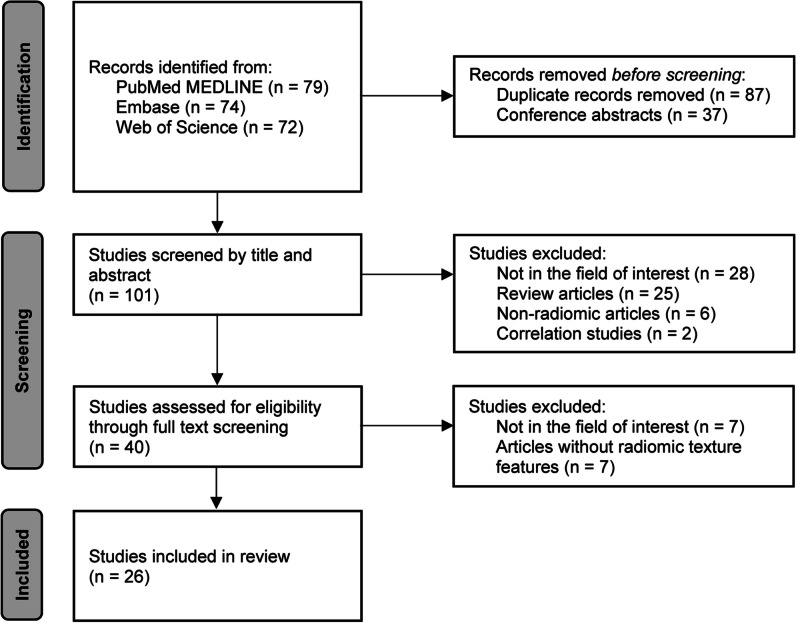
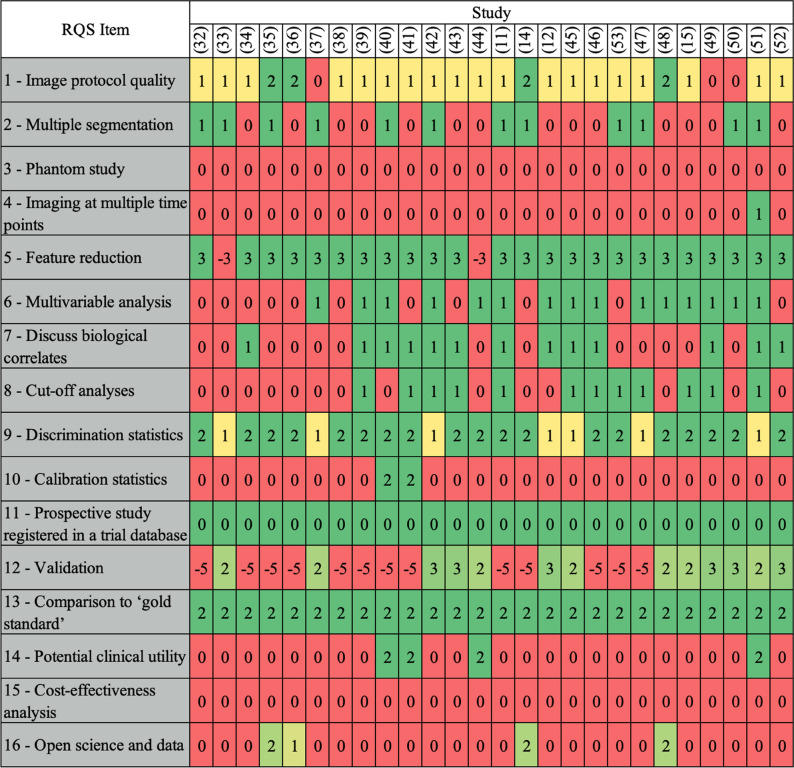
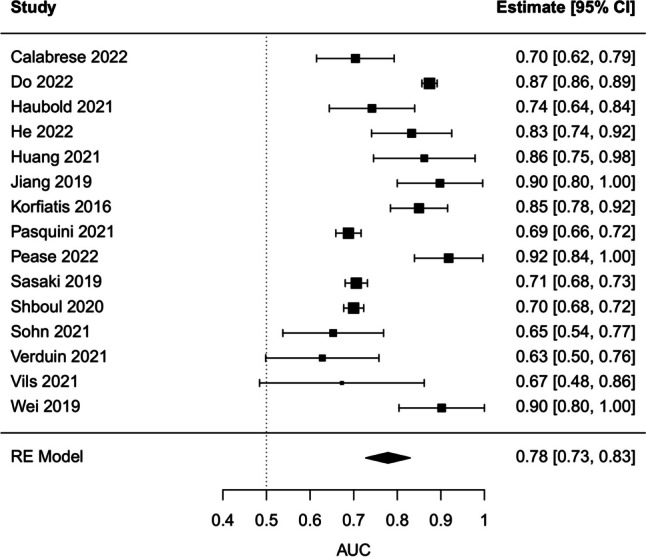
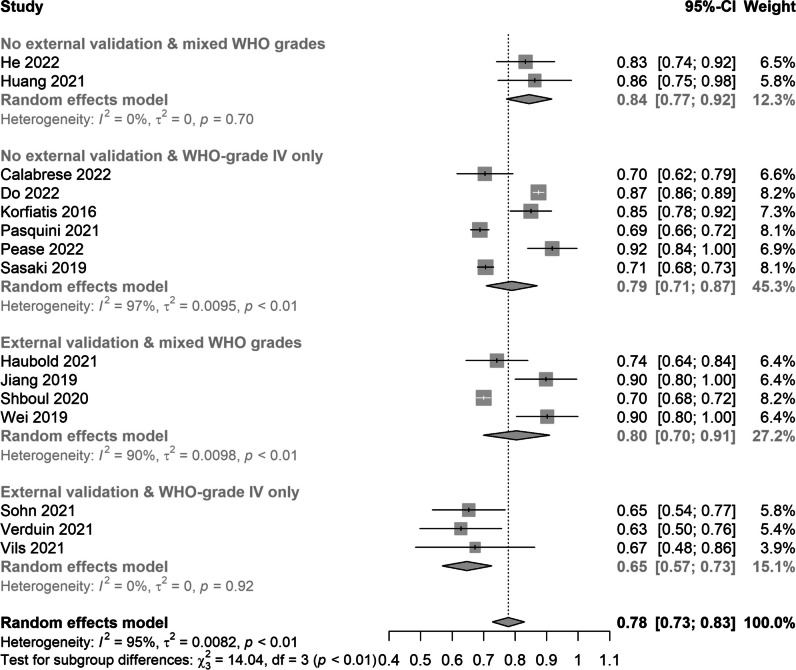
Results: We included 26 studies, published from 2016. The median RQS total score was 8 out of 36 (22%, range 8-44%). Thirteen studies performed external validation. All studies reported AUC or accuracy, but only 4 (15%) performed calibration and decision curve analysis. No studies performed phantom analysis, cost-effectiveness analysis, and prospective validation. The overall TRIPOD adherence score was between 50% and 70% in 16 studies and below 50% in 10 studies. The pooled AUC was 0.78 (95% CI, 0.73-0.83, I2 = 94.1%) with a high inter-study heterogeneity. Studies with external validation and including only WHO-grade IV gliomas had significantly lower AUC values (0.65; 95% CI, 0.57-0.73, p < 0.01).
Conclusions: Study RQS and adherence to TRIPOD guidelines was generally low. Radiomic prediction of MGMT methylation status showed great heterogeneity of results and lower performances in grade IV gliomas, which hinders its current implementation in clinical practice.
Clinical relevance statement: MGMT promoter methylation status appears to be variably correlated with MRI radiomic features; radiomic models are not sufficiently robust to be integrated into clinical practice to accurately predict MGMT promoter methylation status in patients with glioma before surgery.
Key points: • Adherence to the indications of TRIPOD guidelines was generally low, as was RQS total score. • MGMT promoter methylation status prediction with MRI radiomic features provided heterogeneous diagnostic accuracy results across studies. • Studies that included grade IV glioma only and performed external validation had significantly lower diagnostic accuracy than others.
Keywords: Glioma; Magnetic resonance imaging; Meta-analysis; O(6)-Methylguanine-DNA methyltransferase; Systematic review.
© 2024. The Author(s).
Conflict of interest statement
Riccardo Pascuzzo, Tugba Akinci D’Antonoli, and Renato Cuocolo are members of the
Figures
Comment in
-
Windmills in the brain: the radiomic pursuit of MGMT status in gliomas.Eur Radiol. 2024 Sep;34(9):5800-5801. doi: 10.1007/s00330-024-10858-6. Epub 2024 Jun 19. Eur Radiol. 2024. PMID: 38898144 No abstract available.
References
-
- Stupp R, Taillibert S, Kanner A et al (2017) Effect of tumor-treating fields plus maintenance temozolomide vs maintenance temozolomide alone on survival in patients with glioblastoma a randomized clinical trial. JAMA 318:2306–2316. 10.1001/jama.2017.18718 10.1001/jama.2017.18718 - DOI - PMC - PubMed
-
- Esteller M, Hamilton SR, Burger PC et al (1999) Inactivation of the DNA repair gene O6-methylguanine-DNA methyltransferase by promoter hypermethylation is a common event in primary human neoplasia. Cancer Res 59:793–7 - PubMed
Publication types
MeSH terms
Substances
LinkOut - more resources
Full Text Sources
Medical
Research Materials
