


Dietary protein intake in midlife in relation to healthy aging - results from the prospective Nurses' Health Study cohort
- PMID: 38309825
- PMCID: PMC10884611
- DOI: 10.1016/j.ajcnut.2023.11.010
Dietary protein intake in midlife in relation to healthy aging - results from the prospective Nurses' Health Study cohort
Abstract
Background: Protein intake plays an important role in maintaining the health status of older adults. However, few epidemiologic studies examined midlife protein intake in relation to healthy aging.
Objectives: The objective of this study was to evaluate the long-term role of dietary protein intake in healthy aging among female participants in the prospective Nurses' Health Study (NHS) cohort.
Methods: We included 48,762 NHS participants aged <60 y in 1984. Total protein, animal protein, dairy protein (a subset of animal protein), and plant protein were derived from validated food frequency questionnaires. Healthy aging was defined as being free from 11 major chronic diseases, having good mental health, and not having impairments in either cognitive or physical function, as assessed in the 2014 or 2016 NHS participant questionnaires. We used multivariate logistic regression adjusted for lifestyle, demographics, and health status to estimate the odds ratios (ORs) and 95% confidence intervals for protein intake in relation to healthy aging.
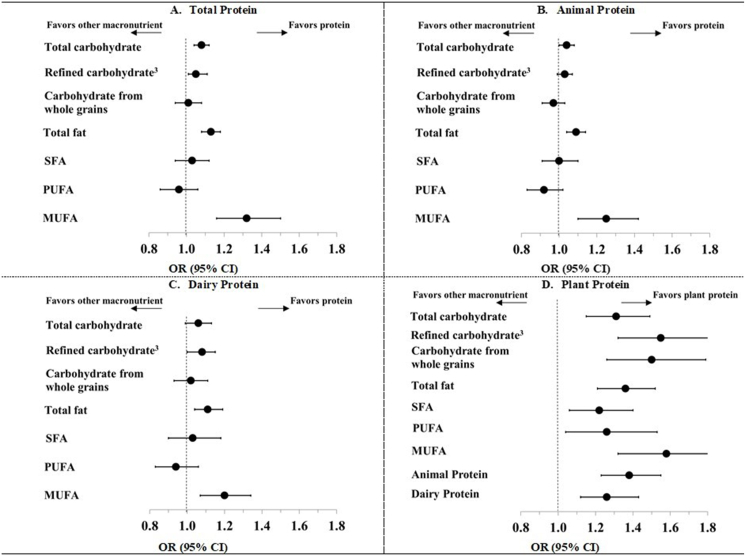
Results: A total of 3721 (7.6%) NHS participants met our healthy aging definition. Protein intake was significantly associated with higher odds of healthy aging. The ORs (95% confidence intervals) per 3%-energy increment with healthy aging were 1.05 (1.01, 1.10) for total protein, 1.07 (1.02, 1.11) for animal protein, 1.14 (1.06, 1.23) for dairy protein, and 1.38 (1.24, 1.54) for plant protein. Plant protein was also associated with higher odds of absence of physical function limitations and good mental status. In substitution analyses, we observed significant positive associations for the isocaloric replacement of animal or dairy protein, carbohydrate, or fat with plant protein (ORs for healthy aging: 1.22-1.58 for 3% energy replacement with plant protein).
Conclusions: Dietary protein intake, especially plant protein, in midlife, is associated with higher odds of healthy aging and with several domains of positive health status in a large cohort of female nurses.
Keywords: animal protein; diet; healthy aging; lifestyle; plant protein; protein.
Copyright © 2023 The Authors. Published by Elsevier Inc. All rights reserved.
Conflict of interest statement
Conflict of interest The authors report no conflicts of interest.
Figures
Comment in
-
Protein intake and healthy aging: sooner rather than later?Am J Clin Nutr. 2024 Feb;119(2):253-254. doi: 10.1016/j.ajcnut.2023.12.004. Epub 2024 Jan 17. Am J Clin Nutr. 2024. PMID: 38238247 No abstract available.
-
Wer sich proteinreich ernährt, altert gesünder.MMW Fortschr Med. 2024 Sep;166(15):24-25. doi: 10.1007/s15006-024-4264-x. MMW Fortschr Med. 2024. PMID: 39266832 German. No abstract available.
References
-
- Vespa J., Medina L., Armstrong D. Demographic turning points for the United States: population projections for 2020 to 2060. Curr. Popul. Rep. P. 2020;1144:25.
Publication types
MeSH terms
Substances
Grants and funding
LinkOut - more resources
Full Text Sources
Medical
Research Materials
Miscellaneous
