Review
. 2023 Oct 12;9(1):16-28.
doi: 10.1016/j.ekir.2023.10.006. eCollection 2024 Jan.

Updates on New Therapies for Patients with CKD

Affiliations
Review

Updates on New Therapies for Patients with CKD

Tushar Tarun et al. Kidney Int Rep. .

Abstract

Individuals diagnosed with chronic kidney disease (CKD) continue to increase globally. This group of patients experience a disproportionately higher risk of cardiovascular (CV) events compared to the general population. Despite multiple guidelines-based medical management, patients with CKD continue to experience residual cardiorenal risk. Several potential mechanisms explain this excessive CV risk observed in individuals with CKD. Several new drugs have become available that could potentially transform CKD care, given their efficacy in this patient population. Nevertheless, use of these drugs presents certain benefits and challenges that are often underrecognized by prescribing these drugs. In this review, we aim to provide a brief discussion about CKD pathophysiology, limiting our discussion to recent published studies. We also explore benefits and limitations of newer drugs, including angiotensin receptor/neprilysin inhibitors (ARNI), sodium glucose transporter 2 inhibitors (SGLT2i), glucagon-like peptides-1 (GLP-1) agonists and finerenone in patients with CKD. Despite several articles covering this topic, our review provides an algorithm where subgroups of patients with CKD might benefit the most from such drugs based on the selection criteria of the landmark trials. Patients with CKD who have nephrotic range proteinuria beyond 5000 mg/g, or those with poorly controlled blood pressure (systolic ≥160 mm Hg or diastolic ≥100 mm Hg) remain understudied.

Keywords: ARNI; SGLT2; chronic kidney disease; finerenone; inflammation; platelets.


Figures

Figure 1
Figure 1
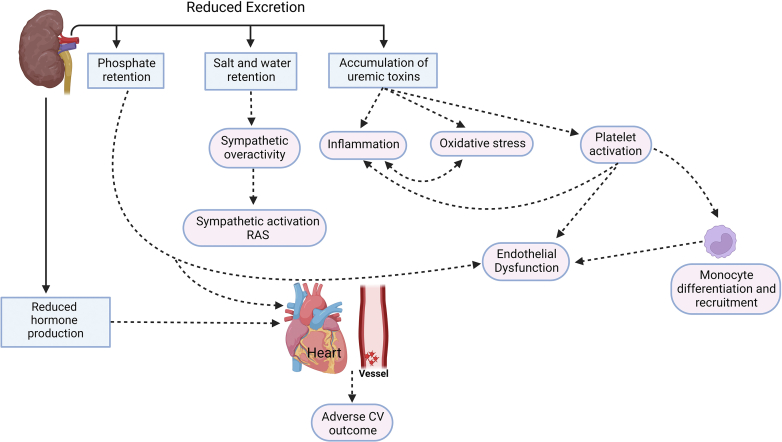
Mechanisms for excessive CV events in patients with CKD arising from reduced excretion from the kidney or reduced hormone (erythropoietin and calcitriol) production from the kidney. Accumulation of salt and water leads to sympathetic overactivity and renin-angiotensin-aldosterone system activation that results in changes to the left ventricle and arterioles that affect systemic vascular resistance. Accumulation of uremic toxins leads to platelet activation causing endothelial dysfunction that generates oxidative stress and inflammation, which also involves liver and adipocytes. Finally, phosphate retention leads to endothelial dysfunction, which has effects on the parathyroid gland, bone, and vessels. Reduced production of calcitriol adds to parathyroid gland, bone, heart, and vessel problems. Reduced production of erythropoietin leads to anemia that affects heart and vessels. CKD, chronic kidney disease; CV cardiovascular; RAAS, renin-angiotensin systems
Figure 2
Figure 2
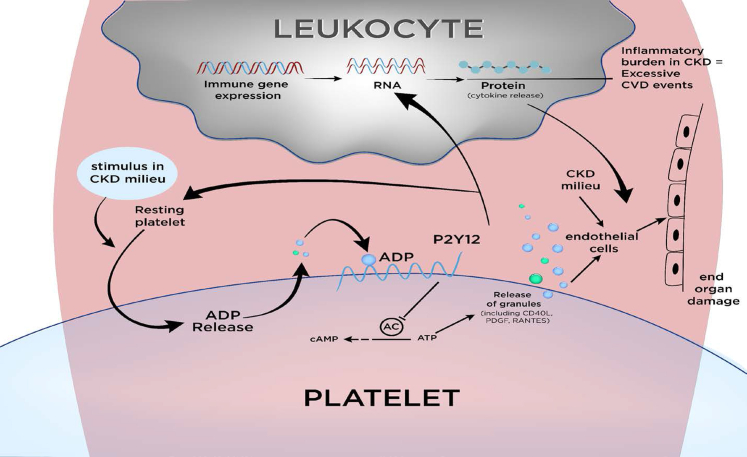
Novel role of platelets in modulating inflammation in patients with CKD. Recently, interaction of platelets with leukocytes in the circulation was reported to modulate inflammation in preclinical studies. With stimulus, platelets interact with leukocytes in circulation via surface receptors. This interaction brings early changes in platelets marked by ADP release from preformed granules. ADP release subsequently acts on P2Y12 receptors to release more platelet granules that contain CD40L, PDGF, RANTES, and other molecules. Release of these molecules results in activation of endothelial cells as well as reprogramming of leukocytes for cytokine release and for monocyte differentiation. CD40L, CD40 ligand; CKD, chronic kidney disease; PDGF, platelet derived growth factor; RANTES, Regulated upon Activation, Normal T Cell Expressed and Presumably Secreted.
Figure 3
Figure 3
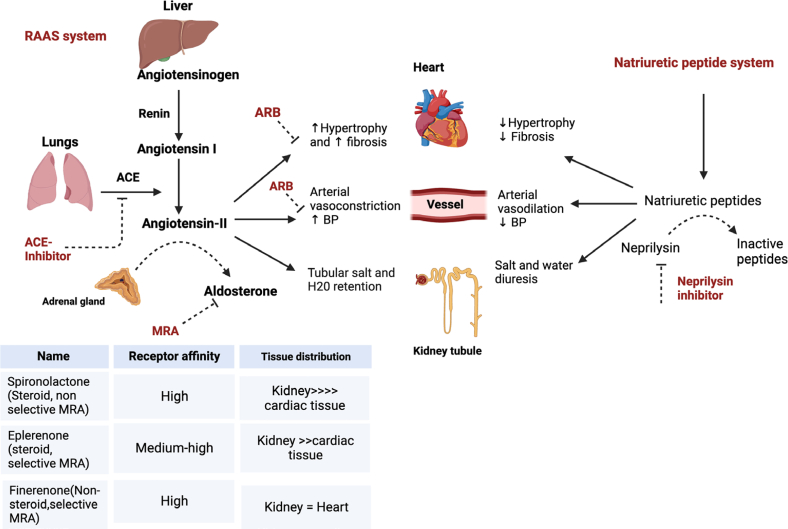
Drugs (in red letters) acting on the RAAS, including newer drugs such as ARNI and mineralocorticoid receptor antagonists. Neprilysin is a neutral endopeptidase. It degrades endogenous vasoactive peptides (e.g., natriuretic peptides, bradykinin, and adrenomedullin). Levels of these neurohormones rise with ACE inhibitor or ARB use. Thus, neprilysin inhibitor counteracts on the neurohormonal activation arising from ACE inhibitor or ARB monotherapy that contributes residual adverse outcomes arising from neurohormone-mediated salt retention and sympathetic overactivity. ACE, angiotensin-converting enzyme; ARB, angiotensin receptor blocker; ARNI, angiotensin receptor/neprilysin inhibitor; AT-1R, angiotensin-1 receptor; BP, blood pressure; RAAS, renin-angiotensin-aldosterone system.
Figure 4
Figure 4
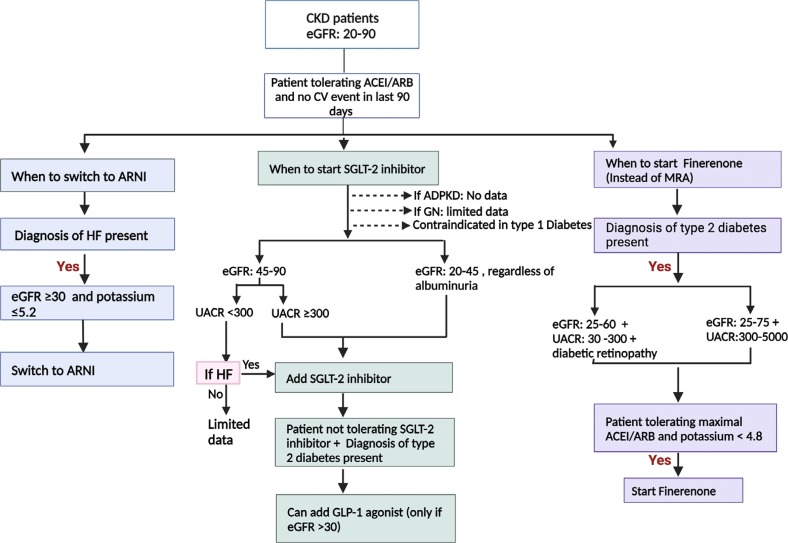
An algorithm when ARNI, SGLT2i, and finerenone can be used based on the selection criteria used in landmark trials. First, ARNI should be limited to patients with heart failure with comorbid CKD if eGFR is >30 ml/min per 1.73 m2, they are tolerating RAASi, and do not have either serum potassium >5.2 mmol/l or systolic blood pressure <110 mm Hg or poorly controlled blood pressure (systolic ≥160 mm Hg or diastolic ≥100 mm Hg). Second, SGLT2i should be prescribed to patients with CKD if they are tolerating stable dose of RAASi, do not have CKD type 1 diabetes, or polycystic kidney disease. Data is limited for patients with glomerulonephritis. Furthermore, either eGFR should be 20 to 45 ml/min per 1.73 m2 regardless of albuminuria, 45 to 90 ml/min per 1.73 m2 with macroalbuminuria, or 45 to 90 ml/min per 1.73 m2 without macroalbuminuria but have heart failure for SGLT2i to be prescribed. Data for SGLT2i in patients with CKD and comorbid obesity (BMI >45 kg/m2) or in those with nephrotic range proteinuria (UACR >5000 mg/g) is limited. Third, GLP-1 agonist use is limited in patients with type 2 diabetic CKD with eGFR >30 ml/min per 1.73 m2 if they are tolerating stable dose of RAASi and cannot tolerate SGLT2i. Finally, finerenone use should be limited to patients with type 2 diabetic CKD who are tolerating maximal doses of ACEi or ARB, serum potassium concentration is <4.8 mmol/l and eGFR 25 to 60 ml/min per 1.73 m2 + microalbuminuria (30–500 mg/g) + diabetic retinopathy or, eGFR 25 to 75 ml/min per 1.73 m2 + macroalbuminuria (300–5000 mg/g). ACE, angiotensin-converting enzyme; ARB, angiotensin receptor blocker; ARNI, angiotensin receptor/neprilysin inhibitor; CKD, chronic kidney disease; eGFR, estimated glomerular filtration rate expressed in ml/min per 1.73 m2; GLP-1, glucagon-like peptide 1; HF, heart failure; SGLT2i, sodium glucose transporter 2 inhibitor; UACR, urine albumin-to-creatinine ratio expressed in mg/g.

References

    1. Cockwell P., Fisher L.A. The global burden of chronic kidney disease. Lancet. 2020;395:662–664. doi: 10.1016/S0140-6736(19)32977-0. - DOI - PubMed
    1. Foley R.N., Murray A.M., Li S., et al. Chronic kidney disease and the risk for cardiovascular disease, renal replacement, and death in the United States Medicare population, 1998 to 1999. J Am Soc Nephrol. 2005;16:489–495. doi: 10.1681/ASN.2004030203. - DOI - PubMed
    1. Foley R.N., Parfrey P.S., Sarnak M.J. Clinical epidemiology of cardiovascular disease in chronic renal disease. Am J Kidney Dis. 1998;32(5 suppl 3):S112–S119. doi: 10.1053/ajkd.1998.v32.pm9820470. - DOI - PubMed
    1. Zhu Z.B., Zhang R.Y., Zhang Q., et al. Moderate-severe renal insufficiency is a risk factor for sirolimus-eluting stent thrombosis. The RIFT study. Cardiology. 2009;112:191–199. doi: 10.1159/000149571. - DOI - PubMed
    1. Best P.J., Lennon R., Ting H.H., et al. The impact of renal insufficiency on clinical outcomes in patients undergoing percutaneous coronary interventions. J Am Coll Cardiol. 2002;39:1113–1119. doi: 10.1016/s0735-1097(02)01745-x. - DOI - PubMed

LinkOut - more resources