


Trends in prevalence, risk factor control and medications in atherosclerotic cardiovascular disease among US Adults, 1999-2018
- PMID: 38313771
- PMCID: PMC10837059
- DOI: 10.1016/j.ajpc.2024.100634
Trends in prevalence, risk factor control and medications in atherosclerotic cardiovascular disease among US Adults, 1999-2018
Abstract
Objectives: Trends in prevalence and treatments of atherosclerotic cardiovascular disease (ASCVD) remains to be documented, with frequent update of relevant guidelines. We aimed to characterize trends in prevalence of ASCVD, and risk factor control and medications among ASCVD adults.
Methods: We conducted a cross-sectional analysis of data from 55,081 adults in the National Health and Nutrition Examination Surveys (NHANES) 1999-2018.
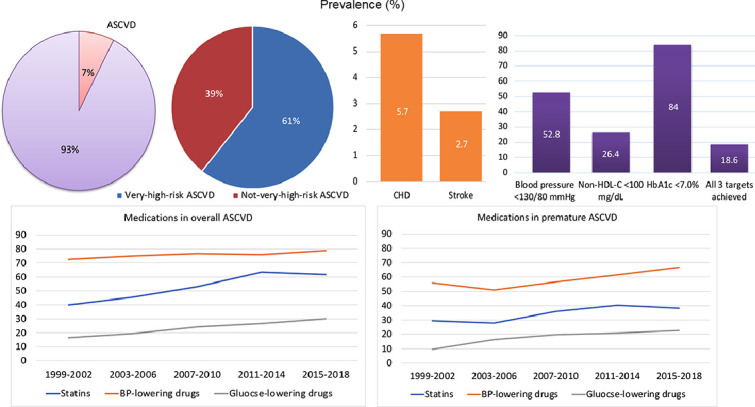
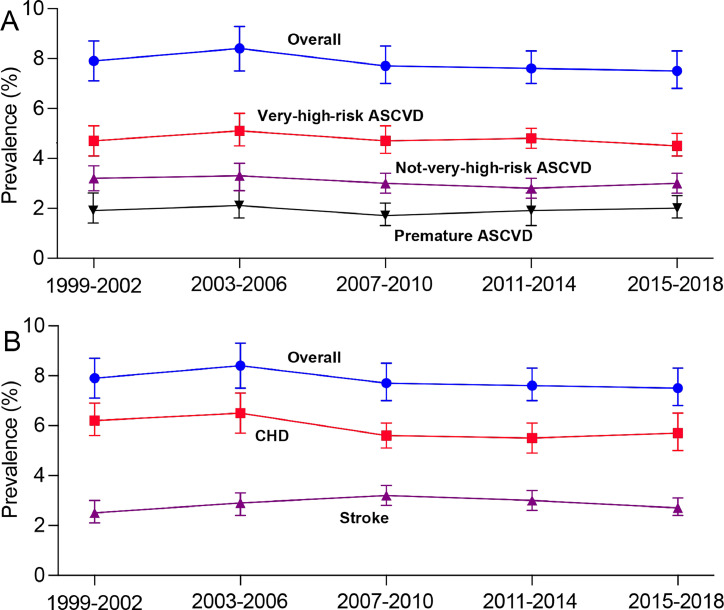
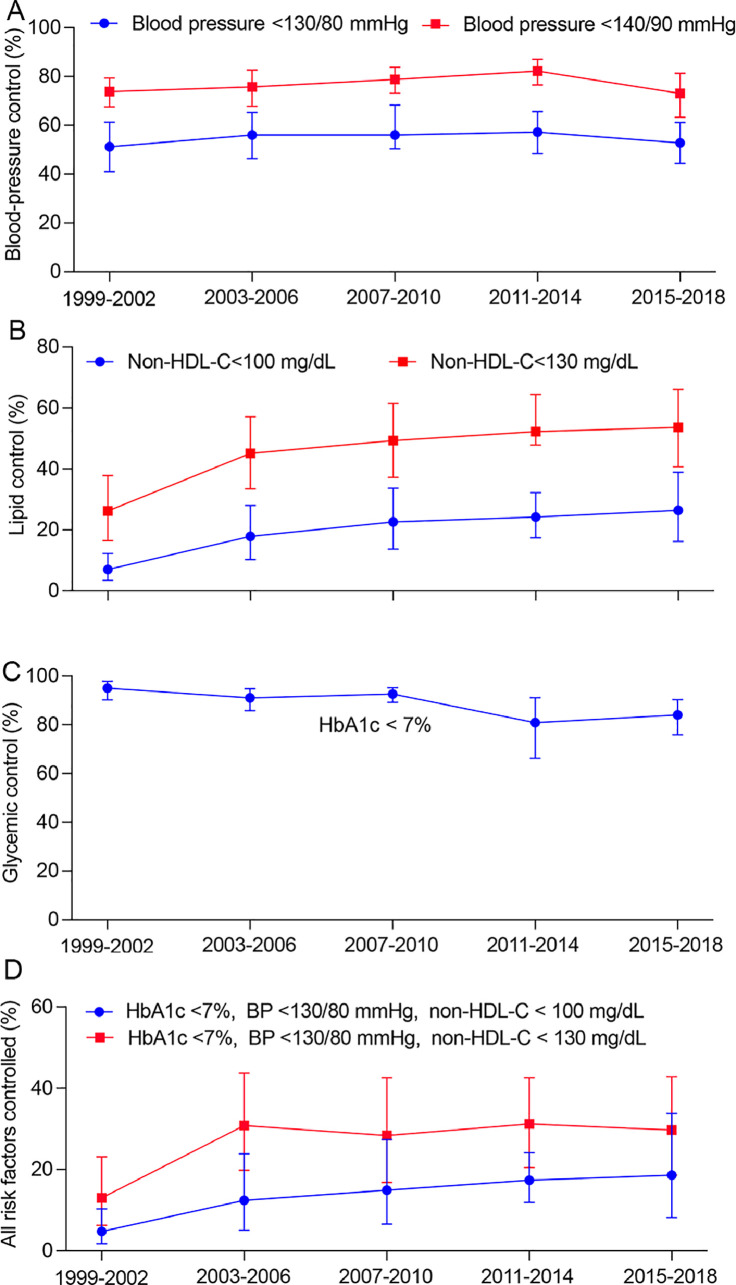
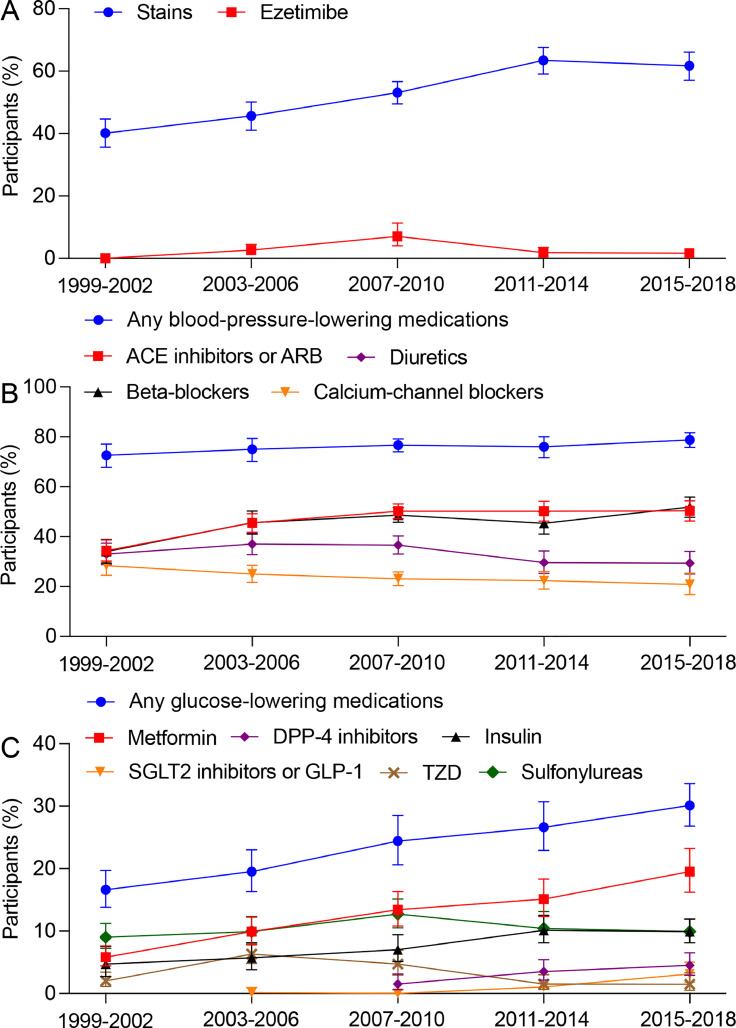
Results: The age-standardized prevalence of ASCVD did not change significantly from 1999-2002 (7.9 %, 95 % CI 7.1 %-8.7 %) to 2015-2018 (7.5 %, CI 6.8 %-8.3 %) (P for trend =0.18), representing an estimated 19.9 million individuals with ASCVD in 2015-2018. The prevalence of premature ASCVD was 2.0 % (CI, 1.6 %-2.5 %). Over 60.0 % of ASCVD participants were at very-high risk. From 1999-2002 to 2015-2018, the percentage with lipid control (non-high-density lipoprotein cholesterol <100 mg/dL) increased from 7.0 % (CI, 3.5 %-12.3 %) to 26.4 % (CI, 16.2 %-38.9 %). The percentage with blood-pressure control (<130/80 mmHg) increased from 51.2 % (CI, 41.0 %-61.3 %) in 1999-2002 to 57.2 % (CI, 48.4 %-65.6 %) in 2011-2014, but then declined to 52.8 % (CI, 44.4 %-81.3 %) in 2015-2018. The percentage with glycemic control (HbA1c <7.0 %) decreased from 95.0 % (CI, 90.2 %-97.9 %) to 84.0 % (CI, 75.9 %-90.3 %). The percentage who achieved all 3 targets was 18.6 % (CI, 8.2 %-33.8 %) in 2015-2018. The percentage of ASCVD participants who were taking statins increased from 1999-2002 to 2011-2014, but then leveled off. Approximately 60 % of individuals with ASCVD and less than 40 % of those with premature ASCVD were taking statins in 2015-2018. The utilization of blood-pressure-lowering drugs remained largely constant over time, whereas the use of glucose-lowering drugs increased.
Conclusions: Based on NHANES data from US adults, the estimated prevalence of ASCVD remained relatively stable between 1999 and 2018. Substantial undertreatment with stains was found in individuals with ASCVD, and the percentage achieving optimal lipid control was low.
Keywords: blood pressure; glucose; lipid; medications; prevalence.
© 2024 The Authors. Published by Elsevier B.V.
Conflict of interest statement
The authors declare that they have no known competing financial interests or personal relationships that could have appeared to influence the work reported in this paper.
Figures
References
-
- Tsao C.W., Aday A.W., Almarzooq Z.I., et al. Heart disease and stroke statistics-2022 update: a report from the American heart association. Circulation. 2022;145:e153–e639. - PubMed
-
- Stone N.J., Robinson J.G., Lichtenstein A.H., et al. 2013 ACC/AHA guideline on the treatment of blood cholesterol to reduce atherosclerotic cardiovascular risk in adults: a report of the American college of cardiology/American heart association task force on practice guidelines. Circulation. 2014;129:S1–45. - PubMed
-
- Whelton P.K., Carey R.M., Aronow W.S., et al. 2017 ACC/AHA/AAPA/ABC/ACPM/AGS/APhA/ASH/ASPC/NMA/PCNA guideline for the prevention, detection, evaluation, and management of high blood pressure in adults: executive summary: a report of the American college of cardiology/American heart association task force on clinical practice guidelines. Circulation. 2018;138:e426–ee83. - PubMed
LinkOut - more resources
Full Text Sources
