


A review of dorsal root ganglia and primary sensory neuron plasticity mediating inflammatory and chronic neuropathic pain
- PMID: 38314104
- PMCID: PMC10837099
- DOI: 10.1016/j.ynpai.2024.100151
A review of dorsal root ganglia and primary sensory neuron plasticity mediating inflammatory and chronic neuropathic pain
Abstract
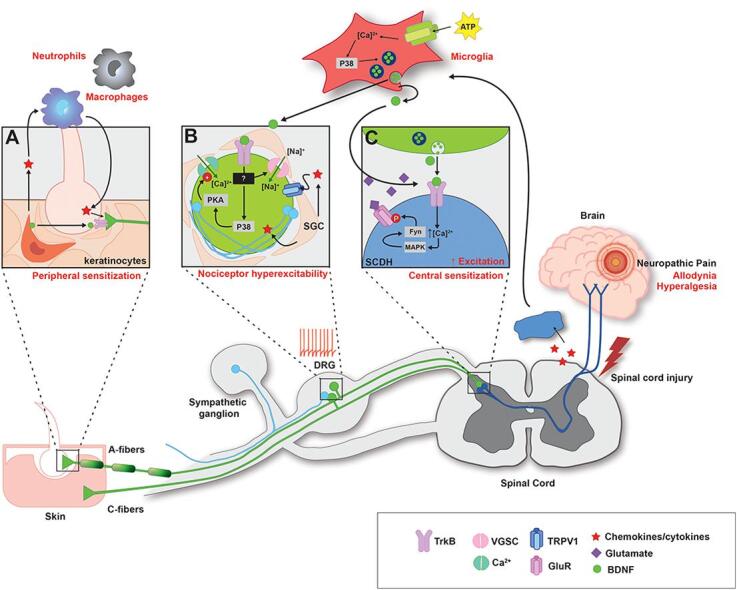
Pain is a sensory state resulting from complex integration of peripheral nociceptive inputs and central processing. Pain consists of adaptive pain that is acute and beneficial for healing and maladaptive pain that is often persistent and pathological. Pain is indeed heterogeneous, and can be expressed as nociceptive, inflammatory, or neuropathic in nature. Neuropathic pain is an example of maladaptive pain that occurs after spinal cord injury (SCI), which triggers a wide range of neural plasticity. The nociceptive processing that underlies pain hypersensitivity is well-studied in the spinal cord. However, recent investigations show maladaptive plasticity that leads to pain, including neuropathic pain after SCI, also exists at peripheral sites, such as the dorsal root ganglia (DRG), which contains the cell bodies of sensory neurons. This review discusses the important role DRGs play in nociceptive processing that underlies inflammatory and neuropathic pain. Specifically, it highlights nociceptor hyperexcitability as critical to increased pain states. Furthermore, it reviews prior literature on glutamate and glutamate receptors, voltage-gated sodium channels (VGSC), and brain-derived neurotrophic factor (BDNF) signaling in the DRG as important contributors to inflammatory and neuropathic pain. We previously reviewed BDNF's role as a bidirectional neuromodulator of spinal plasticity. Here, we shift focus to the periphery and discuss BDNF-TrkB expression on nociceptors, non-nociceptor sensory neurons, and non-neuronal cells in the periphery as a potential contributor to induction and persistence of pain after SCI. Overall, this review presents a comprehensive evaluation of large bodies of work that individually focus on pain, DRG, BDNF, and SCI, to understand their interaction in nociceptive processing.
Keywords: BDNF; Dorsal root ganglia; Nociceptors; Pain; Spinal cord injury; TrkB.
© 2024 The Authors.
Conflict of interest statement
The authors declare that they have no known competing financial interests or personal relationships that could have appeared to influence the work reported in this paper.
Figures
References
-
- Abrahamsson T., Chou C.Y.C., Li S.Y., Mancino A., Costa R.P., Brock J.A., Nuro E., Buchanan K.A., Elgar D., Blackman A.V., Tudor-Jones A., Oyrer J., Farmer W.T., Murai K.K., Sjöström P.J. Differential regulation of evoked and spontaneous release by presynaptic NMDA receptors. Neuron. 2017;96(4):839–855.e835. doi: 10.1016/j.neuron.2017.09.030. - DOI - PubMed
Publication types
Grants and funding
LinkOut - more resources
Full Text Sources
