How Outreach Training and Supportive Supervision (OTSS) Affect Health Facility Readiness and Health-Care Worker Competency to Prevent and Treat Malaria in Niger: A Secondary Analysis of OTSS Data
- PMID: 38320312
- PMCID: PMC10919237
- DOI: 10.4269/ajtmh.23-0359
How Outreach Training and Supportive Supervision (OTSS) Affect Health Facility Readiness and Health-Care Worker Competency to Prevent and Treat Malaria in Niger: A Secondary Analysis of OTSS Data
Abstract
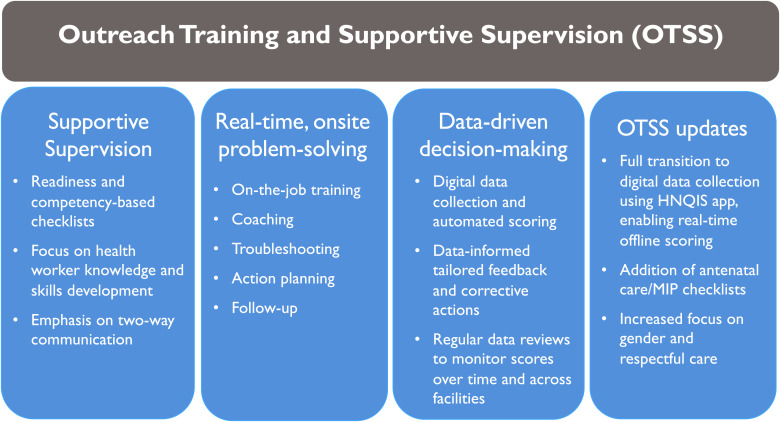
The quality of health services is key to the goal of averting morbidity and mortality from malaria. From July 2020 to August 2021, PMI Impact Malaria supported the implementation of four rounds of Outreach Training and Supportive Supervision (OTSS) in 12 health districts in the two regions of Niger: Dosso and Tahoua. Through OTSS, trained supervisors conducted onsite visits to observe an average of 174 healthcare workers (HCWs) per round in 96 public primary health facilities, managing persons with fever or conducting antenatal care (ANC) consultations, and then provided instant and individualized feedback and onsite training. Data from health facility readiness, case management, and malaria in pregnancy (MiP) checklists across the four rounds were analyzed using Wilcoxon's and the χ2 tests. These analyses highlighted improved facility readiness, including an increased likelihood that HCWs had received classroom training, and facilities had increased availability of guidelines and algorithms by round 4 compared with round 1. Median HCW performance scores showed an improvement in the correct performance and interpretation of malaria rapid diagnostic tests, in classification of malaria as uncomplicated or severe, and in the management of uncomplicated malaria across the four rounds. For MiP services, malaria prevention and the management of pregnant women with malaria also improved from round 1 to round 4. These findings provide further evidence that OTSS can achieve rapid improvements in health facility readiness and HCW competency in managing outpatients and ANC clients.
Conflict of interest statement
Disclosure: The findings and conclusions in this report are those of the authors and do not necessarily represent the official position of the U.S. Agency for International Development. The secondary analysis of the OTSS data received approval from the Niger National Ethics Committee on May 25, 2022 and a nonresearch determination from the PSI Research Ethics Board on December 5, 2022. All personally identifiable information was excluded from the analysis and all data were aggregated to a level at which results could not be connected to any individual HCW, health facility, or geographic area.
Figures
References
-
- World Health Organization , 2022. World Malaria Report 2022. Geneva, Switzerland: WHO.
-
- Bailey C, Blake C, Schriver M, Cubaka VK, Thomas T, Martin Hilber A, 2016. A systematic review of supportive supervision as a strategy to improve primary healthcare services in sub-Saharan Africa. Int J Gynaecol Obstet 132: 117–125. - PubMed
MeSH terms
LinkOut - more resources
Full Text Sources
Medical