


The relationship between atrial cardiopathy biomarkers and prognosis of patients with acute ischemic stroke after endovascular treatment
- PMID: 38320384
- PMCID: PMC10963924
- DOI: 10.1016/j.neurot.2024.e00327
The relationship between atrial cardiopathy biomarkers and prognosis of patients with acute ischemic stroke after endovascular treatment
Erratum in
-
Corrigendum to "The relationship between atrial cardiopathy biomarkers and prognosis of patients with acute ischemic stroke after endovascular treatment" [Neurotherapeutics 21 (2) (2024) e00327].Neurotherapeutics. 2024 Jul;21(4):e00361. doi: 10.1016/j.neurot.2024.e00361. Epub 2024 Apr 30. Neurotherapeutics. 2024. PMID: 38692951 Free PMC article. No abstract available.
Abstract
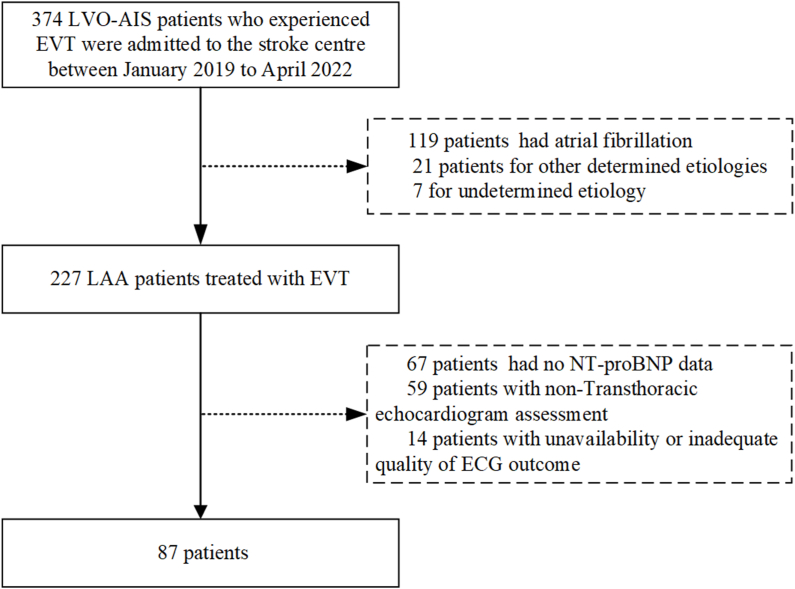
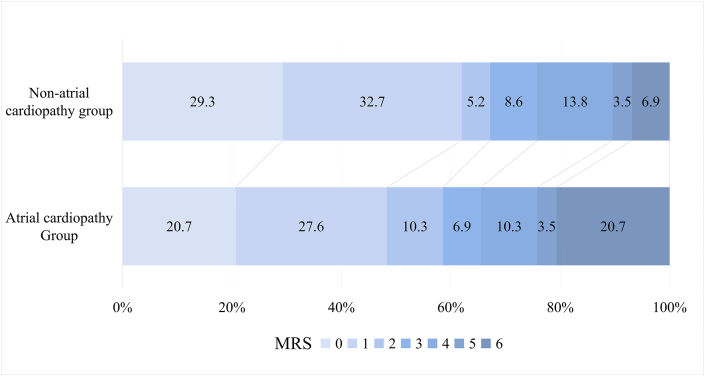
Thromboembolism is a possible consequence of underlying atrial cardiopathy, which can occur even before the onset of atrial fibrillation. Our objective was to examine the association between biomarkers of atrial cardiopathy and outcomes of acute ischemic stroke (AIS) following endovascular treatment (EVT). We conducted a retrospective study that collected data from patients with AIS who underwent EVT and compared the outcomes between those with and without atrial cardiopathy. Neurological function was assessed using the modified Rankin Scale (mRS), with an mRS score >2 indicating poor function at day 90. Additionally, we evaluated secondary consequences, including symptomatic intracerebral hemorrhage (sICH), early neurological deterioration (END), and malignant cerebral edema (MCE). Our study included 87 patients (77.6 % male; mean age 60.93 ± 12.47 years). Among these patients, 29 (33.3 %) had atrial cardiopathy, while the remaining 58 (66.7 %) did not. In the atrial cardiopathy group, 12 patients (41.4 %) had poor functional outcomes (mRS>2), compared to 19 (32.8 %) in the non-atrial cardiopathy group. We observed sICH in 22 (25.3 %) patients, END in 14 (16.1 %) patients, MCE in 11 (12.6 %) patients, and two (2.3 %) patients who died in the hospital. We found that patients with PTFV1>5000 μV/ms (OR: 8.39, 95 % CI: 1.43-105.95, P = 0.02) and NT-proBNP>250 pg/mL (OR: 5.09, 95 % CI: 1.20-27.63, P = 0.03) had significantly higher risk of END. After adjusting for covariates in the Firth logistic regression, we further found that atrial cardiopathy was significantly associated with END, as revealed by both univariate (OR: 6.31, 95 % CI: 1.42-59.87, P = 0.01) and multivariable firth regression models (Modle 1, OR: 7.10, 95 % CI: 1.57-67.38, P < 0.01; Modle 2, OR: 7.82, 95 % CI: 1.69, 76.36, P < 0.01; Modle 3, OR: 8.59, 95 % CI: 1.72-91.70, P < 0.01). Moreover, we observed that atrial cardiopathy was associated with an increased risk of END in AIS patients with large artery atherosclerosis (LAA) receiving EVT. Therefore, clinicians should consider atrial cardiopathy as a possible underlying cause of AIS in their patients. Further investigation is warranted to elucidate the relationship between atrial cardiopathy and AIS's occurrence, progression, and prognosis.
Keywords: Atrial cardiopathy; Endovascular treatment; Ischemic stroke; Prognosis.
Copyright © 2024 The Author(s). Published by Elsevier Inc. All rights reserved.
Conflict of interest statement
Declaration of competing interest The authors declare that they have no known competing financial interests or personal relationships that could have appeared to influence the work reported in this paper.
Figures
References
-
- Calenda B.W., Fuster V., Halperin J.L., Granger C.B. Stroke risk assessment in atrial fibrillation: risk factors and markers of atrial myopathy. Nat Rev Cardiol. 2016;13(9):549–559. - PubMed
-
- Guichard J.-B., Nattel S. Atrial cardiomyopathy: a useful notion in cardiac disease management or a passing fad? J Am Coll Cardiol. 2017;70(6):756–765. - PubMed
-
- Andrade J., Khairy P., Dobrev D., Nattel S. The clinical profile and pathophysiology of atrial fibrillation: relationships among clinical features, epidemiology, and mechanisms. Circ Res. 2014;114(9):1453–1468. - PubMed
-
- Tufano A., Lancellotti P. Atrial cardiomyopathy: pathophysiology and clinical implications. Eur J Intern Med. 2022;101:29–31. - PubMed
MeSH terms
Substances
LinkOut - more resources
Full Text Sources
Medical
Research Materials
