. 2024 Feb 7;36(1):25.
doi: 10.1007/s40520-024-02694-x.

Calf circumference as a surrogate indicator for detecting low muscle mass in hospitalized geriatric patients

Affiliations

Calf circumference as a surrogate indicator for detecting low muscle mass in hospitalized geriatric patients

Caroline M Kiss et al. Aging Clin Exp Res. .

Abstract

Background: Sarcopenia is characterized by low muscle strength, decreased muscle mass, and decline in physical performance. While the measurements of muscle strength and physical performance are easy to perform, an accurate evaluation of muscle mass is technically more demanding. We therefore evaluated the suitability of calf circumference (CC) as a clinical indicator for muscle mass.

Methods: In a cross-sectional single-centre study, geriatric inpatients were assessed for sarcopenia according to the European Working Group on Sarcopenia in Older People 2 (EWGSOP2) consensus. Calf circumference was tested for correlation with appendicular skeletal muscle mass index (ASMI). Receiver operating characteristic curves (ROC) were used to calculate the discriminatory value of the CC cut-off values to differentiate patients above and below ASMI cut-offs for sarcopenia.

Results: In this study population (n = 305, age 83.5 ± 7.0 years, BMI 25.7 kg/m2, 65.6% female), the prevalence of sarcopenia was 22.6%. In subjects with low ASMI, mean CC was 29.5 ± 3.4 cm for females and 32.0 ± 3.4 cm for males. A positive relationship between CC and ASMI was found. The optimized cut-off value for CC to identify patients with low ASMI was <31.5 cm for females (sensitivity 78%, specificity 79%), and <33.5 cm for males (sensitivity 71%, specificity 62%).

Conclusion: In clinical settings where imaging technology for muscle mass quantification is not available, simple calf circumference measurement may be used as a dependable indicator for low muscle mass in older adults.

Keywords: Calf circumference; EWGSOP2; Geriatrics; Older adults; Sarcopenia.


Conflict of interest statement

On behalf of all authors, the corresponding author states that there is no conflict of interest.

Figures

Fig. 1
Fig. 1
Box and whisker plot and five-number summaries of calf circumference. In males (n = 54) and females (n = 137) with normal appendicular muscle mass index (ASMI), and with low ASMI in males (n = 51) and females (n = 63)
Fig. 2
Fig. 2
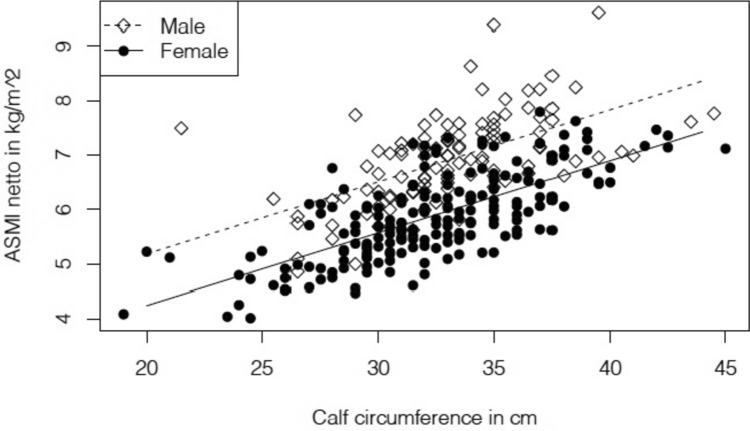
Regression analysis of calf circumference and appendicular skeletal muscle mass index (ASMI). In females (n = 200, circles) and males (n = 105, squares) The corresponding regression equations are for males 2.23 + 0.1324 * calf circumference and for females 1.6 + 0.1324 * calf circumference. R2 = .60, F(302) = 15.5 (p< 0001), and for difference between sex F(302) = − 12.98 (p<0.001)
Fig. 3
Fig. 3
The flowchart illustrates the research process to investigate the relationship between Calf Circumference (CC) and muscle mass in geriatric patients. The study shows a significant correlation and establishes for the first time gender-specific CC cutoffs to improve sarcopenia assessment. ASMI appendicular skeletal muscle mass index, cm centimeter
Fig. 4
Fig. 4
Receiver operating characteristic curves for predicting calf circumference for low appendicular muscle mass index. A In females (n = 200), the optimal cut-off for calf circumference was 31.5 cm (sensitivity 78%, specificity 79%), the area under the curve (AUC) was 0.87 (95% CI: 0.82–0.92). B In males (n = 105) the optimal cut-off was 33.5 cm (sensitivity 71%, specificity 62%) and AUC 0.72 (95% CI: 0.62–0.82)

References

    1. Cruz-Jentoft AJ, Bahat G, Bauer J, et al. Sarcopenia: revised European consensus on definition and diagnosis. Age Ageing. 2019;48:16–31. doi: 10.1093/ageing/afy169. - DOI - PMC - PubMed
    1. Yeung SSY, Reijnierse EM, Pham VK, et al. Sarcopenia and its association with falls and fractures in older adults: A systematic review and meta-analysis. J Cachexia Sarcopenia Muscle. 2019;10:485–500. doi: 10.1002/jcsm.12411. - DOI - PMC - PubMed
    1. Xia L, Zhao R, Wan Q, et al. Sarcopenia and adverse health-related outcomes: an umbrella review of meta-analyses of observational studies. Cancer Med. 2020;92:7964–7978. doi: 10.1002/cam4.3428. - DOI - PMC - PubMed
    1. Chen LK, Woo J, Assantachai P, et al. Asian Working Group for Sarcopenia: 2019 consensus update on sarcopenia diagnosis and treatment. J Am Med Dir Assoc. 2020;21:300–307 e2. doi: 10.1016/j.jamda.2019.12.012. - DOI - PubMed
    1. Bhasin S, Travison TG, Manini TM, et al. Sarcopenia definition: the position statements of the Sarcopenia definition and outcomes consortium. J Am Geriatr Soc. 2020;68:1410–1418. doi: 10.1111/jgs.16372. - DOI - PMC - PubMed