


Effectiveness of digital games promoting young people's mental health: A review of reviews
- PMID: 38323239
- PMCID: PMC10845979
- DOI: 10.1177/20552076231220814
Effectiveness of digital games promoting young people's mental health: A review of reviews
Abstract
Objectives: Digital games are a popular form of entertainment for youth. They are often used as a therapy for psychological problems, a mental health promotion intervention, and a preventative measure. Systematic reviews and meta-analyses have been conducted to assess the effectiveness of mental health-related digital games. However, a synthesis considering all evaluation results to inform their development is missing.
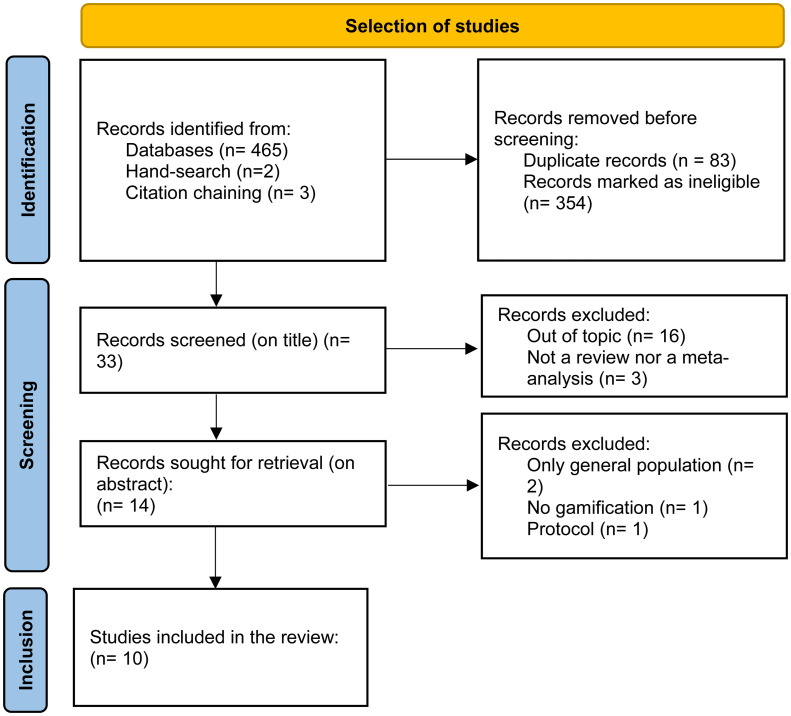
Methods: We performed a review of reviews to synthetize results of previous research to describe the impact of digital games on the mental health of young people aged <30 years old. We considered systematic reviews and meta-analyses published between 2012 and 2022. Searches were conducted in Scopus, Google Scholar, Pubmed, and Cochrane library systematic reviews (CENTRAL) during October 2023.
Results: Our final selection included 10 systematic reviews and meta-analyses on interventions targeting youth of both sexes aged 2-29 years old across the world. In total, 218 interventions were identified. Selected articles reported different types of games, e.g., active and non-active video games, virtual reality games, serious games. Not all digital games were conscientiously evaluated, but, in general, their impact on mental health was positive. Regarding the quality, 5 studies were of high quality, 3 of moderate quality and 2 of low quality.
Conclusions: Overall, elements of gamification were well-accepted, but they lacked assessment through rigorous experimental conditions. Digital games for mental health are promising, but in order to be consistently effective in promoting young people's mental health and prevent psychological diseases, they should present specific features.
Keywords: Digital; game; mental health; review; young.
© The Author(s) 2024.
Conflict of interest statement
The authors declared no potential conflicts of interest with respect to the research, authorship, and/or publication of this article.
Figures
References
-
- World Health Organization. Adolescent mental health, https://www.who.int/news-room/fact-sheets/detail/adolescent-mental-health (2021, accessed 24 April 2023).
-
- Kessler RC, Berglund P, Demler O, et al. Lifetime prevalence and age-of-onset distributions of DSM-IV disorders in the national comorbidity survey replication. Arch Gen Psychiatry 2005; 62: 593. Epub ahead of print 2005. - PubMed
-
- Cerel J, McIntosh JL, Neimeyer RA, et al. The continuum of ‘survivorship’: definitional issues in the aftermath of suicide. Suicide Life Threat Behav 2014; 44: 591–600. Epub ahead of print 2014. - PubMed
Publication types
LinkOut - more resources
Full Text Sources
Medical
