Outbreak of Oropouche virus in frontier regions in western Amazon
- PMID: 38323826
- PMCID: PMC10913433
- DOI: 10.1128/spectrum.01629-23
Outbreak of Oropouche virus in frontier regions in western Amazon
Abstract
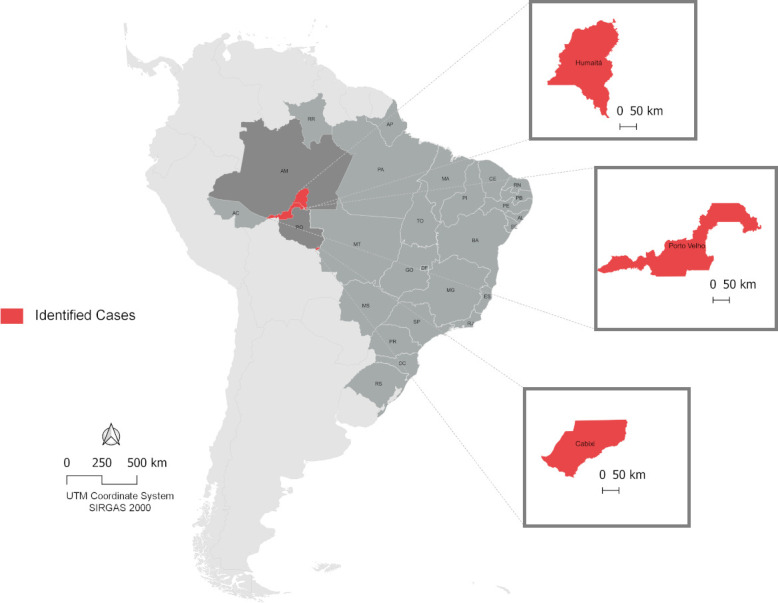
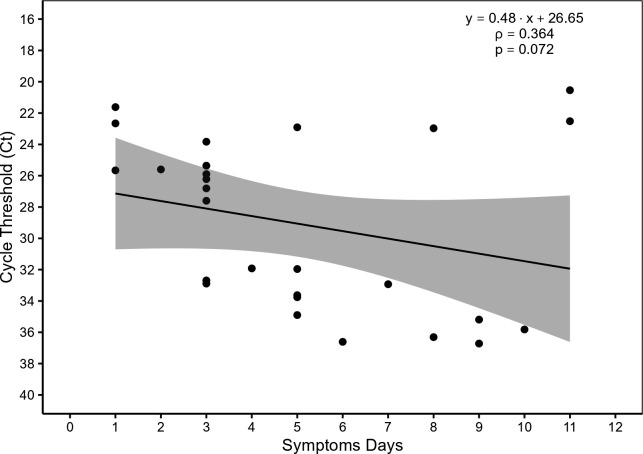
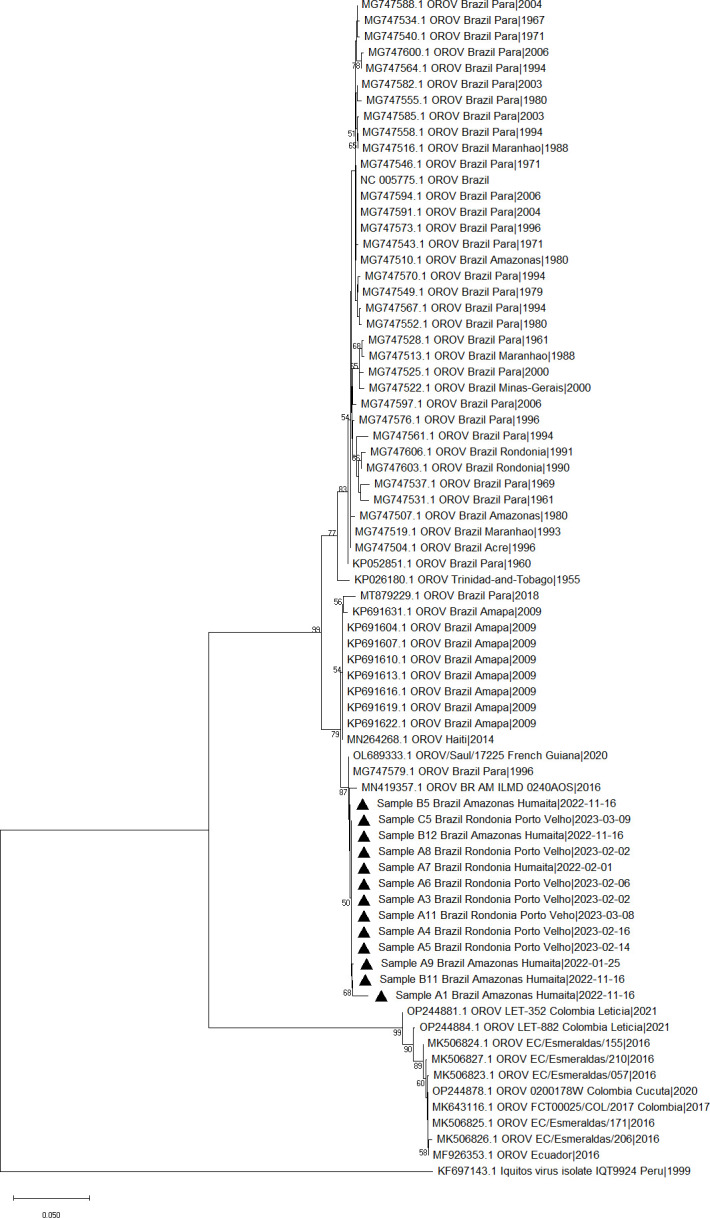
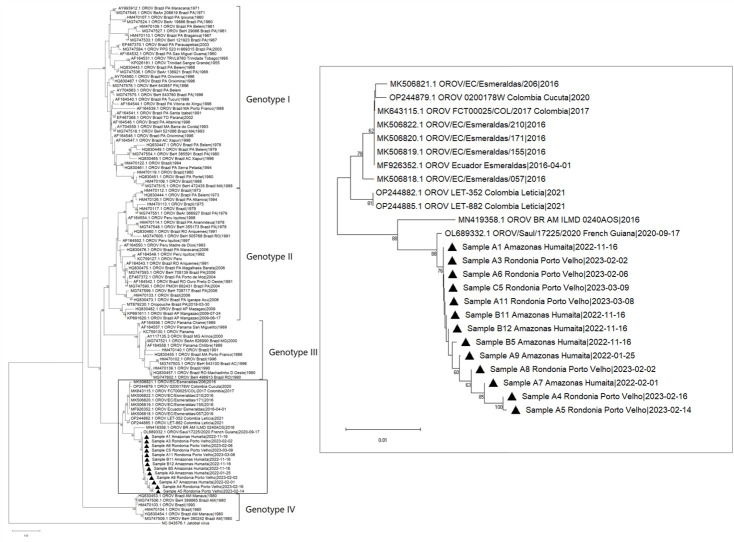
Oropouche virus (OROV) is characterized as a re-emerging arbovirus of great concern for public health, being responsible for several outbreaks of acute fever identified in Latin American countries, registering more than half a million reported cases. The incidence of reports of this virus is intrinsically favored by environmental conditions, in which such characteristics are related to the increase and distribution of the vector population to areas of human traffic. Moreover, there is a problem regarding the lack of diagnosis in Brazil that aggregates the success of the etiologic agent. Thus, by means of molecular techniques, we identified 27 positive cases of the OROV circulating in border locations in western Amazon, with 44.44% (12/27) of the cohort characterized as infected individuals with reported symptoms, mainly ranging from fever, myalgia, and back pain. Among the positive samples, it was possible to obtain a total of 48.14% (13/27) samples to analyze the S and M segments of Oropouche, which showed similarities among the Brazilian sequences. Thus, it was possible to verify the circulation of the OROV in Rondonia and border areas, in which the tracking of neglected arboviruses is necessary for the genomic surveillance of emerging and re-emerging viruses.IMPORTANCEThe western Amazon region is known for outbreaks of acute febrile illnesses, to which the lack of specific diagnostics for different pathogens hinders the management of patients in healthcare units. The Oropouche virus has already been recorded in the region in the 1990s. However, this is the first study, after this record, to perform the detection of individuals with acute febrile illness using a screening test to exclude Zika, dengue, and chikungunya, confirmed by sequencing the circulation of the virus in the state of Rondonia and border areas. We emphasize the importance of including diagnostics for viruses such as Oropouche, which suffers underreporting for years and is related to seasonal periods in Western Amazon locations, a factor that has a direct influence on public health in the region. In addition, we emphasize the importance of genomic surveillance in the elucidation of outbreaks that affect the resident population of these locations.
Keywords: OROV; Oropouche; epidemiology; genomic surveillance; phylogeny.
Conflict of interest statement
The authors declare no conflict of interest.
Figures
References
-
- Current ICTV taxonomy release. ICTV. Available from: https://ictv.global/taxonomy
-
- de Mendonça SF, Rocha MN, Ferreira FV, Leite THJF, Amadou SCG, Sucupira PHF, Marques JT, Ferreira AGA, Moreira LA. 2021. Evaluation of Aedes aegypti, Aedes albopictus, and Culex quinquefasciatus mosquitoes competence to Oropouche virus infection. Viruses 13:755. doi:10.3390/v13050755 - DOI - PMC - PubMed
-
- Schwarz MM, Price DA, Ganaie SS, Feng A, Mishra N, Hoehl RM, Fatma F, Stubbs SH, Whelan SPJ, Cui X, Egawa T, Leung DW, Amarasinghe GK, Hartman AL. 2022. Oropouche orthobunyavirus infection is mediated by the cellular host factor Lrp1. Proc Natl Acad Sci U S A 119:e2204706119. doi:10.1073/pnas.2204706119 - DOI - PMC - PubMed
MeSH terms
Supplementary concepts
Grants and funding
- Process: VPPIS-003-FIO-20-2-67 - INOVA AMAZÔNIA/Fundação para o Desenvolvimento da Ação Científica e Tecnológica e à Pesquisa do Estado de Rondonia
- Process: 35562.558.20485.10082022 - INICIATIVA AMAZÔNIA +10/Fundação para o Desenvolvimento da Ação Científica e Tecnológica e à Pesquisa do Estado de Rondonia
LinkOut - more resources
Full Text Sources
Medical