. 2024 Jan-Dec:21:14799731231221821.
doi: 10.1177/14799731231221821.

Respiratory impairments in patients suffering from Fabry disease - A cross-sectional study

Affiliations

Respiratory impairments in patients suffering from Fabry disease - A cross-sectional study

Huma Ahmed et al. Chron Respir Dis. 2024 Jan-Dec.

Abstract

Background: The inherited X-linked disorder, Fabry disease, is caused by deficient lysosomal enzyme α-galactosidase A, with progressive accumulation of globotriaosylceramide in multiple organs including the upper and lower airways.

Objectives: To assess pulmonary function at the time of the first pulmonary function test (PFT) performed among the National Danish Fabry cohort and define the prevalence of affected lung function variables.

Materials and method: A cross-sectional retrospective cohort study of 86 adult patients enrolled in one or both international patient registry databases for Fabry disease, Fabry Registry or FollowME with at least one PFT. The Mainz Severity Score Index (MSSI) was calculated to determine the disease severity. Lung function variables were examined by multivariate regression adjusted for important variables for developing airway illness.

Results: Seventeen patients (20%) showed obstructive airflow limitation and 7 (8%) a restrictive lung deficiency. Smoking status (p = .016) and MSSI (p < .001) were associated with increasing obstructive airway limitation.

Conclusion: The prevalence of affected lung function among the National Danish Fabry cohort was 28%. Patients with classic gene variants frequently developed a decrease in lung function regardless of their smoking status, with significant relationship with disease severity.

Keywords: Fabry disease; pulmonary function test; pulmonary involvement; respiratory impairment.


Conflict of interest statement

Declaration of conflicting interestsThe author(s) declared no potential conflicts of interest with respect to the research, authorship, and/or publication of this article.

Figures
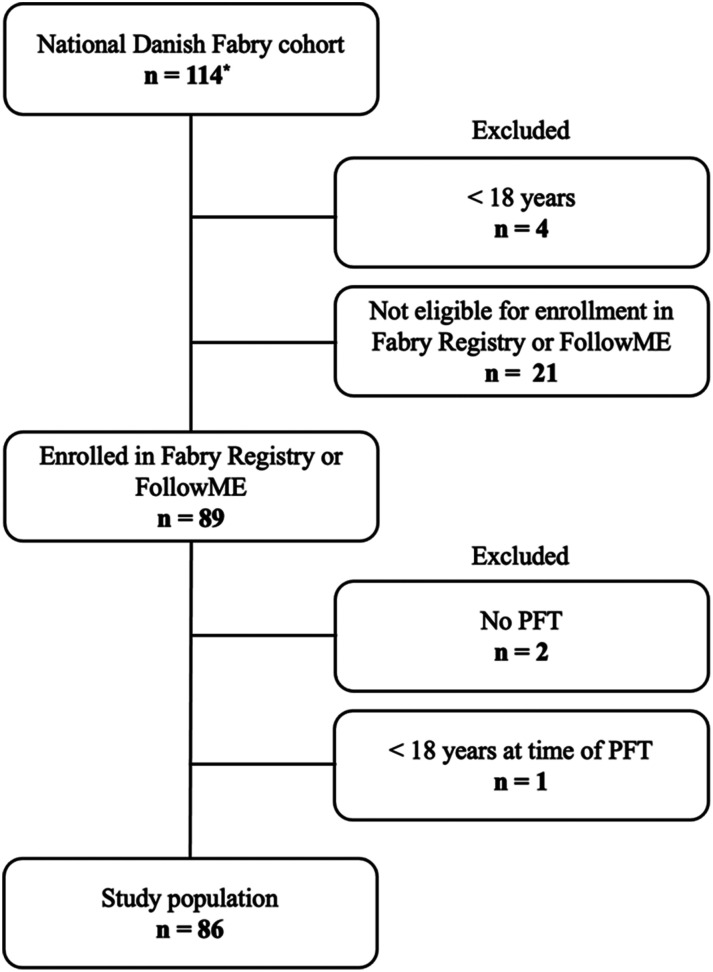
Figure 1.
Figure 1.
Patient flowchart of the National Danish Fabry cohort * includes 16 dead patients; PFT, pulmonary function test.
Figure 2.
Figure 2.
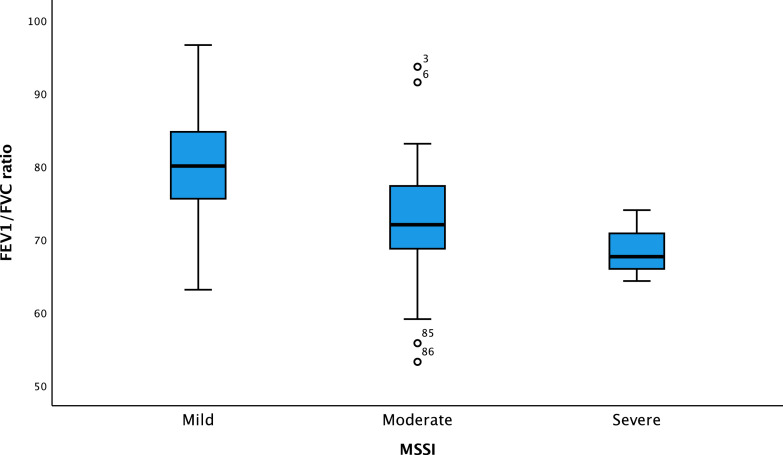
Box plot of the association between MSSI mild, moderate, and severe and FEV1/FVC ratio in the National Danish Fabry cohort. FEV1/FVC ratio: forced expiratory volume in the first-second divided by forced vital capacity; MSSI: Mainz Severity Score Index. ANOVA analysis p < .001.
Figure 3.
Figure 3.
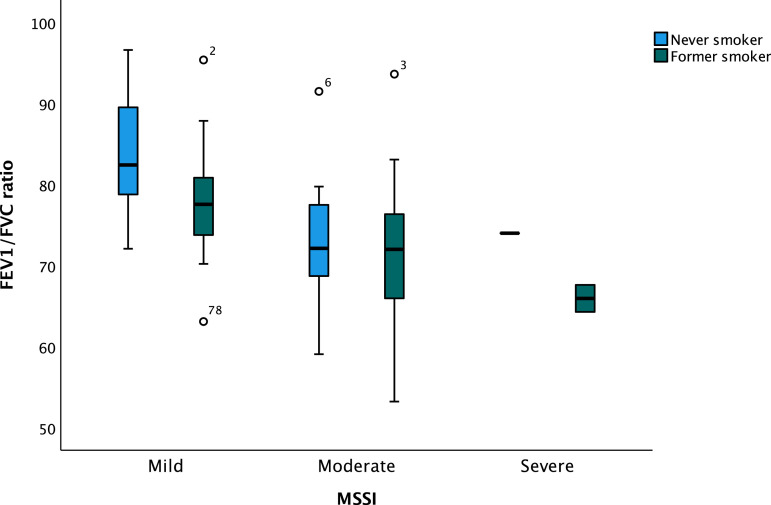
Box plot of the association between MSSI mild, moderate, and severe and FEV1/FVC ratio in never and former smoking patients in the National Danish Fabry cohort. FEV1/FVC ratio: forced expiratory volume in the first-second divided by forced vital capacity; MSSI: Mainz Severity Score Index. ANOVA analysis p < .001 (never smokers) and ANOVA analysis p = .031 (former smokers).
Figure 4.
Figure 4.
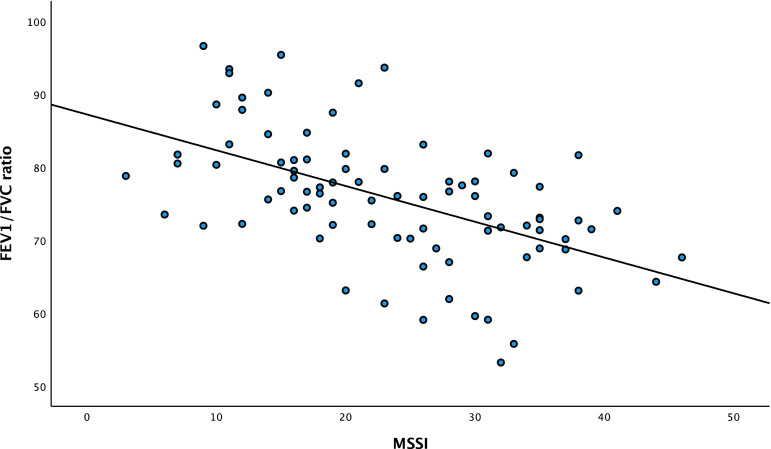
Scatter plot of the association between MSSI and FEV1/FVC ratio in the National Danish Fabry. FEV1/FVC ratio: forced expiratory volume in the first-second divided by forced vital capacity; MSSI: Mainz Severity Score Index. Correlation coefficient of −0.29.
Figure 5.
Figure 5.
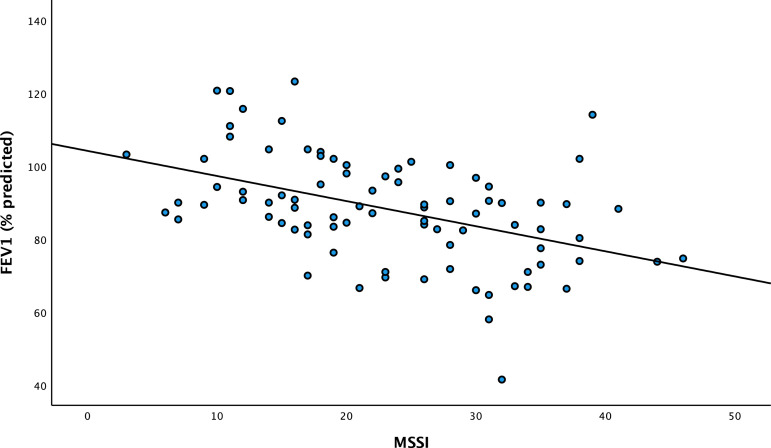
Scatterplot of the association between MSSI on FEV1 (% predicted) in the National Danish Fabry cohort. FEV1: forced expiratory volume in the first-second; MSSI: Mainz Severity Score Index. Correlation coefficient of −0.21.
Figure 6.
Figure 6.
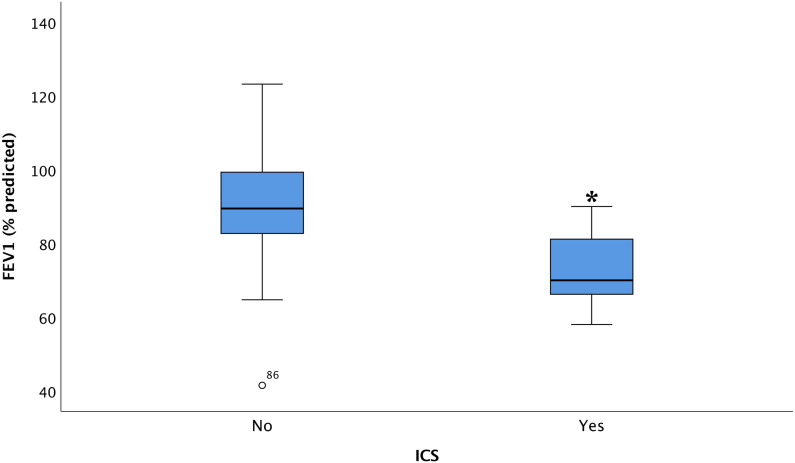
Box plot of the association between ICS and FEV1 (% predicted) in Fabry patients with or without use of ICS. FEV1: forced expiratory volume in the first second; ICS: inhalation corticosteroid. p < .001.

References

    1. Svensson CK, Feldt-Rasmussen U, Backer V. Fabry disease, respiratory symptoms, and airway limitation – a systematic review. Eur Clin Respir J 2015; 2(1): 26721. - PMC - PubMed
    1. Bernardes TP, Foresto RD, Kirsztajn GM. Fabry disease: genetics, pathology, and treatment. Rev Assoc Med Bras 2020; 66(Suppl 1): 10–16. - PubMed
    1. Duning T, Deppe M, Brand E, et al. Brainstem involvement as a cause of central sleep apnea: pattern of microstructural cerebral damage in patients with cerebral microangiopathy. PLoS One 2013; 8(4): e60304. - PMC - PubMed
    1. Franzen D, Haile SR, Kasper DC, et al. Pulmonary involvement in Fabry disease: effect of plasma globotriaosylsphingosine and time to initiation of enzyme replacement therapy. BMJ Open Respir Res 2018; 5(1): e000277–e000279. - PMC - PubMed
    1. Franzen D, Gerard N, Bratton DJ, et al. Prevalence and risk factors of sleep disordered breathing in fabry disease a prospective cohort study. Med (United States) 2015; 94(52): e2413–e2416. - PMC - PubMed

Publication types

Substances

LinkOut - more resources