


Prediction of Sjögren's disease diagnosis using matched electronic dental-health record data
- PMID: 38336735
- PMCID: PMC10854092
- DOI: 10.1186/s12911-024-02448-9
Prediction of Sjögren's disease diagnosis using matched electronic dental-health record data
Abstract
Background: Sjögren's disease (SD) is an autoimmune disease that is difficult to diagnose early due to its wide spectrum of clinical symptoms and overlap with other autoimmune diseases. SD potentially presents through early oral manifestations prior to showing symptoms of clinically significant dry eyes or dry mouth. We examined the feasibility of utilizing a linked electronic dental record (EDR) and electronic health record (EHR) dataset to identify factors that could be used to improve early diagnosis prediction of SD in a matched case-control study population.
Methods: EHR data, including demographics, medical diagnoses, medication history, serological test history, and clinical notes, were retrieved from the Indiana Network for Patient Care database and dental procedure data were retrieved from the Indiana University School of Dentistry EDR. We examined EHR and EDR history in the three years prior to SD diagnosis for SD cases and the corresponding period in matched non-SD controls. Two conditional logistic regression (CLR) models were built using Least Absolute Shrinkage and Selection Operator regression. One used only EHR data and the other used both EHR and EDR data. The ability of these models to predict SD diagnosis was assessed using a concordance index designed for CLR.
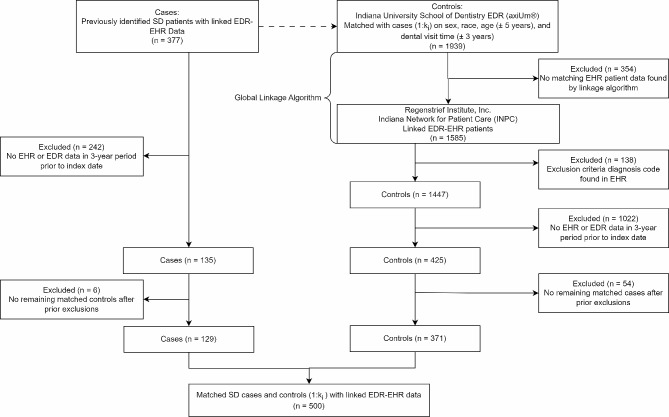
Results: We identified a sample population of 129 cases and 371 controls with linked EDR-EHR data. EHR factors associated with an increased risk of SD diagnosis were the usage of lubricating throat drugs with an odds ratio (OR) of 14.97 (2.70-83.06), dry mouth (OR = 6.19, 2.14-17.89), pain in joints (OR = 2.54, 1.34-4.76), tear film insufficiency (OR = 27.04, 5.37-136.), and rheumatoid factor testing (OR = 6.97, 1.94-25.12). The addition of EDR data slightly improved model concordance compared to the EHR only model (0.834 versus 0.811). Surgical dental procedures (OR = 2.33, 1.14-4.78) were found to be associated with an increased risk of SD diagnosis while dental diagnostic procedures (OR = 0.45, 0.20-1.01) were associated with decreased risk.
Conclusion: Utilizing EDR data alongside EHR data has the potential to improve prediction models for SD. This could improve the early diagnosis of SD, which is beneficial to slowing or preventing complications of SD.
Keywords: Electronic dental records; Electronic health records; Prediction; Sjögren’s disease.
© 2024. The Author(s).
Conflict of interest statement
The authors declare no competing interests.
Figures
References
-
- Psianou K, Panagoulias I, Papanastasiou AD, de Lastic AL, Rodi M, Spantidea PI, et al. Clinical and immunological parameters of Sjögren’s syndrome. Autoimmun Rev. 2018;17(10):1053–64. - PubMed
-
- Brito-Zerón P, Acar-Denizli N, Zeher M, Rasmussen A, Seror R, Theander E, et al. Influence of geolocation and ethnicity on the phenotypic expression of primary Sjögren’s syndrome at diagnosis in 8310 patients: a cross-sectional study from the Big Data Sjögren Project Consortium. Ann Rheum Dis. 2017;76(6):1042–50. - PubMed
-
- Brito-Zerón P, Acar-Denizli N, Ng WF, Horváth IF, Rasmussen A, Seror R, et al. Epidemiological profile and north–south gradient driving baseline systemic involvement of primary Sjögren’s syndrome. Rheumatology. 2020;59(9):2350–9. - PubMed
-
- Vivino FB, Bunya VY, Massaro-Giordano G, Johr CR, Giattino SL, Schorpion A, et al. Sjogren’s syndrome: an update on disease pathogenesis, clinical manifestations and treatment. Clin Immunol. 2019;203:81–121. - PubMed
-
- Kassan SS, Moutsopoulos HM. Clinical manifestations and early diagnosis of Sjögren Syndrome. Arch Intern Med. 2004;164(12):1275. - PubMed
MeSH terms
Grants and funding
LinkOut - more resources
Full Text Sources
Medical
