


Antiviral and Antibacterial 3D-Printed Products Functionalised with Poly(hexamethylene biguanide)
- PMID: 38337200
- PMCID: PMC10856986
- DOI: 10.3390/polym16030312
Antiviral and Antibacterial 3D-Printed Products Functionalised with Poly(hexamethylene biguanide)
Abstract
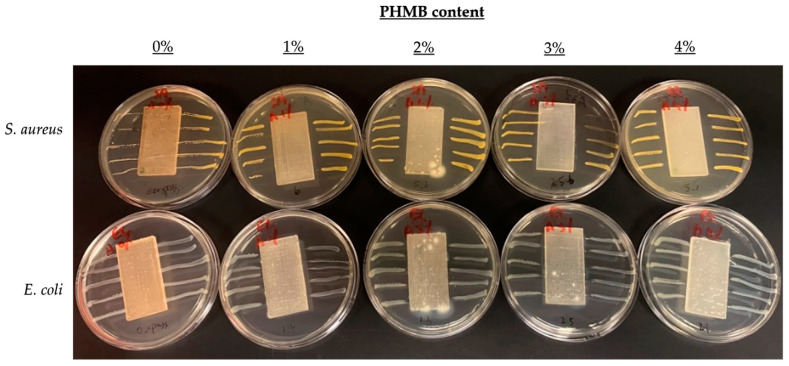
Infection prevention and public health are a vital concern worldwide, especially during pandemics such as COVID-19 and seasonal influenza. Frequent manual disinfection and use of chemical spray coatings at public facilities are the typical measures taken to protect people from coronaviruses and other pathogens. However, limitations of human resources and coating durability, as well as the safety of disinfectants used are the major concerns in society during a pandemic. Non-leachable antimicrobial agent poly(hexamethylene biguanide) (PHMB) was mixed into photocurable liquid resins to produce novel and tailor-made covers for public facilities via digital light processing, which is a popular 3D printing technique for satisfactory printing resolution. Potent efficacies of the 3D-printed plastics were achieved in standard antibacterial assessments against S. aureus, E. coli and K. pneumoniae. A total of 99.9% of Human coronavirus 229E was killed after being in contact with the 3D-printed samples (containing the promising PHMB formulation) for two hours. In an eight-week field test in Hong Kong Wetland Park, antibacterial performances of the specially designed 3D-printed covers analysed by environmental swabbing were also found to be satisfactory. With these remarkable outcomes, antimicrobial products prepared by digital light processing 3D printing can be regarded as a reliable solution to long-term infection prevention and control.
Keywords: 3D-printed plastics; additive manufacturing; antibacterial; antiviral; digital light processing; poly(hexamethylene biguanide).
Conflict of interest statement
Anson M.Y. Luk, Ki Law, Tsz Long Lau, and Matthew Hui were employed by Immune Materials Limited. The remaining authors declare that the research was conducted in the absence of any commercial or financial relationships that could be construed as a potential conflict of interest.
Figures




References
-
- Otter J.A., Yezli S., Salkeld J.A., French G.L. Evidence that contaminated surfaces contribute to the transmission of hospital pathogens and an overview of strategies to address contaminated surfaces in hospital settings. Am. J. Infect. Control. 2013;41:S6–S11. doi: 10.1016/j.ajic.2012.12.004. - DOI - PubMed
-
- Weber D.J., Rutala W.A., Anderson D.J., Chen L.F., Sickbert-Bennett E.E., Boyce J.M. Effectiveness of ultraviolet devices and hydrogen peroxide systems for terminal room decontamination: Focus on clinical trials. Am. J. Infect. Control. 2016;44:e77–e84. doi: 10.1016/j.ajic.2015.11.015. - DOI - PMC - PubMed
-
- Van Doremalen N., Bushmaker T., Morris D.H., Holbrook M.G., Gamble A., Williamson B.N., Tamin A., Harcourt J.L., Thornburg N.J., Gerber S.I., et al. Aerosol and Surface Stability of SARS-CoV-2 as Compared with SARS-CoV-1. N. Engl. J. Med. 2020;382:1564–1567. doi: 10.1056/NEJMc2004973. - DOI - PMC - PubMed
Grants and funding
LinkOut - more resources
Full Text Sources
Molecular Biology Databases
