


The Association between Obesity and Reduced Weight-Adjusted Bone Mineral Content in Older Adults: A New Paradigm That Contrasts with the Obesity Paradox
- PMID: 38337637
- PMCID: PMC10857150
- DOI: 10.3390/nu16030352
The Association between Obesity and Reduced Weight-Adjusted Bone Mineral Content in Older Adults: A New Paradigm That Contrasts with the Obesity Paradox
Abstract
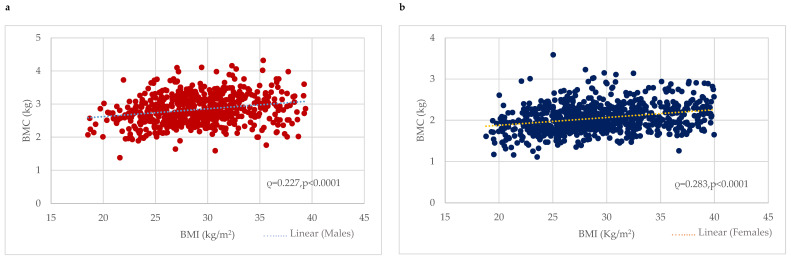
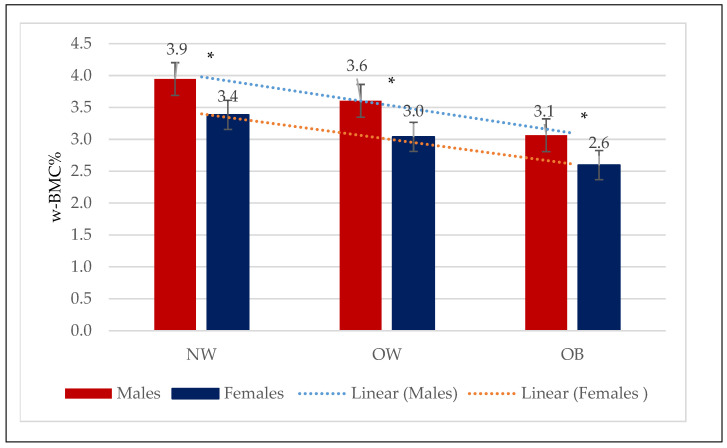
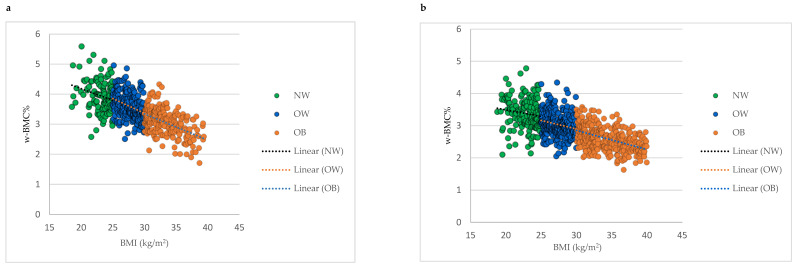
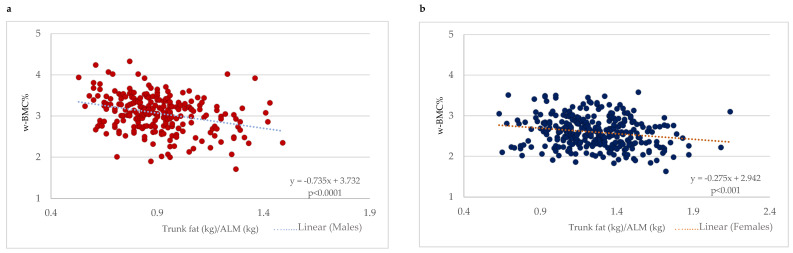
The relationship between body weight and bone mass in the elderly remains unclear, and whether obesity is a protective factor is still a matter of debate. For this reason, the aim of this study is to assess the association between body mass index (BMI) and bone mineral content adjusted by body weight, expressed as a percentage (w-BMC%), and to test the validity of the obesity paradox in this context. A cohort of 1404 older adults was categorized according to the World Health Organization's BMI cut-off points and completed a total and segmental body composition measurement by means of a dual X-ray absorptiometry scan. Individuals with obesity displayed a lower mean w-BMC% (3.06 ± 0.44%; 2.60 ± 0.37%) compared to those who were normal-weight (3.95 ± 0.54%; 3.38 ± 0.48%) and overweight (3.06 ± 0.44%; 3.04 ± 0.37%) in both genders. Linear regression analysis also showed a negative association between BMI and w-BMC% in males (β = -0.09; p < 0.001) and females (β = -0.06; p < 0.001). Finally, among individuals with obesity, and after adjusting for age, the linear regression models revealed a significant decrease of 0.75% and 0.28% in w-BMC% for every one-unit increase in the trunk fat/appendicular lean mass ratio in both males (β = -0.749; p < 0.0001) and females (β = -0.281; p < 0.001). In conclusion, we suggest a new paradigm regarding the impact of obesity on bone mass, in which the former does not appear to be a protective factor of the latter, especially in individuals with central obesity and low muscle mass.
Keywords: appendicular lean mass; bone mineral content; obesity; older adults; trunk fat.
Conflict of interest statement
The authors declare no conflicts of interest.
Figures
References
-
- Lifshitz F., Lifshitz J.Z. Globesity: The root causes of the obesity epidemic in the USA and now worldwide. Pediatr. Endocrinol. Rev. 2014;12:17–34. - PubMed
MeSH terms
Substances
LinkOut - more resources
Full Text Sources
Medical
