


Degradation Product-Promoted Depolymerization Strategy for Chemical Recycling of Poly(bisphenol A carbonate)
- PMID: 38338384
- PMCID: PMC10856637
- DOI: 10.3390/molecules29030640
Degradation Product-Promoted Depolymerization Strategy for Chemical Recycling of Poly(bisphenol A carbonate)
Abstract
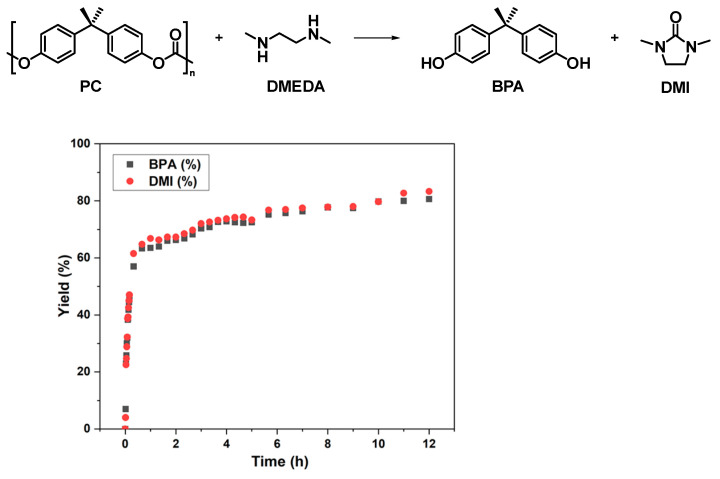
The accumulation of waste plastics has a severe impact on the environment, and therefore, the development of efficient chemical recycling methods has become an extremely important task. In this regard, a new strategy of degradation product-promoted depolymerization process was proposed. Using N,N'-dimethyl-ethylenediamine (DMEDA) as a depolymerization reagent, an efficient chemical recycling of poly(bisphenol A carbonate) (BPA-PC or PC) material was achieved under mild conditions. The degradation product 1,3-dimethyl-2-imidazolidinone (DMI) was proven to be a critical factor in facilitating the depolymerization process. This strategy does not require catalysts or auxiliary solvents, making it a truly green process. This method improves the recycling efficiency of PC and promotes the development of plastic reutilization.
Keywords: PC; bisphenol A; chemical recycling; depolymerization; plastic wastes.
Conflict of interest statement
The authors declare no conflicts of interest.
Figures


References
-
- Potter H.V. Plastics and some recent applications. Nature. 1939;143:785–787. doi: 10.1038/143785a0. - DOI
-
- Bergmann M., Collard F., Fabres J., Gabrielsen G.W., Provencher J.F., Rochman C.M., Sebille E., Tekman M.B. Plastic pollution in the arctic. Nat. Rev. Earth Environ. 2022;3:323–337. doi: 10.1038/s43017-022-00279-8. - DOI
-
- Zhao X., Korey M., Li K., Copenhaver K., Tekinalp H., Celik S., Kalaitzidou K., Ruan R., Ragauskas A.J., Ozcan S. Plastic waste upcycling toward a circular economy. Chem. Eng. J. 2022;428:131928. doi: 10.1016/j.cej.2021.131928. - DOI
LinkOut - more resources
Full Text Sources
