


Volatilome, Microbial, and Sensory Profiles of Coffee Leaf and Coffee Leaf-Toasted Maté Kombuchas
- PMID: 38338619
- PMCID: PMC10855110
- DOI: 10.3390/foods13030484
Volatilome, Microbial, and Sensory Profiles of Coffee Leaf and Coffee Leaf-Toasted Maté Kombuchas
Abstract
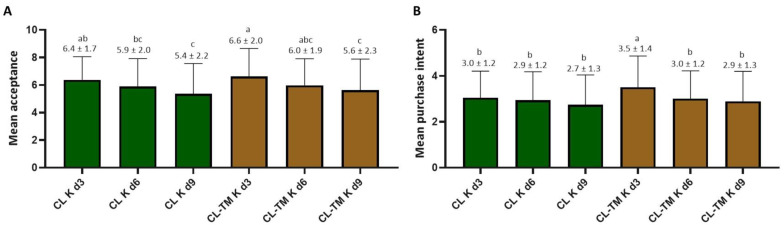
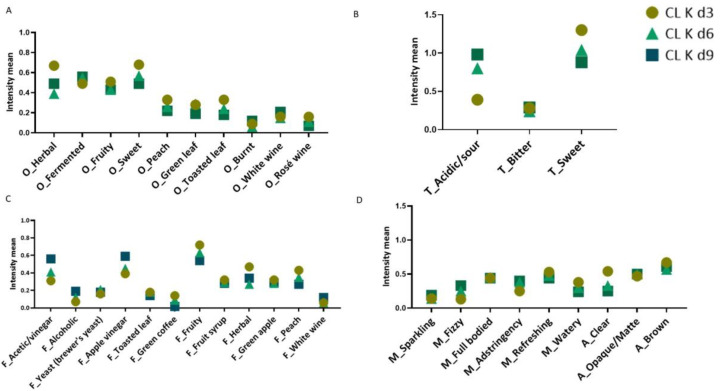
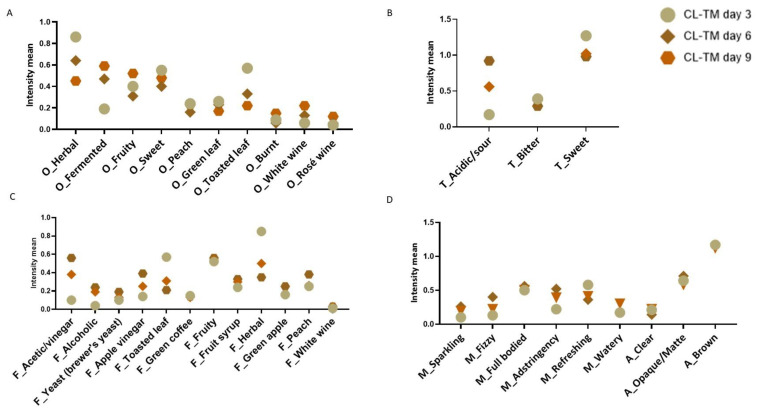
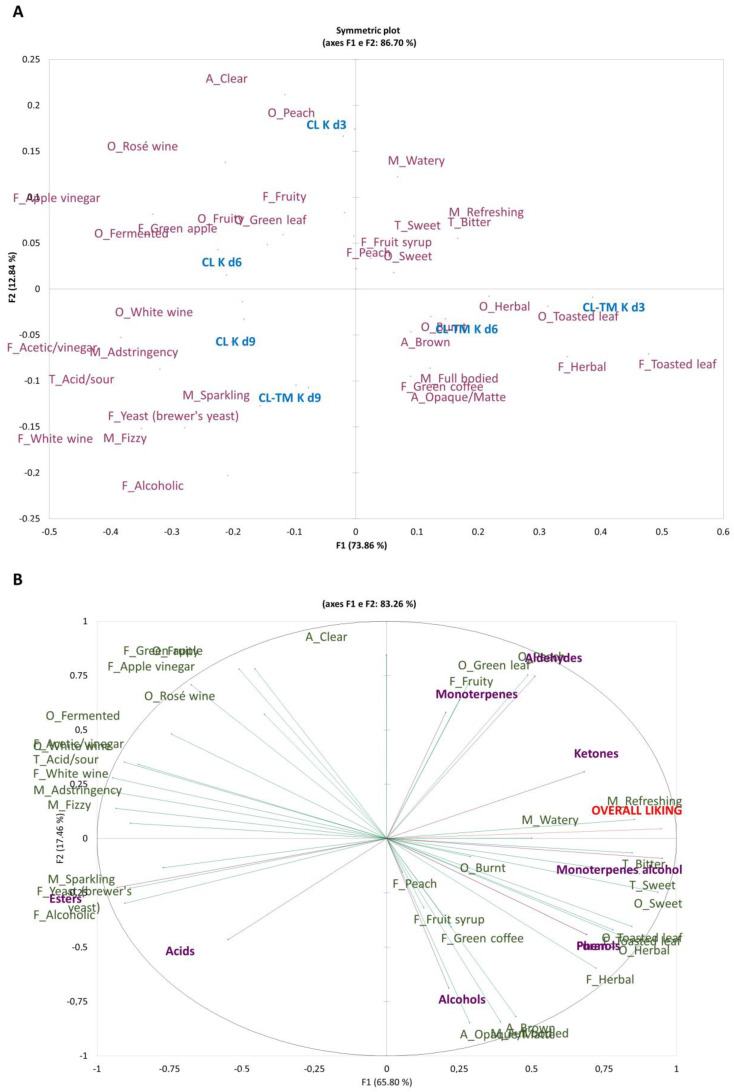
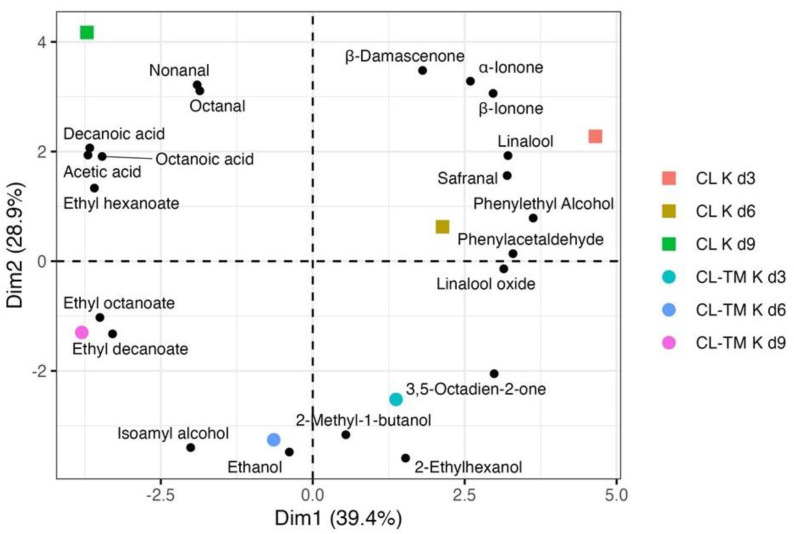
Kombucha is a fermented beverage traditionally made from the leaves of Camelia sinensis. The market has drastically expanded recently, and the beverage has become more elaborated with new, healthy food materials and flavors. Pruning and harvesting during coffee production may generate tons of coffee leaves that are discarded although they contain substantial amounts of bioactive compounds, including those found in maté tea and coffee seeds. This study characterized the changes in volatilome, microbial, and sensory profiles of pure and blended arabica coffee leaf tea kombuchas between 3-9 days of fermentation. Acceptance was also evaluated by consumers from Rio de Janeiro (n = 103). Kombuchas (K) were prepared using black tea kombucha starter (BTKS) (10%), sucrose (10%), a symbiotic culture of Bacteria and Yeasts (SCOBY) (2.5%), and a pure coffee leaf infusion (CL) or a 50:50 blend with toasted maté infusion (CL-TM) at 2.5%. The RATA test was chosen for sensory profile characterization. One hundred volatile organic compounds were identified when all infusions and kombucha samples were considered. The potential impact compounds identified in CL K and CL-TM K were: methyl salicylate, benzaldehyde, hexanal, nonanal, pentadecanal, phenylethyl-alcohol, cedrol, 3,5-octadien-2-one, β-damascenone, α-ionone, β-ionone, acetic acid, caproic acid, octanoic acid, nonanoic acid, decanoic acid, isovaleric acid, linalool, (S)-dihydroactinidiolide, isoamyl alcohol, ethyl hexanoate, and geranyl acetone. Aroma and flavor descriptors with higher intensities in CL K included fruity, peach, sweet, and herbal, while CL-TM K included additional toasted mate notes. The highest mean acceptance score was given to CL-TM K and CL K on day 3 (6.6 and 6.4, respectively, on a nine-point scale). Arabica coffee leaf can be a co-product with similar fingerprinting to maté and black tea, which can be explored for the elaboration of potentially healthy fermented beverages in food industries.
Keywords: Rate-All-That-Apply; coffee by-product; coffee leaf; coffee production waste; fermented beverages; novel foods; toasted maté tea; volatile compounds; yerba mate.
Conflict of interest statement
The authors declare no conflicts of interest.
Figures
References
-
- Food and Agriculture Organization of the United Nations Sustainable Food and Agriculture. [(accessed on 12 September 2023)]. Available online: https://www.fao.org/sustainability/background/en/
-
- Farah A. Coffee By-Products for Sustainable Health Promotion. Proceedings. 2023;89:20.
-
- International Coffee Organization Coffee Report and Outlook. [(accessed on 17 November 2023)]. Available online: https://icocoffee.org/documents/cy2022-23/Coffee_Report_and_Outlook_Apri....
-
- Food and Agriculture Organization of the United Nations Markets and Trade. Coffee. [(accessed on 12 September 2023)]. Available online: https://www.fao.org/markets-and-trade/commodities/coffee/en/
-
- Matiello J.B., Almeida S.R., Rosa G.N., Filho S.L., Aguiar E.C., Araújo R.A., Josino V. Quantificação do processo de reciclagem de folhas em cafezais; Proceedings of the 36 Congresso Brasileiro de Pesquisas Cafeeiras; Guarapari, Brasil. 26–27 October 2010; Varginha, Brasil: Fundação Procafé; 2010. pp. 46–47.
Grants and funding
LinkOut - more resources
Full Text Sources
