


Adverse Childhood Experiences and the Risk of Multiple Sclerosis Development: A Review of Potential Mechanisms
- PMID: 38338799
- PMCID: PMC10855716
- DOI: 10.3390/ijms25031520
Adverse Childhood Experiences and the Risk of Multiple Sclerosis Development: A Review of Potential Mechanisms
Abstract
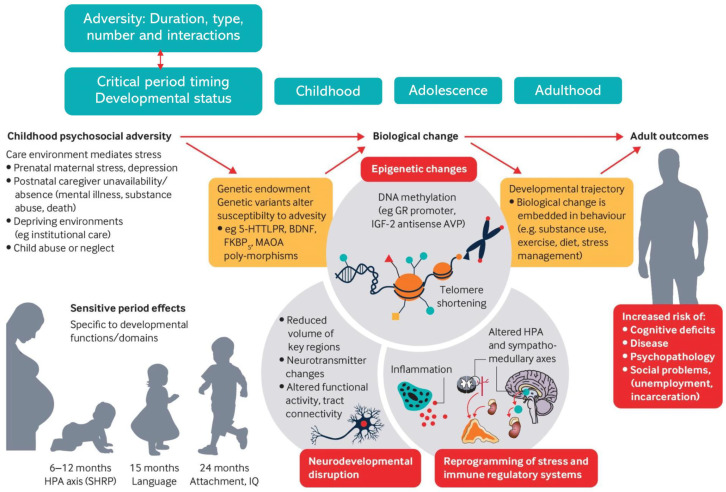
Adverse childhood experiences (ACEs), such as abuse, neglect, and household dysfunction, contribute to long-term systemic toxic stress and inflammation that may last well into adulthood. Such early-life stressors have been associated with increased susceptibility to multiple sclerosis (MS) in observational studies and with the development of experimental autoimmune encephalomyelitis in animal models. In this review, we summarize the evidence for an ACE-mediated increase in MS risk, as well as the potential mechanisms for this association. ACEs dysregulate neurodevelopment, stress responses, and immune reactivity; they also alter the interplay between the immune system and neural networks. All of this may be relevant for MS risk. We further discuss how ACEs induce epigenetic changes and how the toxic stress caused by ACEs may reactivate the Epstein-Barr Virus (EBV), a key risk factor for MS. We conclude by suggesting new initiatives to obtain further insights into this topic.
Keywords: MS; abuse; childhood; early; stress; trauma; violence.
Conflict of interest statement
Eid, K. has received unrestricted research grant and speaker honoraria from Novartis. Bjørk, M-H. has received speaker honoraria and/or served on scientific advisory boards for Teva, Eisai, AbbVie, Pfizer, Novartis, Lundbeck, Angelini Pharma, Jazz pharmaceuticals, and Lilly during the last five years, some of which are marked authorization holders of MS drugs. Gilhus, N. has received honoraria from UCB, Argevix, Janssen, Roche, Merck, Alexion, Immunsvant, Huma, Denka, Dianthos, and Grifols for work outside this topic. Torkildsen, Ø. has received speaker honoraria from and/or served on scientific advisory boards for Biogen, Roche, Teva, Sanofi-Aventis, Merck, and Novartis.
Figures
References
-
- Bjornevik K., Bjornevik K., Cortese M., Cortese M., Healy B.C., Healy B.C., Kuhle J., Kuhle J., Mina M.J., Mina M.J., et al. Longitudinal analysis reveals high prevalence of Epstein-Barr virus associated with multiple sclerosis. Science. 2022;375:296–301. doi: 10.1126/science.abj8222. - DOI - PubMed
-
- Xu Y., Hiyoshi A., Smith K.A., Piehl F., Olsson T., Fall K., Montgomery S. Association of Infectious Mononucleosis in Childhood and Adolescence With Risk for a Subsequent Multiple Sclerosis Diagnosis Among Siblings. JAMA Netw. Open. 2021;4:e2124932. doi: 10.1001/jamanetworkopen.2021.24932. - DOI - PMC - PubMed
-
- Loosen S.H., Doege C., Meuth S.G., Luedde T., Kostev K., Roderburg C. Infectious mononucleosis is associated with an increased incidence of multiple sclerosis: Results from a cohort study of 32,116 outpatients in Germany. Front. Immunol. 2022;13:937583. doi: 10.3389/fimmu.2022.937583. - DOI - PMC - PubMed
Publication types
MeSH terms
Grants and funding
LinkOut - more resources
Full Text Sources
Medical
Miscellaneous
