Review
. 2024 Jan 31;16(3):612.
doi: 10.3390/cancers16030612.

Social and Biological Determinants in Lung Cancer Disparity

Affiliations
Review

Social and Biological Determinants in Lung Cancer Disparity

Briana A Brock et al. Cancers (Basel). .

Abstract

Lung cancer remains a leading cause of death in the United States and globally, despite progress in treatment and screening efforts. While mortality rates have decreased in recent years, long-term survival of patients with lung cancer continues to be a challenge. Notably, African American (AA) men experience significant disparities in lung cancer compared to European Americans (EA) in terms of incidence, treatment, and survival. Previous studies have explored factors such as smoking patterns and complex social determinants, including socioeconomic status, personal beliefs, and systemic racism, indicating their role in these disparities. In addition to social factors, emerging evidence points to variations in tumor biology, immunity, and comorbid conditions contributing to racial disparities in this disease. This review emphasizes differences in smoking patterns, screening, and early detection and the intricate interplay of social, biological, and environmental conditions that make African Americans more susceptible to developing lung cancer and experiencing poorer outcomes.

Keywords: African Americans; disparity; immunity; lung cancer; socioeconomic status.


Conflict of interest statement

The authors declare no conflicts of interest.

Figures
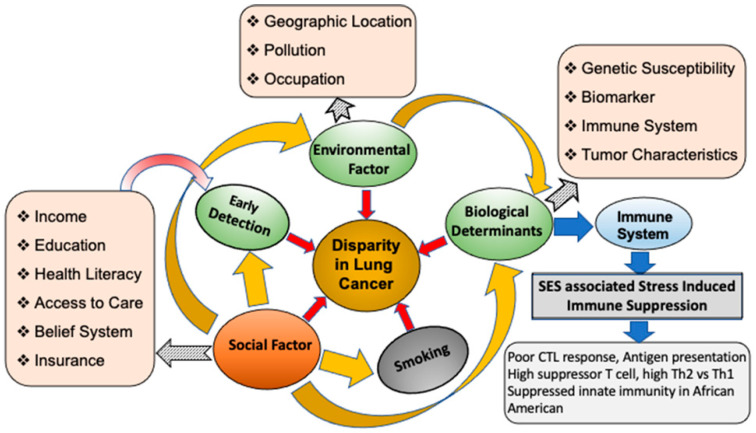
Figure 1
Figure 1
Social and biological determinants of lung cancer. The diagram shows an association of social factors such as income, education, health literacy, access to care, belief system, and insurance status with racial differences in lung cancer incidence and outcome. Low socioeconomic status negatively impacts education, income, health awareness, and access to insurance, leading to lower screening rates, unhealthy geographical location, forced choice of occupation, and frequent proneness to exposure to hazards. Low SES also induces chronic stress, impacting the biology of lung cancer and favoring an immunosuppressive environment in African Americans.

References

    1. Siegel R.L., Miller K.D., Wagle N.S., Jemal A. Cancer statistics, 2023. CA Cancer J. Clin. 2023;73:17–48. doi: 10.3322/caac.21763. - DOI - PubMed
    1. Miller K.D., Nogueira L., Devasia T., Mariotto A.B., Yabroff K.R., Jemal A., Kramer J., Siegel R.L. Cancer treatment and survivorship statistics, 2022. CA A Cancer J. Clin. 2022;72:409–436. doi: 10.3322/caac.21731. - DOI - PubMed
    1. Lawrence W.R., McGee-Avila J.K., Vo J.B., Luo Q., Chen Y., Inoue-Choi M., Berrington de González A., Freedman N.D., Shiels M.S. Trends in Cancer Mortality Among Black Individuals in the US From 1999 to 2019. JAMA Oncol. 2022;8:1184–1189. doi: 10.1001/jamaoncol.2022.1472. - DOI - PMC - PubMed
    1. Dubin S., Griffin D. Lung Cancer in Non-Smokers. Mo. Med. 2020;117:375–379. - PMC - PubMed
    1. Scagliotti G.V., Longo M., Novello S. Nonsmall cell lung cancer in never smokers. Curr. Opin. Oncol. 2009;21:99–104. doi: 10.1097/CCO.0b013e328321049e. - DOI - PubMed

LinkOut - more resources
