


Recurrence and Survival Following Cytoreductive Surgery and Hyperthermic Intraperitoneal Chemotherapy for Synchronous and Metachronous Peritoneal Metastases of Colorectal Origin
- PMID: 38339382
- PMCID: PMC10854638
- DOI: 10.3390/cancers16030631
Recurrence and Survival Following Cytoreductive Surgery and Hyperthermic Intraperitoneal Chemotherapy for Synchronous and Metachronous Peritoneal Metastases of Colorectal Origin
Abstract
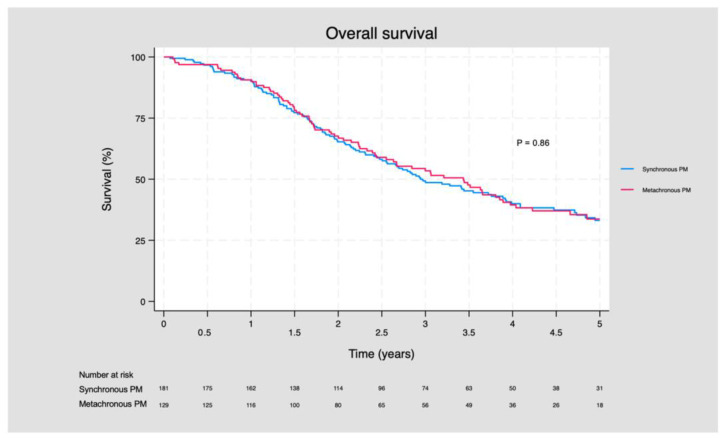
Cytoreductive surgery (CRS) with hyperthermic intraperitoneal chemotherapy (HIPEC) has improved the 5-year survival for colorectal cancer (CRC) patients with peritoneal metastases (PM). Little is known about recurrence patterns and recurrence rates between synchronous (S) and metachronous (M) PM following CRS+HIPEC. We aimed to describe the recurrence patterns, overall survival (OS) and disease-free survival (DFS) in S-PM and M-PM patients after complete CRS+HIPEC. From June 2006 to December 2020, a prospective cohort study included 310 CRC patients, where 181 patients had S-PM (58.4%) and 129 patients had M-PM (41.6%). After a median 10.3-month follow-up, 247/310 (79.7%) patients experienced recurrence, and recurrence sites included isolated peritoneal (32.4%), multifocal (peritoneal and liver and/or lung(s)) (22.7%), isolated liver (17.8%), isolated lung (10.5%) and other (16.6%) sites. Recurrence patterns did not differ between S-PM and M-PM. M-PM patients had an impaired DFS compared to S-PM patients (9.4 months (95% CI: 7.3-12.1) vs. 12.5 months (95% CI: 11.2-13.9), p = 0.01). The median OS was similar for S-PM and M-PM (38.4 months (95% CI: 31.2-46.8) vs. 40.8 months (95% CI: 28.8-46.8), p = 0.86). Despite frequent recurrence at extraperitoneal locations, long-term survival was achievable after CRS+HIPEC in CRC patients with PM. The recurrence patterns and OS did not differ between groups, yet M-PM patients had a shorter DFS.
Keywords: colorectal cancer; cytoreductive surgery; hyperthermic intraperitoneal chemotherapy; metachronous peritoneal metastases; prognosis; recurrence; synchronous peritoneal metastases.
Conflict of interest statement
The authors declare no conflicts of interest.
Figures


References
-
- Danish Colorectal Cancer Database (DCCG) Landsdaekkende Database for Kraeft i Tyk-Og Endetarm. [(accessed on 29 January 2023)]. Available online: https://dccg.dk/ (In Danish)
-
- Majano S.B., Girolamo C.D., Rachet B., Maringe C., Guren M.G., Glimelius B., Iversen L.H., Schnell E.A., Lundqvist K., Christensen J., et al. Surgical Treatment and Survival from Colorectal Cancer in Denmark, England, Norway, and Sweden: A Population-Based Study. Lancet Oncol. 2019;20:74–87. doi: 10.1016/S1470-2045(18)30646-6. - DOI - PMC - PubMed
-
- Lurvink R.J., Bakkers C., Rijken A., van Erning F.N., Nienhuijs S.W., Burger J.W., Creemers G.J., Verhoef C., Lemmens V.E., Hingh I.H.D. Increase in the Incidence of Synchronous and Metachronous Peritoneal Metastases in Patients with Colorectal Cancer: A Nationwide Study: Colorectal PM: Incidence & Associated Factors. Eur. J. Surg. Oncol. 2021;47:1026–1033. doi: 10.1016/j.ejso.2020.11.135. - DOI - PubMed
LinkOut - more resources
Full Text Sources
