. 2024 Apr;60(2):148-158.
doi: 10.1007/s11262-024-02054-x. Epub 2024 Feb 10.

Guinea pig herpes like virus is a gamma herpesvirus

Affiliations

Guinea pig herpes like virus is a gamma herpesvirus

Brent A Stanfield et al. Virus Genes. 2024 Apr.

Abstract

Guinea Pig Herpes-Like Virus (GPHLV) is a virus isolated from leukemic guinea pigs with herpes virus-like morphology described by Hsiung and Kaplow in 1969. GPHLV transformed embryonic cells from Syrian hamsters or rats, which were tumorigenic in adult animals. Herein, we present the genomic sequence of GPHLV strain LK40 as a reference for future molecular analysis. GPHLV has a broad host tropism and replicates efficiently in Guinea pig, Cat, and Green African Monkey-derived cell lines. GPHLV has a GC content of 35.45%. The genome is predicted to encode at least 75 open-reading frames (ORFs) with 84% (63 ORFs) sharing homology to human Kaposi Sarcoma Associated Herpes Virus (KSHV). Importantly, GPHLV encodes homologues of the KSHV oncogenes, vBCL2 (ORF16), vPK (ORF36), viral cyclin (v-cyclin, ORF72), the latency associated nuclear antigen (LANA, ORF73), and vGPCR (ORF74). GPHLV is a Rhadinovirus of Cavia porcellus, and we propose the formal name of Caviid gamma herpesvirus 1 (CaGHV-1). GPHLV can be a novel small animal model of Rhadinovirus pathogenesis with broad host tropism.

Keywords: Rhadinovirus; GPHLV; Gammaherpesvirus; Genome; Guinea pig; Guinea pig herpes-like virus.


Conflict of interest statement

The authors declare no competing interests.

Figures
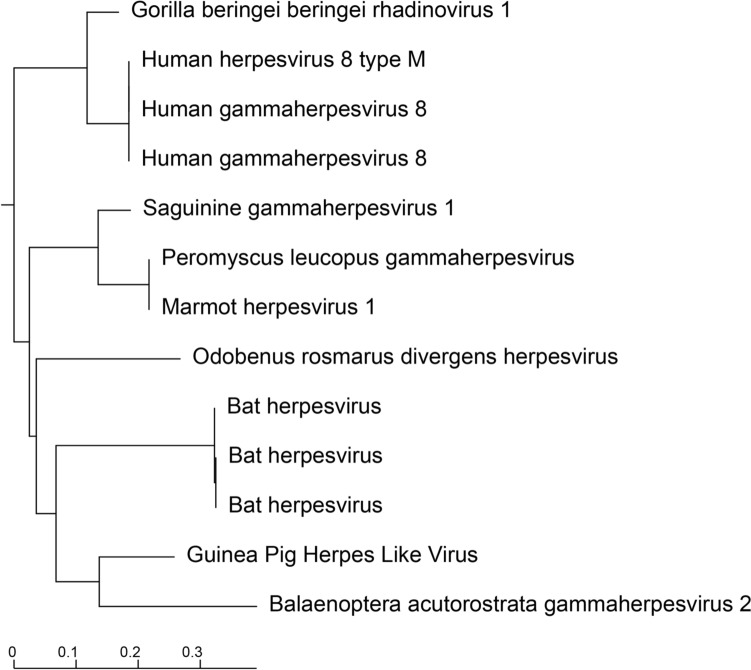
Fig. 1
Fig. 1
Phylogenetic Analysis of the Translated Nested Pan Herpesvirus PCR Product. The translated Nested PCR product clusters phylogenetically with other viruses in the gammaherpesvirinae Subfamily of herpesviruses. Rendered from NCBI BLASTp results using the Newick Display tool
Fig. 2
Fig. 2
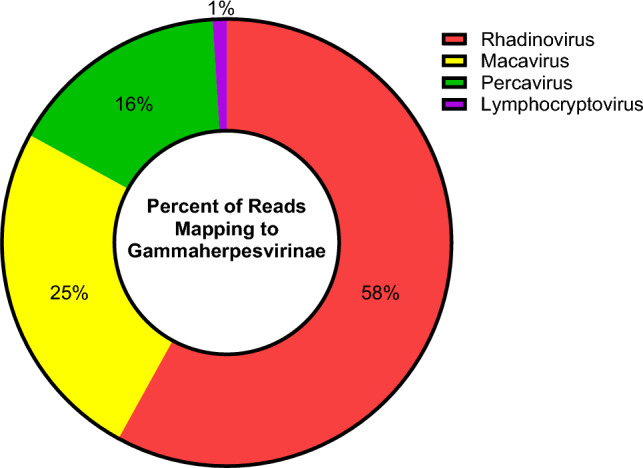
Taxonomic Classification of GPHLV. Raw paired end FASTQ reads were submitted to the BV-BRC Taxonomic Classification Tool. Of the parent classifications 99% of the reads mapped to the gammaherpesvirinae subfamily of herpesviruses with 58% of reads identified as belonging to Rhadinoviruses
Fig. 3
Fig. 3
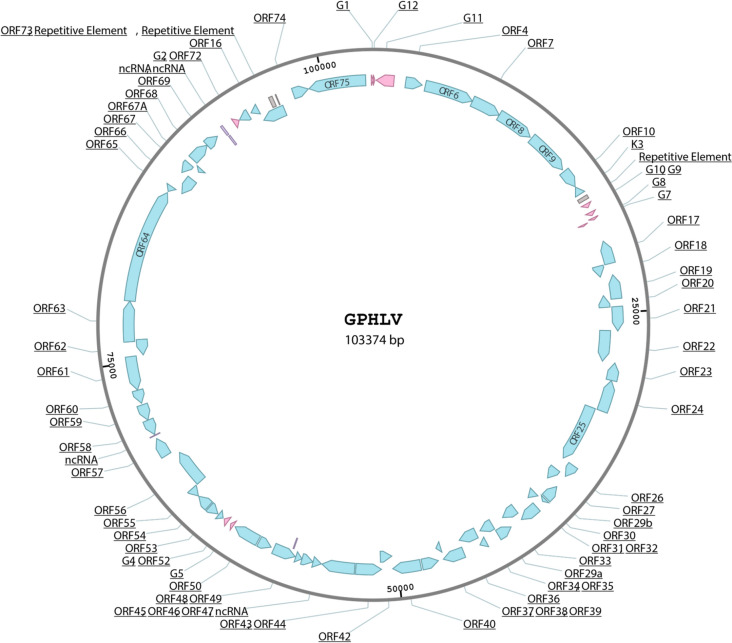
Schematic Representation of the GPHLV genome. Schematic Representation of the GPHLV genome. A 103374 base pair consensus genome was assembled de novo from Illumina NGS reads of DNA isolated from purified GPHLV virions. The genomic structure is homologous to the KSHV genome and places GPHLV in the Rhadinovirus subfamily of gammaherpesviruses. 63 of these ORFs share homology to KSHV genes (Blue) with potentially 12 GPHLV specific genes (G1-G12, pink ORFS). The GPHLV genome also encodes several potential ncRNAs (Purple) and repetitive elements (Gray). GenBank: OQ679822.1. GPHLV has a GC content of 35.45%
Fig. 4
Fig. 4
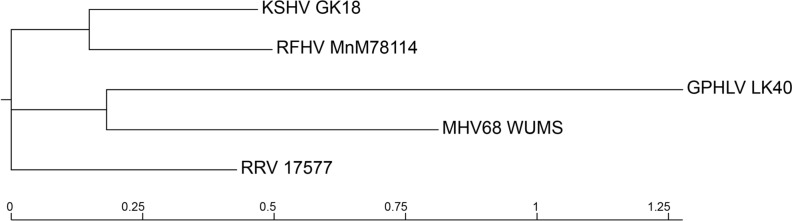
Phylogenetic Tree of Rhadinovirus Model Organisms. Phylogenetic analysis of the complete nucleotide sequences of select Rhadinovirus genomes was conducted using the BV-BRC Viral Genome Tree tool. Reference genomes for KSHV (GK18), RFHV (MnM78114), MHV68 (WUMS), and RRV (17577) were utilized to analyze the phylogenetic distribution of the GPHLV genome in comparison to viruses used to model Rhadinovirus pathogenesis
Fig. 5
Fig. 5
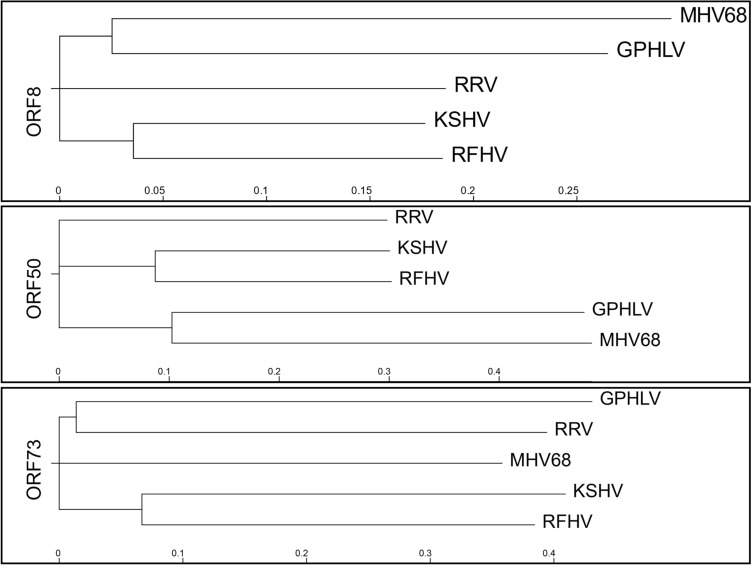
Phylogenetic Analysis of Key Rhadinovirus ORFs. Phylogenetic trees for translations of individual ORFs were constructed using Clustal Omega. ORF8 (Glycoprotein B), ORF50 (RTA), and ORF73 (LANA) were selected due to their conserved importance in the Rhadinovirus lifecycle. Scale bars represent phylogenetic distance
Fig. 6
Fig. 6
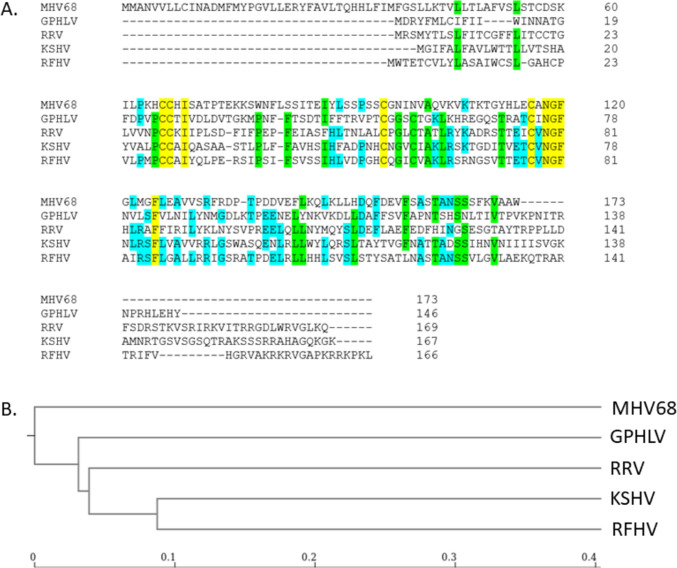
Sequence Conservation of Glycoprotein L. A. Clustal Omega alignment of MHV68, GPHLV, KSHV, RRV, and RFHV glycoprotein L (gL) amino acid sequences. Residues highlighted in yellow are 100% conserved, green 80%, and blue 60% between the 5 viruses. B. Phylogenetic analysis of gL generated by Clustal Omega and visualized by the Newick Display tool

References

    1. Chang Y, Cesarman E, Pessin MS, Lee F, Culpepper J, Knowles DM, et al. Identification of herpesvirus-like DNA sequences in AIDS-associated Kaposi’s sarcoma. Science. 1994;266(5192):1865–1869. doi: 10.1126/science.7997879. - DOI - PubMed
    1. Moore PS, Chang Y. Kaposi’s sarcoma-associated herpesvirus-encoded oncogenes and oncogenesis. J Natl Cancer Inst Monogr. 1998;23:65–71. doi: 10.1093/oxfordjournals.jncimonographs.a024176. - DOI - PubMed
    1. Pietropaolo V, Prezioso C, Moens U. Role of virus-induced host cell epigenetic changes in cancer. Int J Mol Sci. 2021;22(15):8346. doi: 10.3390/ijms22158346. - DOI - PMC - PubMed
    1. Soliman SHA, Orlacchio A, Verginelli F. Viral manipulation of the host epigenome as a driver of virus-induced oncogenesis. Microorganisms. 2021;9(6):1179. doi: 10.3390/microorganisms9061179. - DOI - PMC - PubMed
    1. Domsic JF, Chen HS, Lu F, Marmorstein R, Lieberman PM. Molecular basis for oligomeric-DNA binding and episome maintenance by KSHV LANA. PLoS Pathog. 2013;9(10):e1003672. doi: 10.1371/journal.ppat.1003672. - DOI - PMC - PubMed

LinkOut - more resources