


The Mental Health of Elite-Level Coaches: A Systematic Scoping Review
- PMID: 38341831
- PMCID: PMC10859359
- DOI: 10.1186/s40798-023-00655-8
The Mental Health of Elite-Level Coaches: A Systematic Scoping Review
Abstract
Background: Elite-level coaches are exposed to multiple performance, organisational and personal stressors which may contribute to reduced mental health and wellbeing. This systematic scoping review examined the current body of evidence to explore what is known about the mental health of elite-level coaches (i.e. wellbeing and mental ill-health), the risk and protective factors that influence coach mental health, and the relationship between mental health and coaching effectiveness.
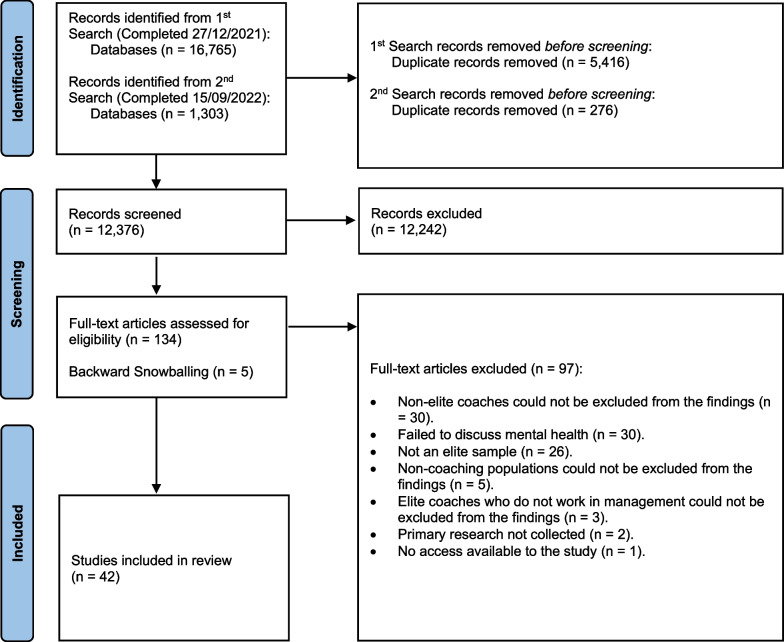
Methods: The review adhered to the Preferred Reporting Items for Systematic reviews and Meta-Analyses extension for Scoping Reviews (PRISMA-ScR) guidelines. A systematic search was undertaken and updated in September 2022 using six electronic databases.
Results: 12,376 studies were identified and screened, with 42 studies satisfying the inclusion criteria. Despite the paucity of high-quality research, findings indicated that 40% of the included studies examined themes connected to wellbeing, with 76% assessing the nature or prevalence of mental ill-health in elite-level coaches. Among studies exploring mental ill-health, coach burnout was the primary focus, while scant research examined symptoms associated with clinical disorders (e.g. anxiety and depression). Overall, psychological outcomes for elite-level coaches were shaped by risk and protective factors operating at the individual, interpersonal, organisational and societal level. Preliminary evidence was also found to suggest that poor mental health may contribute to reduced coaching effectiveness. It is proposed that coaching effectiveness could therefore be employed as a 'hook' to engage elite-level coaches in greater consideration of their mental health needs.
Conclusion: Alongside the development of methodologically robust research, there is a need to examine dynamic individual (e.g. psychological skills), interpersonal (e.g. strong social supports) and organisational (e.g. workload) factors that aim to preserve the mental health and optimise the efficacy of elite-level coaches.
Keywords: Coaches; Coaching effectiveness; High-performance; Sports psychology; Wellbeing.
© 2024. The Author(s).
Conflict of interest statement
The authors report no competing interests.
References
-
- Knights S, Ruddock-Hudson M. Experiences of occupational stress and social support in Australian Football League senior coaches. Int J Sports Sci Coach. 2016;11(2):162–171. doi: 10.1177/1747954116636711. - DOI
-
- Lyle J. Sports coaching concepts: a framework for coaches' behaviour. London: Routledge; 2002.
-
- Olsen MG, Haugan JA, Hrozanova M, Moen F. Coping amongst elite-level sports coaches: a systematic review. Int Sport Coach J. 2021;8(1):34–47. doi: 10.1123/iscj.2019-0051. - DOI
-
- Olusoga P, Butt J, Hays K, Maynard I. Stress in elite sports coaching: identifying stressors. J Appl Sport Psychol. 2009;21(4):442–459. doi: 10.1080/10413200903222921. - DOI
-
- Gould D, Greenleaf C, Guinan D, Chung Y. A survey of US olympic coaches: variables perceived to have influenced athlete performances and coach effectiveness. Sport Psychol. 2002;16(3):229–250. doi: 10.1123/tsp.16.3.229. - DOI
Publication types
LinkOut - more resources
Full Text Sources
