Review
. 2023 Dec 1;9(2):203-213.
doi: 10.1016/j.ekir.2023.11.026. eCollection 2024 Feb.

Novel Treatment Paradigms: Primary IgA Nephropathy

Affiliations
Review

Novel Treatment Paradigms: Primary IgA Nephropathy

Haresh Selvaskandan et al. Kidney Int Rep. .

Abstract

IgA nephropathy (IgAN) is the most common primary glomerulonephritis worldwide. Approximately 30% to 45% of patients progress to kidney failure (KF) within 20 to 25 years of diagnosis, and there has long been a lack of effective treatments. The therapeutic landscape in IgAN is rapidly evolving, driven in large part by the acceptance of the surrogate clinical trial end point of proteinuria reduction by regulatory authorities for the accelerated approval of new therapies. Two drugs, targeted release formulation (TRF)-budesonide (nefecon) and sparsentan, have recently been approved under this scheme. Advancing insights into the pathophysiology of IgAN, including the roles of the mucosal immune system, B-cells, the complement system, and the endothelin system have driven development of therapies that target these factors. This review outlines current, recently approved, and emerging therapies for IgAN.

Keywords: APRIL; BAFF; IgA nephropathy; clinical trials; complement; endothelin.


Figures

Figure 1
Figure 1
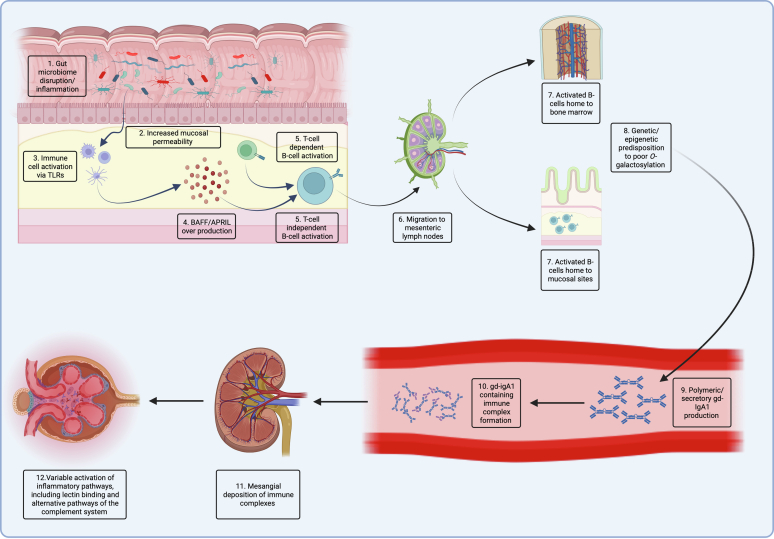
An overview of the pathophysiology of IgAN. (a) Infections, inflammation, or disruptions to host mucosal microbiota in conjunction with (b) increased mucosal permeability can lead to (c) mucosal immune cells being activated via toll like receptors. (d) This leads to an in increased production of BAFF and APRIL and (e) activation of mucosal B-cells via T-cell independent mechanisms, although these cells may also be activated by T-cells. (f) Activated B-cells traffic to central lymph nodes and (g) then traffic back to mucosal sites or mis-home to systemic sites such as bone marrow. (h) Mucosally-derived plasma cells produce Gd-IgA1 of which the magnitude is in part determined by genetic and epigenetic factors, which take up (i) polymeric and secretory forms. (j) Gd-IgA1 containing circulating immune complexes (k) deposit in the glomerular mesangium, (l) variably activating inflammatory pathways, including the lectin and alternative pathways of the complement system. BAFF, B-cell activating factor; Gd-IgA1, galactose deficient-IgA1; IgAN, IgA nephropathy.
Figure 2
Figure 2
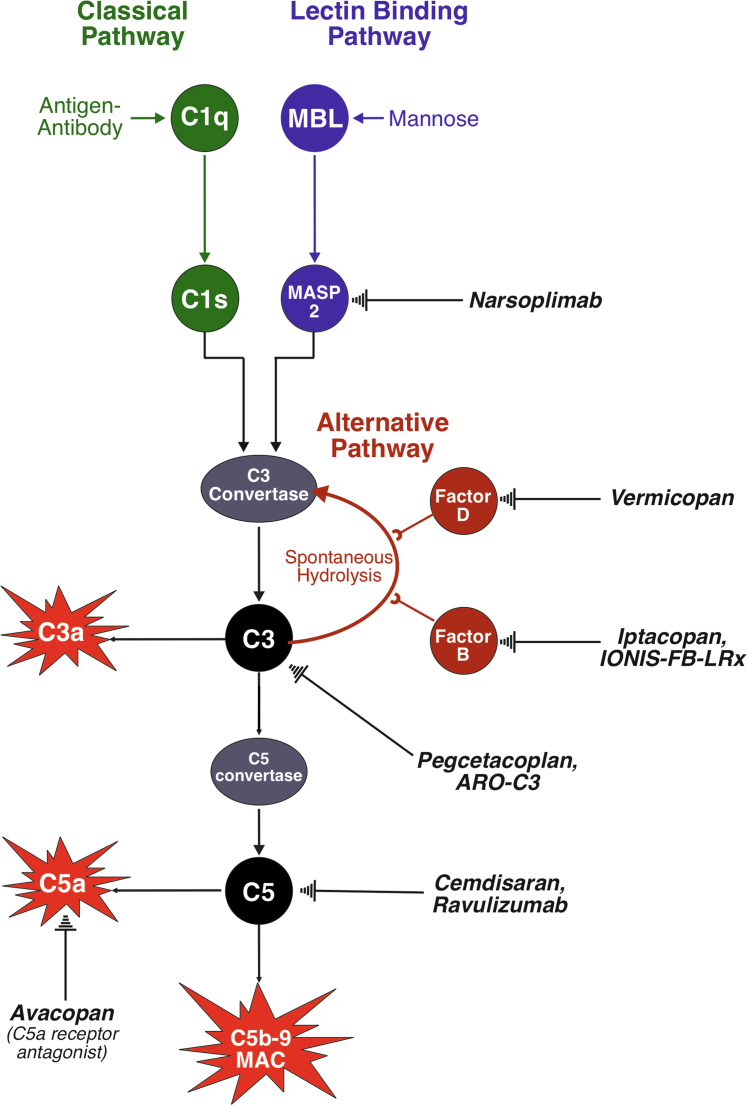
The complement system. The complement system can be activated by the classical, lectin, or alternative pathways. The classical pathway (green) is activated by antigen-antibody complexes, which bind C1q allowing C1r to cleave C1s which eventually leads to the formation of a C3 convertase downstream. There is little evidence of complement system activation via the classical pathway in IgAN. The lectin pathway (blue) is activated by mannose moieties commonly found on microbial surfaces, but also on Gd-IgA1, which bind mannose binding lectin to activate MASP1 and MASP2. MASP2 activation mirrors that of C1s, eventually leading to the formation of a C3 convertase. MASP2 is inhibited by narsoplimab. The alternative pathway (red) is constantly activated by the hydrolysis of C3; the pathway is promoted by factor B and factor D. Factor B is inhibited by iptacopan and IONIS-FB-LRx, whereas factor D is inhibited by vermicopan. The common pathway (black) is activated by any C3 convertase, cleaving C3 (inhibited by pegcetacoplan and ARO-C3) to C3a, an inflammatory mediator, and C3b. C3b is further acted upon by the C3 convertases to produce a C5 convertase, which cleaves C5 (can be inhibited by cemdisaran and ravuluzimab) to produce C5a, an inflammatory mediator (the C5a receptor can be blocked by avacopan), and C5b. This eventually leads to the formation of the membrane attack complex, which is capable of cell lysis. Gd-IgA1, galactose deficient-IgA1; IgAN, IgA nephropathy; MASP1, mannose-binding lectin serine protease 1; MASP2, mannose-binding lectin serine protease 2.

References

    1. Berger J., Hinglais N. [Intercapillary deposits of IgA-IgG] J Urol Nephrol (Paris) 1968;74:694–695. - PubMed
    1. Galla J.H. IgA nephropathy. Kidney Int. 1995;47:377–387. doi: 10.1038/ki.1995.50. - DOI - PubMed
    1. Reich H.N., Troyanov S., Scholey J.W., Cattran D.C., Toronto Glomerulonephritis Registry Remission of proteinuria improves prognosis in IgA nephropathy. J Am Soc Nephrol. 2007;18:3177–3183. doi: 10.1681/ASN.2007050526. - DOI - PubMed
    1. D’Amico G., Colasanti G., Barbiano di Belgioioso G., et al. Long-term follow-up of IgA mesangial nephropathy: clinico-histological study in 374 patients. Semin Nephrol. 1987;7:355–358. - PubMed
    1. Hastings M.C., Bursac Z., Julian B.A., et al. Life expectancy for patients from the Southeastern United States with IgA nephropathy. Kidney Int Rep. 2018;3:99–104. doi: 10.1016/j.ekir.2017.08.008. - DOI - PMC - PubMed

LinkOut - more resources