


Strategies for Oxygen Ecosystems in Middle-Income Countries: A Review and Case Study from Lebanon
- PMID: 38344746
- PMCID: PMC10857875
- DOI: 10.1155/2024/9964636
Strategies for Oxygen Ecosystems in Middle-Income Countries: A Review and Case Study from Lebanon
Abstract
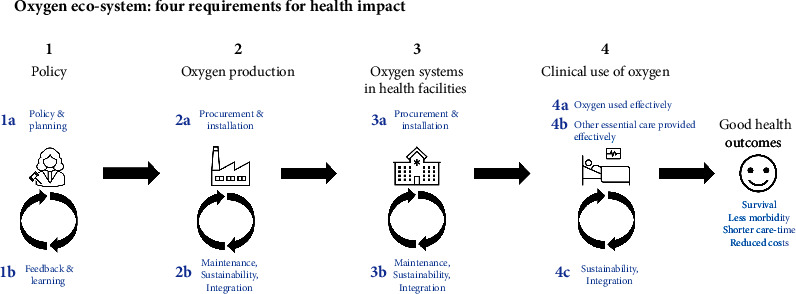
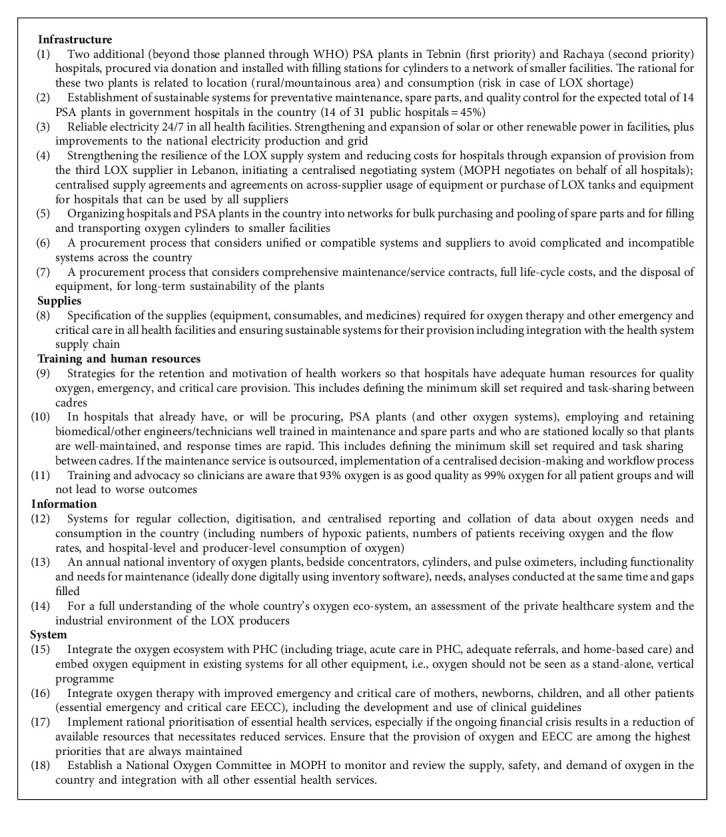
The COVID-19 pandemic led to a surge of critically ill patients and a sudden increase in the need for oxygen treatment worldwide. Pre-existing gaps in oxygen systems became apparent, and governments, multilateral agencies, and other partners scrambled to increase the production, supply, and use of oxygen to meet this need. The importance of an oxygen ecosystem that is appropriate for the local context became clear. This review describes strategies for oxygen ecosystems in middle-income countries, with specific experiences from Lebanon, following the authors' extensive assessment of the country's oxygen ecosystem, on behalf of the government and UNICEF. In the assessment, fifteen governmental hospitals were visited and evaluated using the UNICEF Oxygen System Planning Tool, discussions were held with key stakeholders, and documents were reviewed. An optimal oxygen ecosystem needs to take into consideration the production of oxygen and delivery to facilities, the maintenance system within facilities, and the clinical use of oxygen. Lebanon, a lower-middle income country in the Middle East, is contending with an extensive economic crisis affecting the health system. Eighteen recommendations for strengthening the oxygen ecosystem in Lebanon that are relevant for other middle-income countries include the establishment of a National Oxygen Committee, installation of additional oxygen plants, strengthened systems for maintenance and electricity supply, increased production, procurement and supply chain resilience, improved training and human resources, the use of data collection and regular information to guide the ecosystem, and integration of oxygen into the rest of the health system.
Copyright © 2024 Tim Baker et al.
Conflict of interest statement
TB, CG, GR, HT, AD, MM, and RS are either employed by UNICEF or have received consultancy fees from UNICEF for the submitted work. TB declares personal fees from the World Bank, USAID, and the Wellcome Trust, all outside the submitted work. NH is employed by the Ministry of Public Health, Government of Lebanon.
Figures
References
-
- Graham H. R., Olojede O. E., Bakare A. A. A., et al. Pulse oximetry and oxygen services for the care of children with pneumonia attending frontline health facilities in Lagos, Nigeria (INSPIRING-Lagos): study protocol for a mixed-methods evaluation. BMJ Open . 2022;12(5) doi: 10.1136/bmjopen-2021-058901. - DOI - PMC - PubMed
Publication types
LinkOut - more resources
Full Text Sources
