. 2024 Feb 27;121(9):e2201598121.
doi: 10.1073/pnas.2201598121. Epub 2024 Feb 12.

Understanding the ant's unique biting system can improve surgical needle holders

Affiliations

Understanding the ant's unique biting system can improve surgical needle holders

Benjamin Wipfler et al. Proc Natl Acad Sci U S A. .

Abstract

Mechanical grasping and holding devices depend upon a firm and controlled grip. The possibility to improve this gripping performance is severely limited by the need for miniaturization in many applications, such as robotics, microassembly, or surgery. In this paper, we show how this gripping can be improved in one application (the endoscopic needle holder) by understanding and imitating the design principles that evolution has selected to make the mandibles of an ant a powerful natural gripping device. State-of-the-art kinematic, morphological, and engineering approaches show that the ant, in contrast to other insects, has considerable movement within the articulation and the jaw´s rotational axis. We derived three major evolutionary design principles from the ant's biting apparatus: 1) a mobile joint axis, 2) a tilted orientation of the mandibular axis, and 3) force transmission of the adductor muscle to the tip of the mandible. Application of these three principles to a commercially available endoscopic needle holder resulted in calculated force amplification up to 296% and an experimentally measured one up to 433%. This reduced the amount of translations and rotations of the needle, compared to the needle's original design, while retaining its size or outer shape. This study serves as just one example showing how bioengineers might find elegant solutions to their design problems by closely observing the natural world.

Keywords: ant; bioinspiration; evolutionary design; mandibles.


Conflict of interest statement

Competing interests statement:The authors declare no competing interest.

Figures
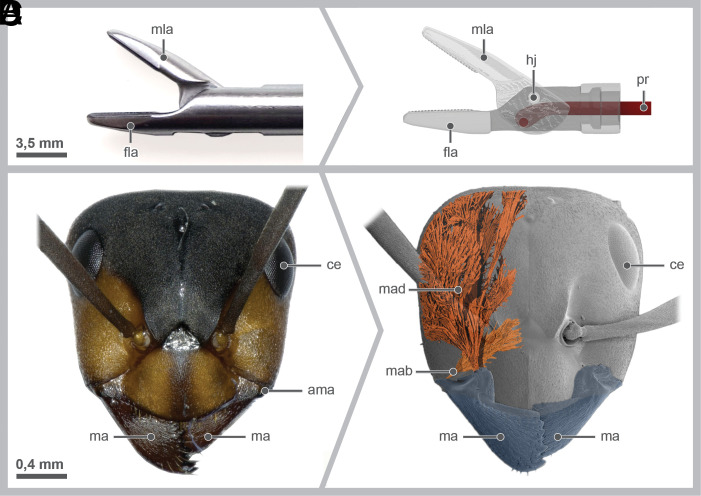
Fig. 1.
Fig. 1.
(A) The used commercial needle holder, lateral view; (B) 3D model of the function of the needle holder in the lateral view. Abbreviations: ama: anterior mandibular joint, ce: compound eye, fla: fixed lever arm, hj: hinge joint, ma: mandible, mab: mandibular abductor, mad: mandibular adductor, mla: moveable lever arm, pr: push rod; (C) photograph of the head of the red wood ant Formica rufa in the frontal view; (D) 3D model of the head of F. rufa in the frontal view showing the mandibles and the associated musculature, cuticle rendered transparent.
Fig. 2.
Fig. 2.
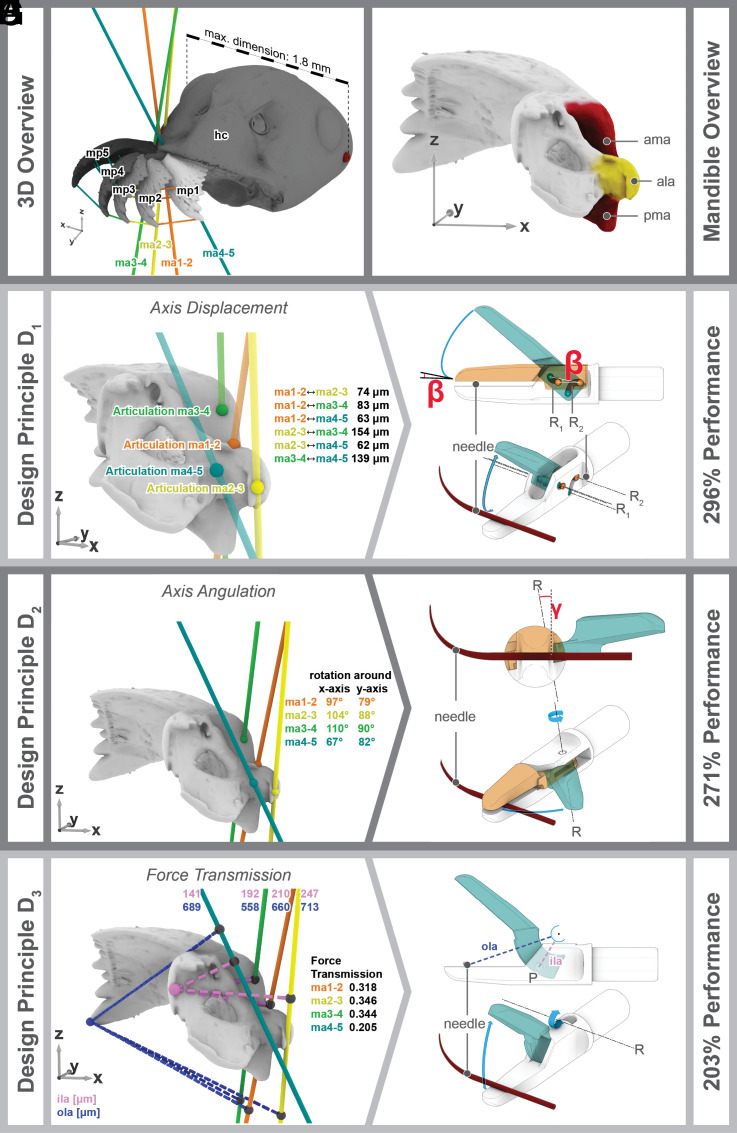
(A) 3D model of the head capsule of F. rufa showing the different studied mandibular positions (mp) and the resulting mandibular axes (ma); (B) articulations of the mandible of F. rufa with the head capsule; (C) 3D model of the mandible of F. rufa in dorsal view showing the points where the mandibular axes meet the surface of the mandibular joint (dots in colors used in A) and the distance between them. (D) Needle holder design D1 derived from the principle of the moveable joint axis, moveable arm in closed (orange) and fully opened (green) position; (E) mandibular axes and their inclination (in °) toward the X- and Y-axis of the head capsule, colored balls show points of articulations; (F) needle holder design D2, which is derived from the principle of the tilted axis, shown in frontal view (Top) and dorso-lateral view (Bottom), moveable arm in closed (orange) and fully opened (green) position, angle β is in between the axis of rotation and the plane of the needle; (G) inner (ila) and outer (ola) lever arms of the different mandibular axes (in µm) and the resulting force transmission (= ila/ola); (H) needle holder design D3 derived from the principle of the force transmission ratio. Abbreviations: ala: alata, ama: anterior mandibular articulation, hc: head capsule, ila: inner lever arm; ma: mandibular axes, ma: mandibular axis, mp: mandibular opening positions, ola: outer lever arm; pma: posterior mandibular articulation, R: rotational axis of the respective needle holder, β: 10° inclination used in D1, γ: angle between the rotational axis and normal of the gripper surfaces in D2 (10°).
Fig. 3.
Fig. 3.
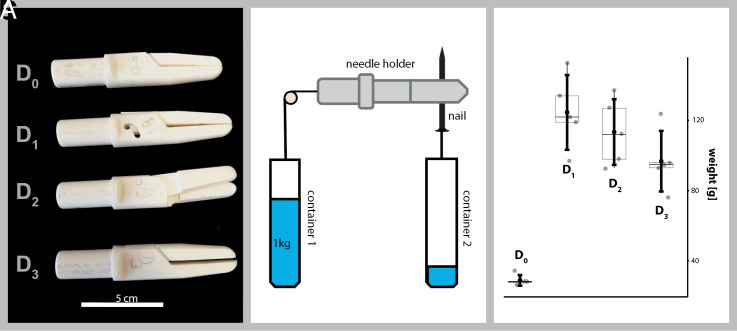
Experimental validation of the needle holders. (A) 3D printed models of the needle holders in scale 10:1. (B) Experimental setup of the experiment. (C) Box plots of the results for the measurements showing the weight of container B in B when in the shown experiment the needle drops out of the needle holder. Gray circles represent individual measurements, thin dark boxes indicate the 25 to 75% quartile with the median as the horizontal line, and thick black lines show the whiskers with the mean as the black dot in the middle. The underlying raw data are provided in SI Appendix, Supplementary Material 3.

References

    1. Van Schaik C. P., Deaner R. O., Merrill M. Y., The conditions for tool use in primates: Implications for the evolution of material culture. J. Hum. Evol. 36, 719–741 (1999). - PubMed
    1. Fantoni G., et al. , Grasping devices and methods in automated production processes. CIRP Ann. 63, 679–701 (2014).
    1. Birglen L., Schlicht T., A statistical review of industrial robotic grippers. Robot. Comput. Integr. Manuf. 49, 88–97 (2018).
    1. Peters B. S., Armijo P. R., Krause C., Choudhury S. A., Oleynikov D., Review of emerging surgical robotic technology. Surg. Endosc. 32, 1636–1655 (2018). - PubMed
    1. Burdett C., Theakston M., Dunning J., Goodwin A., Kendall S. W. H., Left-handed surgical instruments—A guide for cardiac surgeons. J. Cardiothorac. Surg. 11, 1–6 (2016). - PMC - PubMed

LinkOut - more resources