A retrospective study for long-term oncologic and obstetric outcomes in cervical intraepithelial neoplasia treated with loop electrosurgical excision procedure: focus on surgical margin and human papillomavirus
- PMID: 38347568
- PMCID: PMC10863218
- DOI: 10.1186/s12905-024-02923-5
A retrospective study for long-term oncologic and obstetric outcomes in cervical intraepithelial neoplasia treated with loop electrosurgical excision procedure: focus on surgical margin and human papillomavirus
Abstract
Background: The present study aimed to evaluate the long-term oncological and obstetric outcomes following the loop electrosurgical excision procedure (LEEP) in patients with cervical intraepithelial neoplasia (CIN) and investigate the risk factors for recurrence and preterm birth.
Methods: This retrospective cohort study included patients who underwent LEEP for CIN 2-3 between 2011 and 2019. Demographic information, histopathological findings, postoperative cytology, and human papillomavirus (HPV) status were collected and analyzed. The Cox proportional hazards model and Kaplan-Meier curves with the log-rank test were used for risk factor analysis.
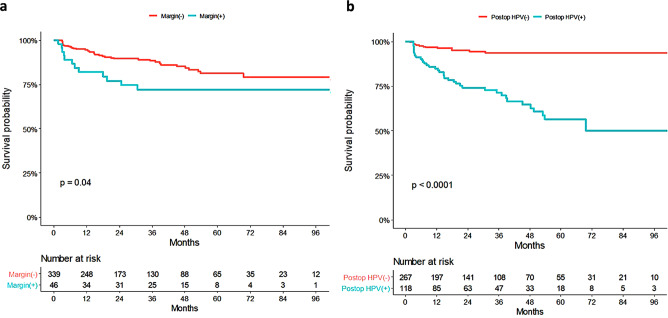
Results: A total of 385 patients treated with the LEEP were analyzed. Treatment failure, including recurrence or residual disease following surgery, was observed in 13.5% of the patients. Positive surgical margins and postoperative HPV detection were independent risk factors for CIN1 + recurrence or residual disease (HR 1.948 [95%CI 1.020-3.720], p = 0.043, and HR 6.848 [95%CI 3.652-12.840], p-value < 0.001, respectively). Thirty-one patients subsequently delivered after LEEP, and the duration between LEEP and delivery was significantly associated with preterm-related complications, such as a short cervix, preterm labor, and preterm premature rupture of the membrane (p = 0.009). However, only a history of preterm birth was associated with preterm delivery.
Conclusions: Positive HPV status after LEEP and margin status were identified as independent risk factors for treatment failure in patients with CIN who underwent LEEP. However, combining these two factors did not improve the prediction accuracy for recurrence.
Keywords: Cervical intraepithelial neoplasia; Human papilloma virus; Loop electrosurgical excision procedure; Margin status; Obstetric outcomes; Oncologic outcomes.
© 2024. The Author(s).
Conflict of interest statement
The authors declare no competing interests.
Figures