Review
. 2024 Jan 29:14:1264774.
doi: 10.3389/fimmu.2023.1264774. eCollection 2023.

Novel tumor-associated macrophage populations and subpopulations by single cell RNA sequencing

Affiliations
Review

Novel tumor-associated macrophage populations and subpopulations by single cell RNA sequencing

Juanjuan Wang et al. Front Immunol. .

Abstract

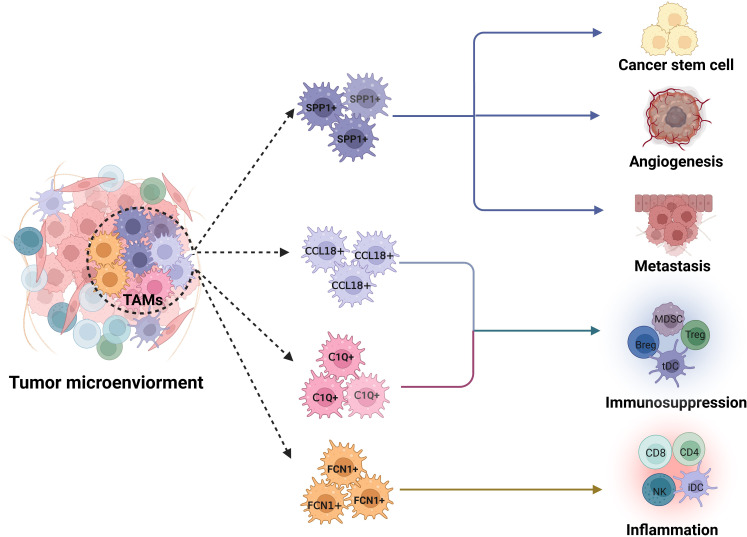
Tumor-associated macrophages (TAMs) are present in almost all solid tumor tissues. 16They play critical roles in immune regulation, tumor angiogenesis, tumor stem cell activation, tumor invasion and metastasis, and resistance to therapy. However, it is unclear how TAMs perform these functions. With the application of single-cell RNA sequencing (scRNA-seq), it has become possible to identify TAM subpopulations associated with distinct functions. In this review, we discuss four novel TAM subpopulations in distinct solid tumors based on core gene signatures by scRNA-seq, including FCN1 +, SPP1 +, C1Q + and CCL18 + TAMs. Functional enrichment and gene expression in scRNA-seq data from different solid tumor tissues found that FCN1 + TAMs may induce inflammation; SPP1 + TAMs are potentially involved in metastasis, angiogenesis, and cancer cell stem cell activation, whereas C1Q + TAMs participate in immune regulation and suppression; And CCL18 + cells are terminal immunosuppressive macrophages that not only have a stronger immunosuppressive function but also enhance tumor metastasis. SPP1 + and C1Q + TAM subpopulations can be further divided into distinct populations with different functions. Meanwhile, we will also present emerging evidence highlighting the separating macrophage subpopulations associated with distinct functions. However, there exist the potential disconnects between cell types and subpopulations identified by scRNA-seq and their actual function.

Keywords: angiogenesis; cancer; metastasis; single cell RNA sequencing; tumor associated macrophages.


Conflict of interest statement

The authors declare that the research was conducted in the absence of any commercial or financial relationships that could be construed as a potential conflict of interest.

Figures
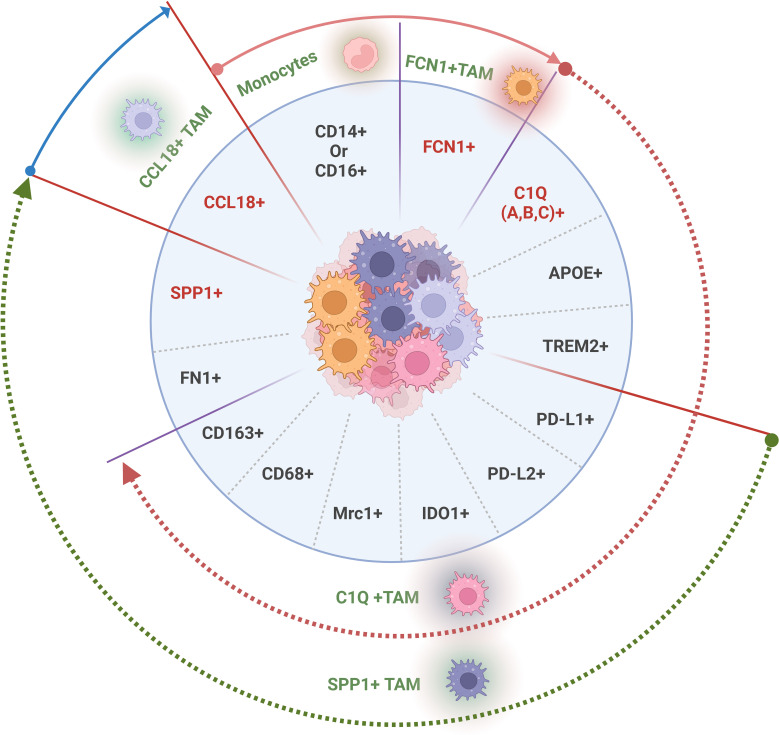
Figure 1
Figure 1
Tumor associated macrophage (TAM) subpopulations with distinct gene signatures in solid tumor tissues. The genes used to recognize TAM population and subpopulations, generally including T cell immune checkpoint ligands on the membrane surface such as PD-L1, PDL2, CD80, and CD86, surface immune suppressive molecules such as CD163, CD68 and MRC1 (CD206) and specific core gene signatures such as FCN1 +, C1Q A/B/C +, SPP1 + or CCL18 + in different TAM subpopulations. Gene with red color, a core gene in each distinct TAM subpopulation.
Figure 2
Figure 2
Potential functions of FCN1 +, C1Q +, SPP1 + and CCL18 + TAM subpopulations in tumor microenvironments. SPP1 + tumor associated macrophage (TAM) subpopulation exerts multiple roles in tumor development such as tumor metastasis, angiogenesis and tumor stem cell activation; Whereas a main function of C1Q+ TAM population is immunosuppression. CCL18 TAM subpopulation has stronger immunosuppressive function. FCN1 + TAM subpopulation is inflammatory macrophages, which can cause inflammation. Dotted line arrow, predicted TAM subpopulations based on core gene signatures.
Figure 3
Figure 3
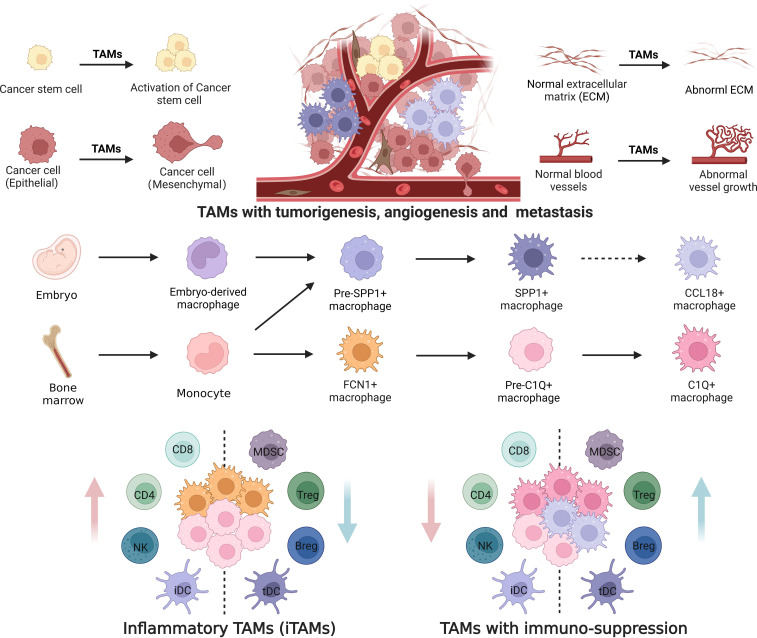
Differentiation of tumor associated macrophages with distinct functions. Tumor associated macrophages (TAMs) are both embryonic and monocyte origins. Monocytes derived TAMs highly express genes related to inflammatory and immunosuppression; While embryo-derived TAMs highly express genes related to tumorigenesis, metastasis and angiogenesis. FCN1 + and C1Q + TAM subpopulations are derived from peripheral blood monocytes, whereas SPP1 + and CCL18+TAMs are derived from tissue-resident macrophages (pre-SPP1+ macrophages from embryo and monocyte derived macrophages). Differentiation of TAMs from peripheral blood monocytes to C1Q + macrophages includes monocytes, FCN1+ macrophages, and pre-C1Q + and mature C1Q + macrophages. Differentiation of TAMs from tissue-resident macrophages into CCL18 + macrophages occurs via pre-SPP1 + and mature SPP1 +. Furthermore, mature C1Q + and SPP1 + macrophages can be divided into different populations with distinct functions. iDC, inflammatory dendritic cells; tDC, tolerant dendritic cells; MDSCs, myeloid-derived suppressor cells; NK, natural killer cells. Dotted line arrow: predicted pathway based on gene expression.

References

    1. Wynn TA, Vannella KM. Macrophages in tissue repair, regeneration, and fibrosis. Immunity (2016) 44:450–62. doi: 10.1016/j.immuni.2016.02.015 - DOI - PMC - PubMed
    1. Wang LX, Zhang SX, Wu HJ, Rong XL, Guo J. M2b macrophage polarization and its roles in diseases. J Leukoc Biol (2019) 106:345–58. doi: 10.1002/JLB.3RU1018-378RR - DOI - PMC - PubMed
    1. Aegerter H, Lambrecht BN, Jakubzick CV. Biology of lung macrophages in health and disease. Immunity (2022) 55:1564–80. doi: 10.1016/j.immuni.2022.08.010 - DOI - PMC - PubMed
    1. Guilliams M, Scott CL. Liver macrophages in health and disease. Immunity (2022) 55:1515–29. doi: 10.1016/j.immuni.2022.08.002 - DOI - PubMed
    1. Pan Y, Yu Y, Wang X, Zhang T. Tumor-associated macrophages in tumor immunity. Front Immunol (2020) 11:583084. doi: 10.3389/fimmu.2020.583084 - DOI - PMC - PubMed

Publication types