


Comparison of the teaching clinical biochemistry in face-to-face and the flex-flipped classroom to medical and dental students: a quasi-experimental study from IRAN
- PMID: 38350863
- PMCID: PMC10863239
- DOI: 10.1186/s12909-024-05051-8
Comparison of the teaching clinical biochemistry in face-to-face and the flex-flipped classroom to medical and dental students: a quasi-experimental study from IRAN
Abstract
Introduction: Biochemistry is one of the main courses of basic sciences in the medical curriculum, along with other difficult subjects that are difficult to learn. The emergence of new technologies has made it possible to test new methods such as e-Learning. In this study, we compared two methods of Flex-Flipped Classroom (FFC) and face-to-face.
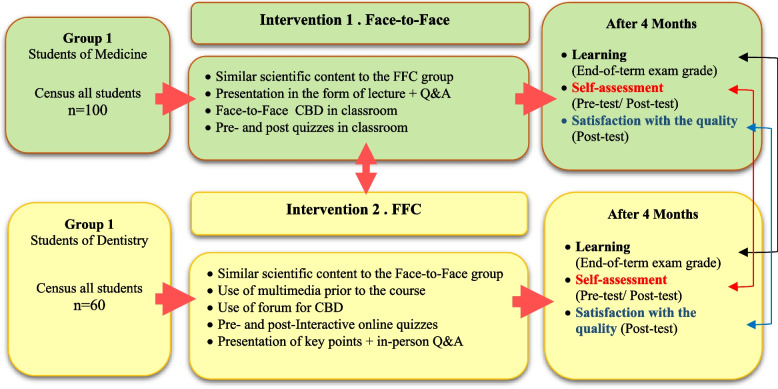
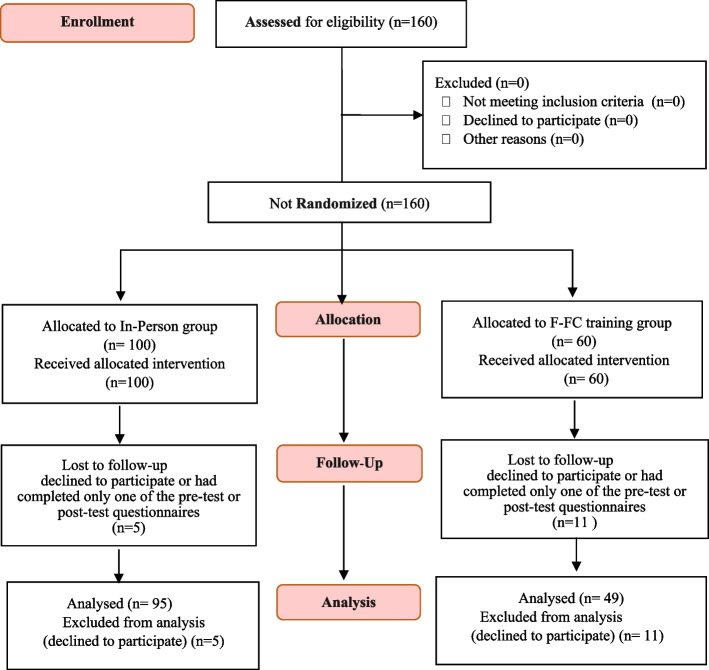
Method: A quasi-experimental research was done which involved both medical and dental students studying the clinical biochemistry course in the joint semester in 2019. A total of 100 medical students were trained in biochemistry through face-to-face teaching, and 60 dental students were trained in the same course through the FFC model. Three researcher-made tools were used to compare the two groups to assess the student's satisfaction, scores, and self-evaluation. The content validity of the tools was checked using the opinions of 10 experts through the CVI index. The results were analyzed using one-sample t-tests, independent t-tests, and ANOVA.
Results: Both groups scored significantly more than the cut-off-point (Mean > 3.5) in their average scores of the total and sub-components of the self-evaluation questionnaire (P < 0.05). Face-to-face teaching was viewed more favorably than the FFC teaching except for considering the flexibility (4.14 ± 1.55), but the difference was not significant (P > 0.05). The students' knowledge score in the FFC was slightly higher than that in the face-to-face method, but this difference was not significant(P = 0.758).
Conclusion: Both face-to-face and FFC methods were effective according to the students, but the level of satisfaction with the face-to-face method was higher. It seems that teacher-student interaction is an important factor in students' preferences. However, the students preferred the flexibility of multimedia. It seems necessary to use the advantages of each method in a model appropriate to the students' conditions and available facilities.
Keywords: Blended learning; Face-to-face education; Flex model; Flipped class; Knowledge; Quality; e-learning.
© 2024. The Author(s).
Conflict of interest statement
The authors declare no competing interests.
Figures
Similar articles
-
Dental students in an orthodontic course flipped classroom: A semi-experimental study on knowledge, practice, attitude, and satisfaction.Clin Exp Dent Res. 2024 Apr;10(2):e868. doi: 10.1002/cre2.868. Clin Exp Dent Res. 2024. PMID: 38433300 Free PMC article.
-
The effectiveness of the technology-enhanced flipped class on the learning and satisfaction of nursing students in the immunology course: A quasi-experimental study.Nurse Educ Today. 2024 Oct;141:106314. doi: 10.1016/j.nedt.2024.106314. Epub 2024 Jul 14. Nurse Educ Today. 2024. PMID: 39053324
-
Examining the effects of student-centered flipped classroom in physiology education.BMC Med Educ. 2023 Apr 12;23(1):233. doi: 10.1186/s12909-023-04166-8. BMC Med Educ. 2023. PMID: 37046277 Free PMC article. Clinical Trial.
-
Application of flipped classroom combined with virtual simulation platform in clinical biochemistry practical course.BMC Med Educ. 2023 Oct 16;23(1):771. doi: 10.1186/s12909-023-04735-x. BMC Med Educ. 2023. PMID: 37845661 Free PMC article.
-
The effects of flipped classrooms to improve learning outcomes in undergraduate health professional education: A systematic review.Campbell Syst Rev. 2023 Jul 7;19(3):e1339. doi: 10.1002/cl2.1339. eCollection 2023 Sep. Campbell Syst Rev. 2023. PMID: 37425620 Free PMC article. Review.
Cited by
-
The combination of a SPOC with evaluative interactive learning in dental adhesion education: a comparison with a lecture-based learning mode.BMC Med Educ. 2025 May 7;25(1):667. doi: 10.1186/s12909-025-07261-0. BMC Med Educ. 2025. PMID: 40336082 Free PMC article.
References
MeSH terms
LinkOut - more resources
Full Text Sources
