


Effect of onion (Allium cepa L.) peel extract on natural killer cell and cytokines in a randomized, double-blind, placebo-controlled trial
- PMID: 38352207
- PMCID: PMC10861340
- DOI: 10.4162/nrp.2024.18.1.33
Effect of onion (Allium cepa L.) peel extract on natural killer cell and cytokines in a randomized, double-blind, placebo-controlled trial
Abstract
Background/objectives: Onion, particularly onion peel, is a quercetin-rich food with, anti-inflammatory and immunomodulatory effects. However, the effect of onion peel extract (OPE) in humans is unclear. Thus, the present study aimed to investigate whether OPE improves natural killer (NK) cell activity and cytokine concentration in a randomized double-blind placebo-controlled trial.
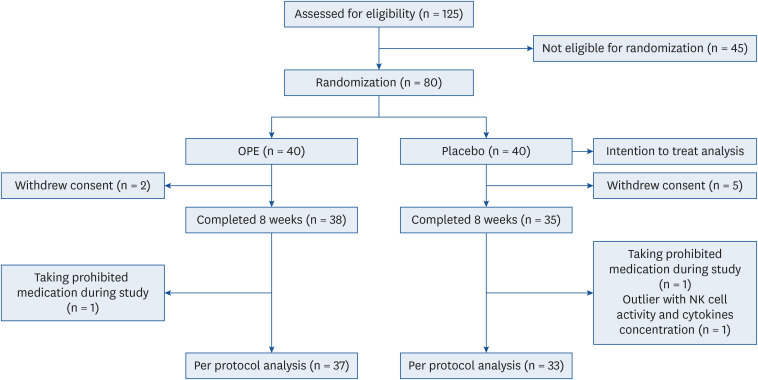
Subjects/methods: Eighty participants aged 19-64 yrs old with a white blood cell count of 4,000-10,000 cells/µL, symptoms of upper respiratory infection at least once within the previous 12 mon, and perceived stress scale (PSS) over 14 were included. Participants were randomly assigned to take either 1,000 mg/day OPE or a placebo for 8 weeks.
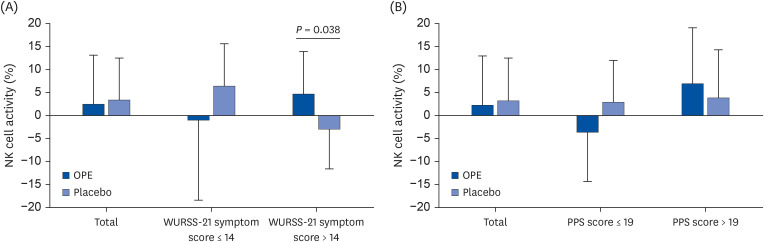
Results: Compliance were 87.4 ± 8.6% and 86.9 ± 79.0% in OPE and placebo groups. Compared to the placebo, OPE supplementation improved "Hoarseness" (P = 0.038) of the Wisconsin Upper Respiratory Symptom Survey (WURSS)-21 symptom, and stress scores (P = 0.001; 0.021) of PSS. Supplementation of OPE had no significant effect on NK cell activity and concentrations of cytokines such as interleukin (IL)-2, IL-6, IL-12, IL-1β, interferon-γ, and tumor necrosis factor-α. At baseline, the WURSS-21 symptom and PSS score (P = 0.024; 0.026) were higher in the OPE group than the placebo group. Among participants with higher than median WURSS-21 symptom score, OPE supplementation increased NK cell activity (P = 0.038). Supplementation of OPE had no significant effects on safety measurements and adverse events.
Conclusions: The present study suggested that OPE supplementation improves NK cell activity in participants with moderate upper respiratory symptoms without any significant adverse effects.
Trial registration: ClinicalTrials.gov Identifier: NCT05666752.
Keywords: Cytokine; natural killer cells; onion; perceived stress scale; respiratory symptom.
©2024 The Korean Nutrition Society and the Korean Society of Community Nutrition.
Conflict of interest statement
Conflict of Interest: The authors declare no potential conflicts of interests.
Figures
References
-
- Chadorshabi S, Hallaj-Nezhadi S, Ghasempour Z. Red onion skin active ingredients, extraction and biological properties for functional food applications. Food Chem. 2022;386:132737. - PubMed
-
- Slimestad R, Fossen T, Vågen IM. Onions: a source of unique dietary flavonoids. J Agric Food Chem. 2007;55:10067–10080. - PubMed
-
- Rodríguez Galdón B, Rodríguez Rodríguez EM, Díaz Romero C. Flavonoids in onion cultivars (Allium cepa L.) J Food Sci. 2008;73:C599–C605. - PubMed
-
- Osojnik Črnivec IG, Skrt M, Šeremet D, Sterniša M, Farčnik D, Štrumbelj E, Poljanšek A, Cebin N, Pogačnik L, Smole Možina S, et al. Waste streams in onion production: bioactive compounds, quercetin and use of antimicrobial and antioxidative properties. Waste Manag. 2021;126:476–486. - PubMed
-
- Fuentes J, de Camargo AC, Atala E, Gotteland M, Olea-Azar C, Speisky H. Quercetin oxidation metabolite present in onion peel protects caco-2 cells against the oxidative stress, NF-kB activation, and loss of epithelial barrier function induced by NSAIDs. J Agric Food Chem. 2021;69:2157–2167. - PubMed
