[Preprint]. 2024 Feb 1:2024.02.01.578466.
doi: 10.1101/2024.02.01.578466.

Pediatric human nose organoids demonstrate greater susceptibility, epithelial responses, and cytotoxicity than adults during RSV infection

Affiliations

Pediatric human nose organoids demonstrate greater susceptibility, epithelial responses, and cytotoxicity than adults during RSV infection

Gina M Aloisio et al. bioRxiv. .

Update in

Abstract

Respiratory syncytial virus (RSV) is a common cause of respiratory infections, causing significant morbidity and mortality, especially in young children. Why RSV infection in children is more severe as compared to healthy adults is not fully understood. In the present study, we infect both pediatric and adult human nose organoid-air liquid interface (HNO-ALIs) cell lines with two contemporary RSV isolates and demonstrate how they differ in virus replication, induction of the epithelial cytokine response, cell injury, and remodeling. Pediatric HNO-ALIs were more susceptible to early RSV replication, elicited a greater overall cytokine response, demonstrated enhanced mucous production, and manifested greater cellular damage compared to their adult counterparts. Adult HNO-ALIs displayed enhanced mucus production and robust cytokine response that was well controlled by superior regulatory cytokine response and possibly resulted in lower cellular damage than in pediatric lines. Taken together, our data suggest substantial differences in how pediatric and adult upper respiratory tract epithelium responds to RSV infection. These differences in epithelial cellular response can lead to poor mucociliary clearance and predispose infants to a worse respiratory outcome of RSV infection.


Conflict of interest statement

Conflict of interest: The authors declare no conflicts of interest.

Figures
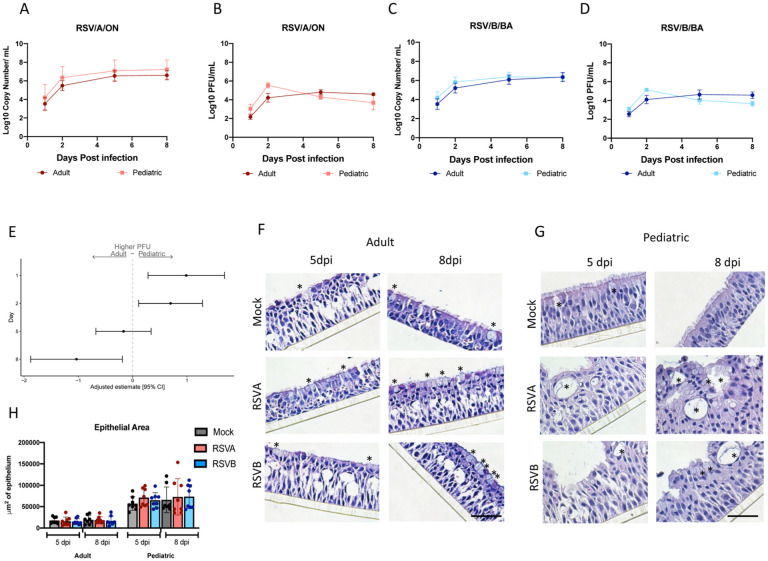
Figure 1.
Figure 1.. Replication kinetics and morphologic analysis of RSV infected pediatric HNO-ALIs and adult HNO-ALIs.
A) Apical RT PCR for 4 adult and 4 pediatric HNO-ALIs for RSV/A/ON and RSV/B/BA and B) corresponding plaque data. C) Apical RT PCR for 4 adult and 4 pediatric HNO-ALIs for RSV/B/BA and D) corresponding plaque data. E) PFU data was modeled using the covariates: HNO age interacting with dpi, and viral infection. Forest plot demonstrating the adjusted beta coefficient estimate with 95% confidence intervals, represented by dots and T bars, respectively, between adult and pediatric HNO-ALIs. F) H&E images of adult HNO-ALI 918 at 5 and 8 day post-infection (dpi). (* denotes goblet cells). G) H&E images of pediatric HNO-ALI 9003 at 5 and 8 dpi. (* denotes goblet cells). H) Comparison of epithelial area between pediatric and adult HNO-ALIs at 5 and 8 dpi with RSV/A/ON, RSV/B/BA, or mock infection. Scale bar is 100 μm.
Figure 2
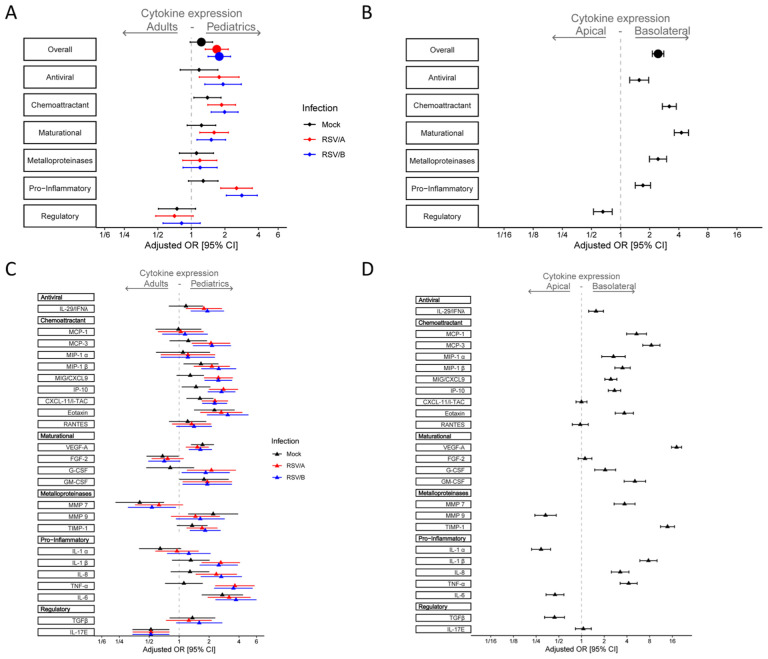
Figure 2. Epithelial cytokine and chemokine response during RSV infection in pediatric and adult HNO-ALIs.
Cytokine/chemokine secretion was modeled on the following factors: HNO age interacting with viral infection, dpi interacting with RSV, and cell surface. Adjusted odds ratio estimates and their associated 95% confidence intervals are represented by dots and T-bars, respectively. Mock infection is shown in black, RSV/A/ON in red, and RSV/B/BA in blue. A) Forest plot showing the adjusted odds ratio with 95% confidence interval for overall cytokine secretion and cytokine group expression between adult and pediatric HNO-ALIs. B) Forest plot showing the adjusted odds ratio with 95% confidence interval cytokine expression for overall cytokine secretion and cytokine group expression in the apical or basolateral compartment. C) Forest plot of adjusted odds ratio with 95% confidence intervals for individual cytokines in each cytokine group for mock, RSV/A/ON, and RSV/B/BA infection between adult and pediatric HNO-ALIs. D) Forest plot of adjusted odds ratios with 95% confidence intervals for individual cytokines in the apical or basolateral compartment.
Figure 3.
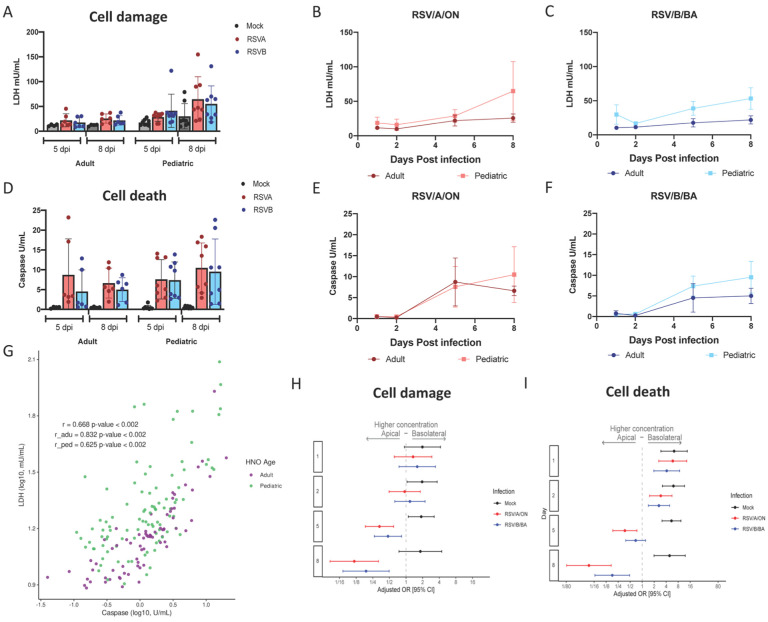
Figure 3.. Cell death and damage during RSV infection in pediatric and adult HNO-ALIs.
LDH and caspase area were modeled on the following factors: interacting cell surface, viral infection, and dpi as well as age. A) Amount of cell damage, measured by apical LDH, at day 5 and day 8 in adult vs pediatric HNO-ALIs, infected with RSV/A/ON, RSV/B/BA, or mock infection. B) Amount of apical LDH in 4 pediatric versus 4 adult HNO-ALIs infected with RSV/A/ON. C) or RSV/B/BA. D) Amount of cell death, measured by apical caspase, at day 5 and day 8 in adult vs pediatric HNO-ALIs, infected with RSV/A/ON, RSV/B/BA, or mock infection. E) Amount of apical caspase in 4 pediatric vs 4 adult HNO-ALIs infected with RSV/A/ON. F) or RSV/B/BA. G) Spearman correlation of pediatric and adult levels of LDH and caspase. Each dot represents the mean value of each unique experimental condition where both LDH and caspase were measured. Adult and Pediatric samples are colored magenta and green, respectfully H) Forest plot with adjusted odds ratio with 95% confidence intervals of apical or basolateral expression of LDH. I) Forest plot of adjusted odds ratios of apical or basolateral expression of caspase. Adjusted odds ratio estimates with 95% confidence intervals are represented by dots and T-bars, respectively.
Figure 4.
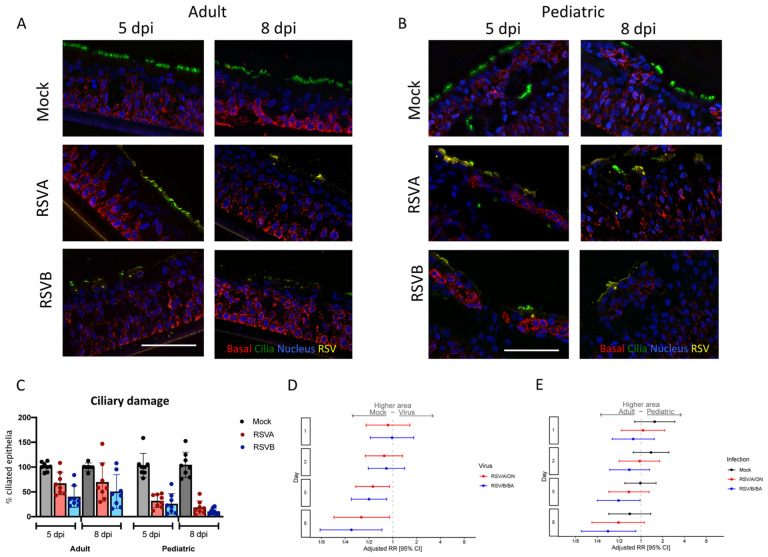
Figure 4.. Ciliary damage in pediatric and adult HNO-ALIs.
A) Representative IF imaging of a single adult HNO at 5 and 8 days post-infection (dpi). Basal cells are stained in red by Krt5, ciliated cells are stained in green by acetylated alpha tubulin, RSV particles are stained in yellow by anti-RSV antibody, and cellular nuclei are stained in blue by DAPI and B) single pediatric HNO-ALI at 5 and 8 dpi. Basal cells are stained in red by Krt5, ciliated cells are stained in green by acetylated alpha tubulin, RSV particles are stained in yellow by anti-RSV antibody, and cellular nuclei are stained in blue by DAPI. Scale bar is 100 μm. C) Percentage of ciliary damage in adult vs pediatric HNO-ALIs at 5 or 8 dpi. In this graph, the ciliary area is normalized to the corresponding HNO-ALI mock infection being 100%. D) Forest plot of mock versus virus of cilia area modeled on the following factors: the interaction of dpi and age, the interaction of age and viral infection, and the interaction of dpi and virus. Adjusted risk ratio estimates and their associated 95% confidence intervals are represented by dots and T-bars, respectively. E) Forest plot of ciliary area of adults versus pediatrics was modeled on the following factors: the interaction of dpi and HNO-ALI age, the interaction of age and viral infection, and the interaction of dpi and virus. Adjusted risk ratio estimates and their associated 95% confidence intervals are represented by dots and T-bars, respectively.
Figure 5.
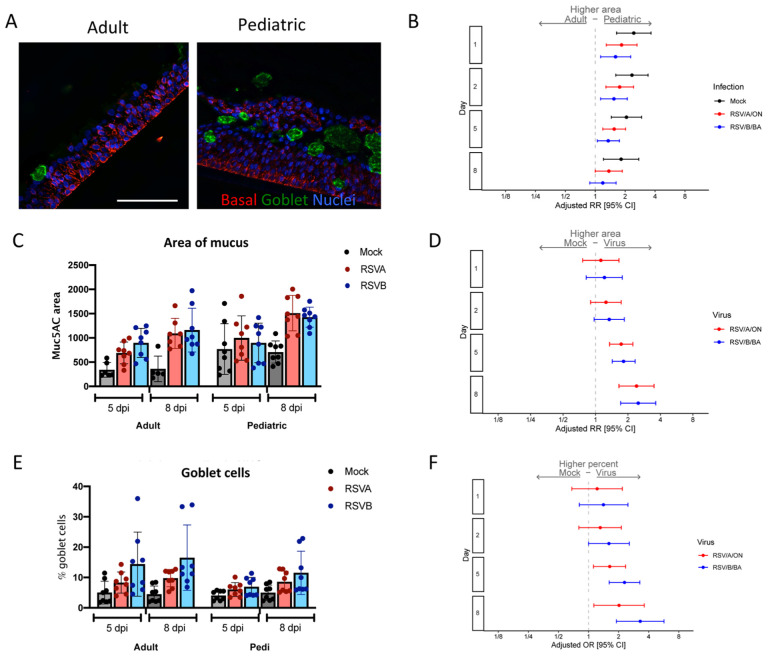
Figure 5.. Mucous secretion in pediatric and adult HNO-ALIs
A) Representative IF imaging of a single uninfected adult and pediatric HNO-ALI. Basal cells are stained in red by Krt5, mucus in green by Muc5AC, and cellular nuclei are stained in blue by DAPI. B) Mucous area was modeled using the following factors: the interaction of days post-infection (dpi) and HNO age, the interaction of age and viral infection, and the interaction of dpi and virus. Forest plot of the adjusted relative risk with 95% confidence interval of having higher mucous area in pediatric vs adult HNO-ALIs. Adjusted risk ratio estimates and their associated 95% confidence intervals are represented by dots and T-bars, respectively. Scale bar is 100 μm. C) The area of mucus (Muc5AC+ area) in adult compared to pediatric HNO-ALIs infected with RSV/A/ON (red) and RSV/B/BA (blue) at 5 and 8 dpi. D) Adjusted relative risk of higher mucus (Muc5AC) area in mock compared to viral infection in combined adult and pediatric HNOs. E) Percentage of goblet cells (Muc5AC+ cells with DAPI+ nuclei over total number of DAPI+ cells) in adult compared to pediatric HNO-ALIs at 5 and 8 dpi. F) Goblet cell percentage data was modeled using the following factors: the interaction of age and virus as well as the interaction of day and virus. Adjusted odds ratio estimates and their associated 95% confidence intervals are represented by dots and T-bars, respectively.
Figure 6.
Figure 6.. Club cells in pediatric and adult HNO-ALIs
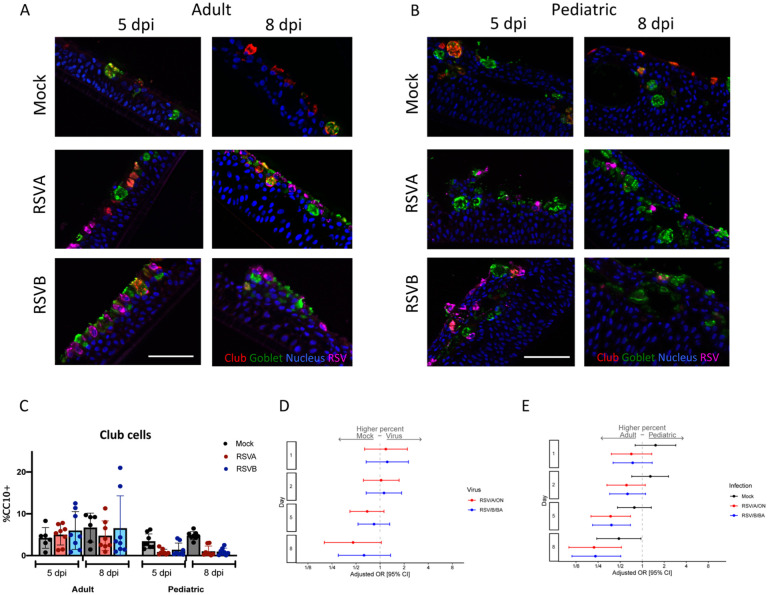
A) Representative IF images of a single adult HNO and B) single pediatric HNO at day 5 and 8 post infection. Club cells are stained red with CC10, goblet cells are stained in green by Muc5AC, RSV particles are stained in magenta by anti-RSV antibody, and cell nuclei are stained in blue by DAPI. Scale bar is 100 μm. C) Percentage of club cells (CC10+ cells with DAPI+ nuclei over total number of DAPI+ cells) in adult compared to pediatric HNO-ALIs at 5- and 8-day post-infection (dpi). D) Club cell percentage data was modeled using the following factors: the interaction of dpi and HNO age, the interaction of age and viral infection, and the interaction of dpi and virus. Adjusted odds ratio estimates with 95% confidence intervals are represented by dots and T-bars, respectively. E) Adjusted odds ratio with 95% confidence intervals of higher percentage of club cells in adult compared to pediatric HNOs.
Figure 7:
Figure 7:. Cell proliferation in pediatric and adult HNO-ALIs
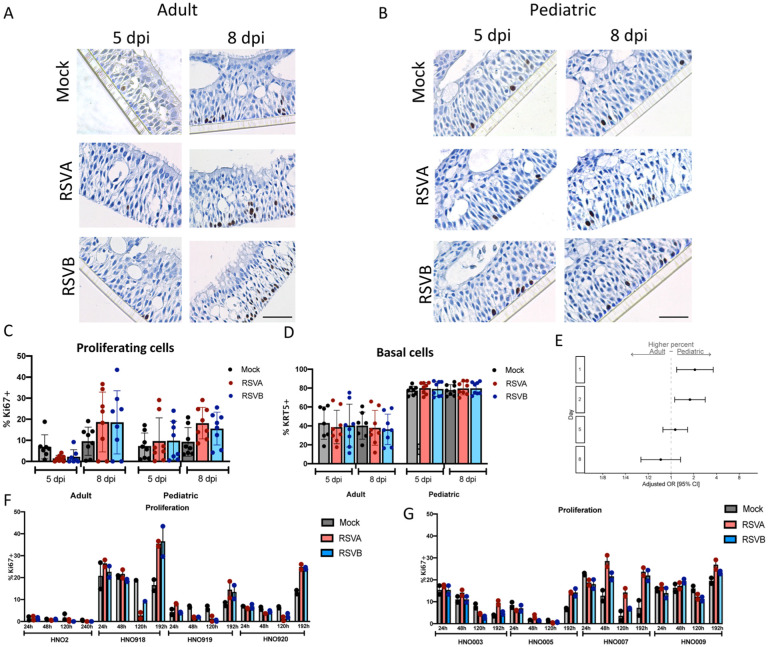
A) Representative Ki67 staining of a single adult HNO-ALI and B) single pediatric HNO-ALI at 5- and 8-day post infection (dpi) with RSV/A/ON, RSV/B/BA, or mock infection. Scale bar is 100 μm. C) Percentage of proliferating cells (number of Ki67 positive cells/ total cells) in 4 adult HNO-ALIs versus 4 pediatric HNO-ALIs at 5 or 8 dpi after infection with RSV/A/ON, RSV/B/BA, or mock infection. D) Percentage of basal cells (number of Krt5 positive cells/ total cells) in 4 adult HNO-ALIs versus 4 pediatric HNO-ALIs at 5 or 8 dpi after infection with RSV/A/ON, RSV/B/BA, or mock infection. E) Ki67 percent data was modeled using the following factors: the interaction of dpi and HNO age as well as the interaction of dpi and virus. Forest plot showing the adjusted odds ratio with 95% confidence intervals between adult and pediatric HNOs of having a higher amount of proliferating cells. Adjusted odds ratio estimates and their associated 95% confidence intervals are represented by dots and T-bars, respectively. There was no difference between mock and RSV infected HNOs, and thus this was dropped from the model and graph. F) Percentage of proliferating cells, in 4 adult HNO-ALIs at 1, 2, 5, and 8 dpi with RSV/A/ON or RSV/B/BA or mock infection. Each line shows variability in amount of proliferation. G) Percentage of proliferating cells in 4 pediatric HNO-ALIs at 1, 2, 5, and 8 dpi with RSV/A/ON or RSV/B/BA or mock infection.
Figure 8:
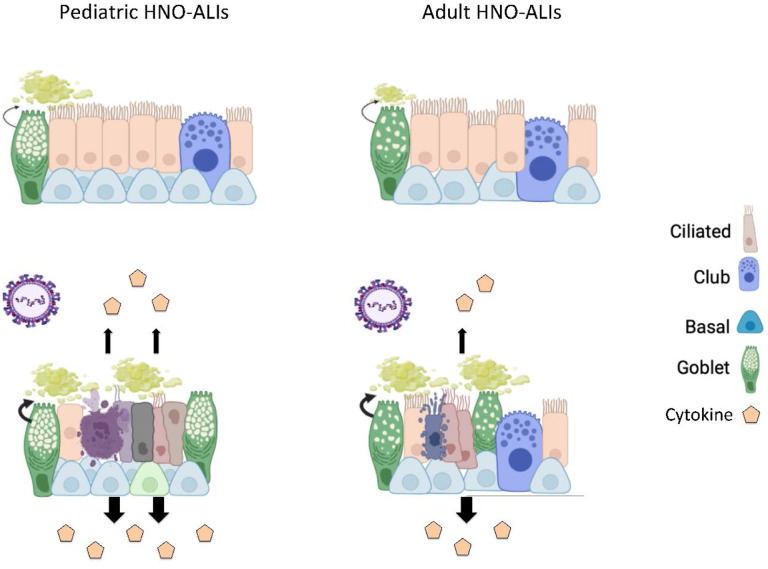
Figure 8:. Schematic of RSV infection in pediatric compared to adult HNO-ALIs.
Prior to infection, pediatric lines have increased mucus as well as more basal cells. After infection with RSV, both pediatric and adult HNOs have ciliary damage, increased mucus production, cell death and damage, and increase cytokine production. However, pediatric lines have more ciliary damage, more cellular damage, and increased cytokine production compared to adult lines. Pediatric lines do not have a comparative increase in the amount of apoptosis to their increased cell damage compared to adult lines, suggesting that other mechanisms of cell death such as cell necrosis may be contributing, further augmenting the inflammatory response. Created with BioRender.com

References

    1. Shi T, et al. Global, regional, and national disease burden estimates of acute lower respiratory infections due to respiratory syncytial virus in young children in 2015: a systematic review and modelling study. Lancet. 2017;390(10098):946–958. - PMC - PubMed
    1. Meissner HC. Viral Bronchiolitis in Children. N Engl J Med. 2016;374(1):62–72. - PubMed
    1. Greenberg SB. Viral pneumonia. Infect Dis Clin North Am. 1991;5(3):603–21. - PubMed
    1. Smith DK, Seales S, Budzik C. Respiratory Syncytial Virus Bronchiolitis in Children. Am Fam Physician. 2017;95(2):94–99. - PubMed
    1. Glezen WP, et al. Risk of primary infection and reinfection with respiratory syncytial virus. Am J Dis Child. 1986;140(6):543–6. - PubMed

Publication types