. 2024 Jan 30:15:1289303.
doi: 10.3389/fimmu.2024.1289303. eCollection 2024.

CAR Immunotherapy for the treatment of infectious diseases: a systematic review

Affiliations

CAR Immunotherapy for the treatment of infectious diseases: a systematic review

Elena Morte-Romea et al. Front Immunol. .

Abstract

Immunotherapy treatments aim to modulate the host's immune response to either mitigate it in inflammatory/autoimmune disease or enhance it against infection or cancer. Among different immunotherapies reaching clinical application during the last years, chimeric antigen receptor (CAR) immunotherapy has emerged as an effective treatment for cancer where different CAR T cells have already been approved. Yet their use against infectious diseases is an area still relatively poorly explored, albeit with tremendous potential for research and clinical application. Infectious diseases represent a global health challenge, with the escalating threat of antimicrobial resistance underscoring the need for alternative therapeutic approaches. This review aims to systematically evaluate the current applications of CAR immunotherapy in infectious diseases and discuss its potential for future applications. Notably, CAR cell therapies, initially developed for cancer treatment, are gaining recognition as potential remedies for infectious diseases. The review sheds light on significant progress in CAR T cell therapy directed at viral and opportunistic fungal infections.

Keywords: CAR; CAR cells; immunotherapy; infectious diseases; viral infections.


Conflict of interest statement

The authors declare that the research was conducted in the absence of any commercial or financial relationships that could be construed as a potential conflict of interest.

Figures
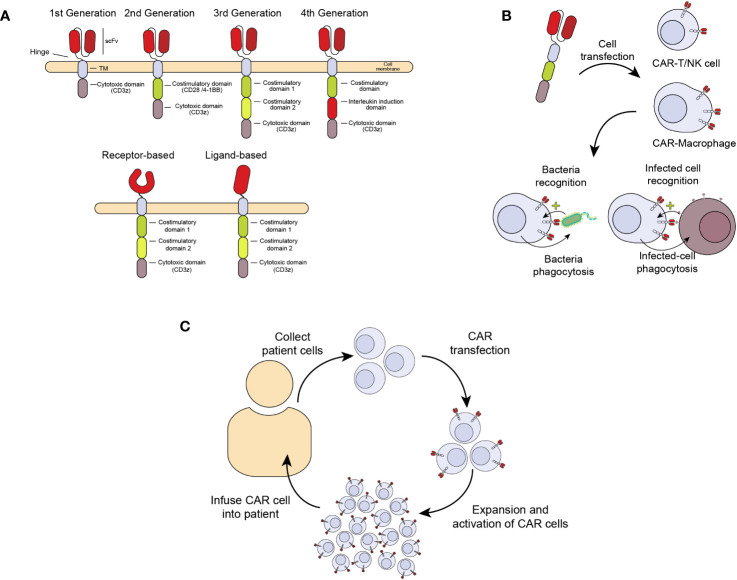
Figure 1
Figure 1
Generation of chimeric antigen receptors (CAR) expressed in cells from the immune system with antimicrobial activity. (A) Chimeric receptor involves an antibody fragment (scFv) or receptor against an antigen followed by a hinge peptide, a transmembrane domain, and one or more intracellular domains of proteins like the CD3 zeta (ζ) chain of the T-cell receptor complex (CD3ζ) and CD28 or 4-1BB (CD137), with the ability to signal and induce proliferation, activation, and cytotoxicity in the cell expressing the CAR. (B) Once the extracellular scFv/receptor domain of the CAR recognizes the antigen in an infected cell, the CAR cell gets activated and eliminates the infected cells. (C) CAR cell production. The manufacturing process begins with collecting peripheral blood mononuclear cells from a patient by leukapheresis. The cells are enriched, selected, and activated, followed by transduction with a self-inactivating lentiviral vector containing the CAR transgene. Cells are expanded following transduction until the final product dose requirements are met. Once the patient is ready, the cells are infused into the same patient who provided the leukapheresed cells.
Figure 2
Figure 2
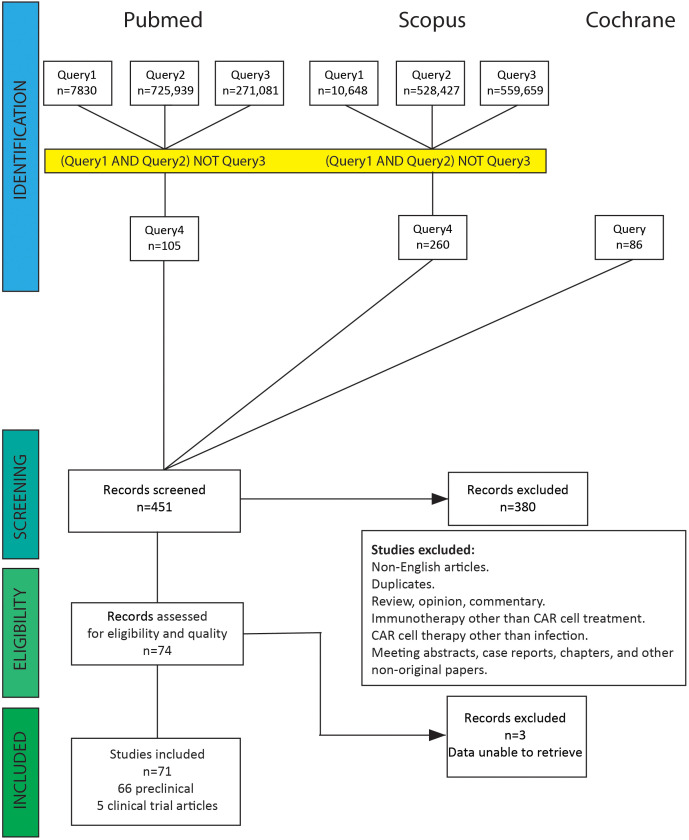
PRISMA flow diagram for literature search. A total of 451 abstracts were identified from the electronic database search. After removing non-English articles, duplicates, reviews, opinions, commentary, meeting abstracts, case reports, chapters, and CAR cell therapy other than treating infectious diseases, 74 abstracts were selected and reviewed. Three clinical trial studies were excluded because the results had not yet been published.
Figure 3
Figure 3
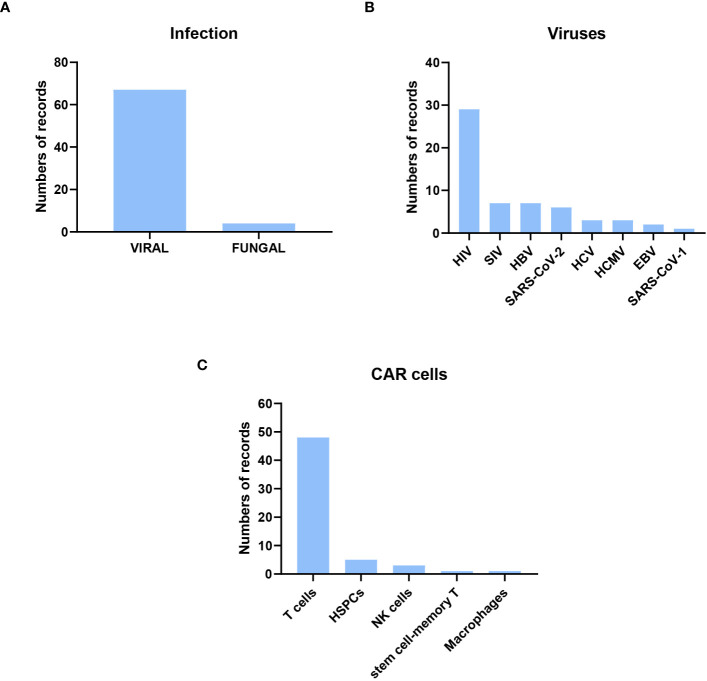
Description of the preclinical research published from their inception to February 13, 2023. Most of the original papers were about CAR cells to treat viral infection, focusing on HIV viruses and using CAR T cells. (A) Distribution of Infection Types: Out of the original papers, 67 focused on viral infections, while four centered on fungal infections. (B) Distribution of Viral Infections: The predominant CAR designs targeted HIV-infected cells. (C) Distribution of CAR-expressing Cell Types: T cells were the most commonly employed cells for expressing CAR constructs.
Figure 4
Figure 4
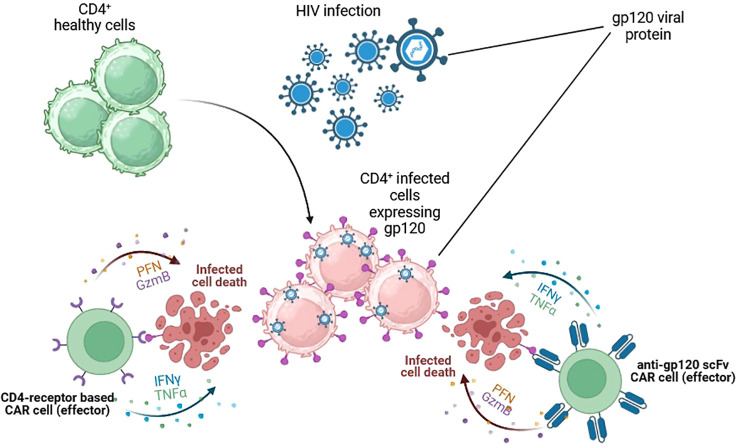
CAR cells targeting HIV-infected cells. Cytotoxic cells are redirected against HIV-infected cells by the expression of gp-120-specific CARs on their surface. Two main structures have been used. The extracellular domain of CD4 receptors and broadly neutralising scFv antibodies. Both target the gp-120 and could successfully kill HIV-infected cells and control HIV infection. Figures created using BioRender.com.

References

    1. Colonna M. Editorial Overview: Sense and react: how the innate immune system detects threats and generates protective responses. Curr Opin Immunol (2017) 44:V–VII. doi: 10.1016/j.coi.2017.05.001 - DOI - PubMed
    1. Coley WB. The treatment of Malignant tumors by repeated inoculations of erysipelas with a report of ten original cases. Am J Med Sci (1983) 105(487):3–9. doi: 10.1097/00000441-189305000-00001 - DOI - PubMed
    1. Hoffmann J, Akira S. Innate immunity. Curr Opin Immunol (2013) 25(1):1–3. doi: 10.1016/j.coi.2013.01.008 - DOI - PubMed
    1. Trapani JA, Smyth MJ. Functional significance of the perforin/granzyme cell death pathway. Nat Rev Immunol (2002) 2(10):735–47. doi: 10.1038/nri911 - DOI - PubMed
    1. Sharpe AH. Mechanisms of costimulation. Immunol Rev (2009) 229:5–11. doi: 10.1111/j.1600-065X.2009.00784.x - DOI - PMC - PubMed

Publication types

MeSH terms

Substances