Review
. 2024 Feb 14;73(3):53.
doi: 10.1007/s00262-024-03641-5.

Immunogenic cell death in colorectal cancer: a review of mechanisms and clinical utility

Affiliations
Review

Immunogenic cell death in colorectal cancer: a review of mechanisms and clinical utility

M De Silva et al. Cancer Immunol Immunother. .

Abstract

Colorectal cancer (CRC) is a major cause of cancer-related morbidity and mortality worldwide. Despite several clinical advances the survival of patients with advanced colorectal cancer remains limited, demanding newer approaches. The immune system plays a central role in cancer development, propagation, and treatment response. Within the bowel, the colorectal mucosa is a key barrier and site of immune regulation that is generally immunosuppressive. Nonetheless, within this tumour microenvironment, it is evident that anti-neoplastic treatments which cause direct cytotoxic and cytostatic effects may also induce immunogenic cell death (ICD), a form of regulated cell death that leads to an anti-tumour immune response. Therefore, novel ICD inducers and molecular biomarkers of ICD action are urgently needed to advance treatment options for advanced CRC. This article reviews our knowledge of ICD in CRC.

Keywords: Biomarker; Chemotherapy; Colorectal cancer; Damage-associated molecular patterns; Immunogenic cell death.


Conflict of interest statement

The authors declare no competing interests.

Figures
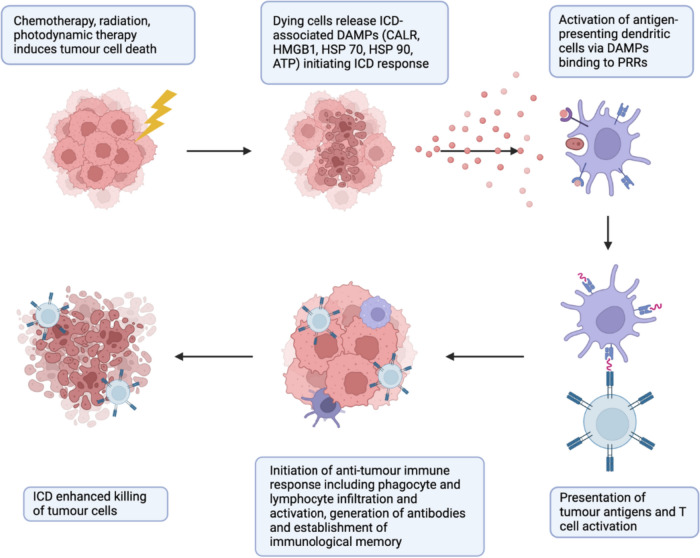
Fig. 1
Fig. 1
Immunogenic cell death-mediated anti-tumour immune response. Induction of immunogenic cell death (ICD) by chemotherapy, radiotherapy, photodynamic therapy, or oncolytic viruses leading to engagement of adaptive immune response via the spatiotemporally coordinated exposure of immunogenic damage-associated molecular patterns (DAMPs) which bind to their associated pattern recognition receptors (PRRs) on dendritic cells (DCs) or other antigen presenting cells (APCs). This results in increased recruitment, phagocytic activity, and maturation of APCs. Mature APCs then prime cytotoxic T cells (CTLs) within the tumour or regional lymph nodes using tumour-specific antigens (TSA) or tumour-associated antigens (TAAs) leading to a tumour-specific anti-tumour CTL immune response and generation of memory T cells. Figure created with BioRender.com
Fig. 2
Fig. 2
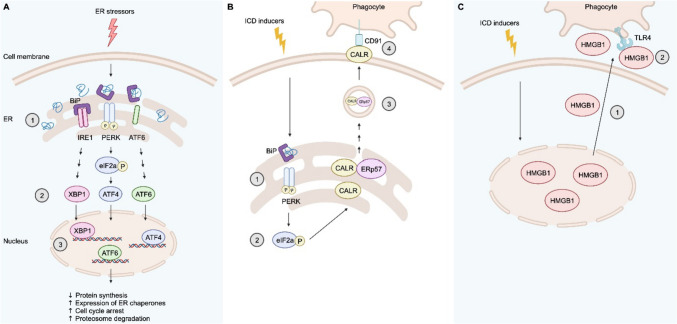
Unfolded protein response and cellular mechanisms of ICD. A: Unfolded protein response (UPR); A1: ER stress resulting in accumulation of misfolded proteins which bind BiP leading to dissociation from IRE1, PERK and ATF resulting in transactivation. A2: Downstream activation of XBP1, ATF4 and ATF6 by mRNA splicing, phosphorylation by eIF2α, and proteolytic cleavage within the Golgi apparatus, respectively. A3: Translocation of remodelled XBP1, ATF4 and ATF6 into the nucleus to induce integrated stress response. B: CALR signalling in ICD; B1: ER stress by ICD inducer results in activation of PERK. B2: eIF2α phosphorylation triggers CALR co-transport with ERp57 from ER to cell membrane (exact mechanisms unknown). B3: CALR/ERp57 reach cell membrane via SNAP/SNARE vesicular exocytosis. B4: CALR binds with ligand CD91 on APCs triggering the immune response. C: HMGB1 signalling in ICD. C1: Dying cells succumbing to ICD passively release HMGB1 from the nucleus into the extracellular space where it binds with ligand TLR4 on APCs triggering the immune response. Figure created with BioRender.com

References

    1. Global burden of colorectal cancer in 2020 and 2040: incidence and mortality estimates from GLOBOCAN | Gut (2023) Accessed 23 July 2023. https://gut.bmj.com/content/72/2/338 - PubMed
    1. Australian Institute of Health and Welfare (2018) Colorectal and other digestive-tract cancers. Cancer series no. 114, Cat. no. CAN 117, AIHW, Canberra
    1. Survival improvement for patients with metastatic colorectal cancer over twenty years | npj Precision Oncology (2023) Accessed 23 July 2023. https://www.nature.com/articles/s41698-023-00353-4 - PMC - PubMed
    1. Kepp O, Senovilla L, Vitale I, et al. Consensus guidelines for the detection of immunogenic cell death. OncoImmunology. 2014;3(9):e955691. doi: 10.4161/21624011.2014.955691. - DOI - PMC - PubMed
    1. Galluzzi L, Vitale I, Warren S, et al. Consensus guidelines for the definition, detection and interpretation of immunogenic cell death. J Immunother Cancer. 2020;8(1):e000337. doi: 10.1136/jitc-2019-000337. - DOI - PMC - PubMed

Substances